##TL;DR That time the Internet lost its mind finding out that farming is based and war is cringe
______
Sentiments of pacifism and anti-war media has existed long before Vinland Saga; Hideo Kojima’s Metal Gear Solid series for video games, All Quiet on the Western Front and the millions of its ilk in Hollywood, even anime tries to tackle the questionable morality of war with the most prominent one besides Vinland right now being… Attack on Titan- which ermm that certainly tackles the issue!
My point is, Vinland Saga isn’t great because of a message that only it is preaching but how that message is relayed to the audience and how it tackles subjects in a more interesting way than I could find elsewhere.
I’m not a fan of historical fiction and that extends to fantasy set in the early 10th centuries- the setting is just not one of my favourites and I’ve never really been invested in a lot of them because it feels like they’re very constricted by either the mindsets of their time or prone to getting a little too whimsical or dark for my tastes. Of course, I have exceptions to this, Dragon Age, The Witcher and a handful of other stories and worlds have transcended this general distaste for the setting by crafting such compelling characters and narratives that the setting is at the complete back of my mind.
When I first heard about Vinland Saga when a casual acquaintance told me to watch it probably a year or two ago now, I thought it sounded… interesting. WIT was the name that sold me on even giving it a shot but hearing the word ‘Viking’ immediately put me off and made me just nervous chuckle and make the empty promise I’d check it out.
We all have our preferences, but I think it’s equally important to broaden our horizons and check out stuff that normally we’d dislike purely from prejudice. It’s something I’ve learned with media can produce some of your most memorable experiences where something in a genre you typically dislike can pleasantly surprise you or something in a genre you love can disappoint you.
Vinland Saga is a show I should have gotten too as soon as that person told me, it’s a gripping story that is rightfully called a ‘saga’ with its dynamic characters, world and themes. I think it’s brilliant, I think the things it does is brilliant, I think the impact it’s managed to muster as a reaction from some of the people I’ve seen is brilliant.
When I finished Season 1 I mentioned how I felt a way about Vinland Saga that was on the precipice of loving it, that I understood it was a quality show but it never quite surpassed the threshold of becoming special or a personal favourite. I think Season 2 has served to reinforce that even more- Vinland Saga is good; it’s great even but I think it’s far from perfect and at some times the flaws and issues I take with it do make it impossible for me to feel the same way as some people do about this series. Which of course is okay, media subjectivity is important.
That’s why even it’s a little soul-crushing to see reviews claiming the show ‘fell off’ because it’s no longer action oriented are equal parts despair-inducing and hilarious, I understand why those people felt like that.
Vinland Saga Season 1 doesn’t glorify war. However, it does make it a spectacle. There are moments in that Season where the horrific nature of war is put on display, most notably for me the episode that’s mostly from the perspective of the only surviving daughter of the family whose village is raided and the villagers executed by Thorfinn, Askeladd and their band of merry Danes. It’s an episode that is downright haunting and its ending with her sanity all but breaking is a moment that I remember being very surprised by. Up to this point, much of the killing is of enemy soldiers, whilst you’re told Vikings are barbarians, you’re only really shown it occasionally and so it’s easy to forget until the show literally shows you them murdering people who are completely innocent, not just warriors but entire families.
This is how typically Vikings have been presented in media and these violent brutish behemoths wrecking the order of 11th century Britain is something extremely longstanding. I never found Vikings all too interesting but there’s a real sentiment of dislike toward them here especially, bearing in mind it’s been literally 1000 years.
Villainisation of entire subsects is sadly common in media and the wider world but I really don’t want to dive into that here, not only is it irrelevant but it also feels a little vain and insensitive to mention when talking about anime. Point is, Vikings have been shown constantly in this fashion and Vinland Saga initially reinforces this longstanding trope before subverting it really wonderfully in Season 2 and of course at its onset with Thors. It’s almost impossible to believe that there wouldn’t be people who wished for a purpose greater than War and that all Vikings were as the Jomsvikings are portrayed in Vinland Saga; killing machines who took pleasure from acts of twisted evil and killing. People who defined themselves entirely on principles of warfare, bloodshed and cruelty.
These are things at the time and as demonstrated in Vinland Saga particularly in the dynamic between Olmar and Thorgill are seen as staples of being a ‘Nordic man’ that for them that’s their path to becoming a ‘true warrior’ to borrow the lexicon of the show. For them, the very idea of being a ‘man’ revolves around being these monstrous individuals.
‘Masculinity’ then becomes something I kind of have to talk about, especially how it is deconstructed and presented in a much more positive light through this arc of the story as a whole. Traditional masculine qualities and values don’t entirely align with the Vikings depicted in Vinland Saga, but they do share a lot of similarities. The idea of concealing emotion under strength and stoicism, the idea that being stronger than your peers is laudable and gives you value. This construct has been shaped around society as its developed and I don’t think it’s the bravest of takes to think there’s a lot more nuance to the discussion surrounding it that makes it difficult to define and more importantly in the context of the show, to redefine. Masculinity isn’t an inherently bad thing but there is a reason that ‘toxic masculinity’ is something that you’ve probably heard echoed somewhere. The bottling of emotions, the violent competition and many other aspects the Vikings demonstrate here are negative aspects of a traditional societal view of masculinity. Thorfinn and Thors on the other hand serve to be more positive depictions of masculinity, strong physically but kind, caring and strong of heart.
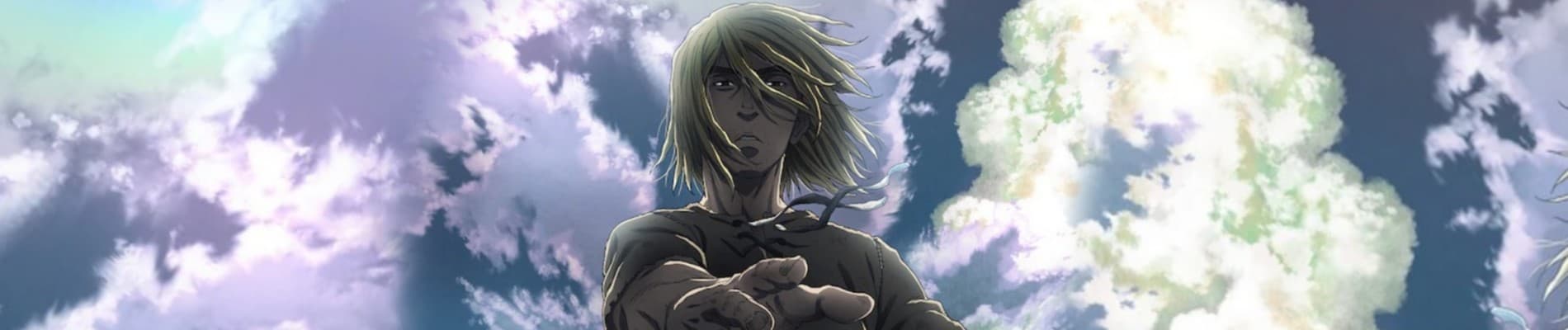
Thorfinn starts as this murder hungry beast fuelled only by a lust for revenge, killing any that get in his way- quickly becoming a valuable asset on the battlefield, for all of Season 1 he’s an unstoppable hurricane of destruction ending lives of people who’s faces he doesn’t care to remember. He hardly mourns his Father and is instead spurred solely by the desire to murder his killer and prove he’s stronger. Askeladd rightly wins everytime, it isn’t just that Thorfinn is physically weaker than he is it’s that he can never match Thors until he follows his path and example. It’s a wonderful thematic demonstration and is doubly so when Thorfinn outlives Askeladd, someone consumed by conflict their whole life and who’s journey somewhat mirrored Thorfinn’s own. Only that he was never able to follow Thors’ path.
That’s why we see Askeladd down in the twisted depiction of Valhalla, an endless warring hellscape providing this season with one of if not its best backdrops. It’s haunting and chilling and yet enlightening too and seeing Thorfinn manage to scramble out of it and toward a better path is incredibly cathartic. I said during Season 1 that I predicted that Thorfinn would grow a lot and that’s why I was fine with disliking him; of course, I didn’t know to what extent but the story pulled this off wonderfully.
Thorfinn’s ideals of pacifism and his very famous in meme culture “I have no enemies” as aforementioned aren’t unique but the setup required to get to this point is his journey of self-reflection takes an incredible amount of pain, anguish and determination. It’s even shown directly to us the audience that it leads to him suffering physically too, his unwillingness to defend himself leads to him being beaten senseless. To these Nordic men whose culture revolves around violence and imposing their will to be a ‘man’, it seems to be worthy of mockery and completely idiotic.
Yet, when Thorfinn proclaims to them all that how could they possibly be enemies when they’ve only met today, he comes across as perfectly rational and through demonstrating his physical strength and resilience he’s able to sway them into respecting him. A respect not earned through fear and intimidation.
Going back to Masculinity I feel the need to make somewhat of a contemporary comment and I apologise if this seems out of place, but I thought it was relevant. I often make fun of videos such as ones like “how to manipulate people like Ayaokouji” and the entire ‘sigma’ culture that somehow derived from its ironic roots into something that is now unrecognisable and twisted. I think it’s funny to poke fun at these issues but that doesn’t stop them from being issues; the resurgence of elements of ‘toxic masculinity’ once again covered with a fresh lick of paint is a problem that is impacting a lot of younger men and their views right now. Just as in the days in which I grew up of 2016 Leafy content and Anti-SJW videos getting shared around like wildfire, there seems to be somewhat of a similar phenomenon taking place. This reinforcement of obsolete ideals like men needing to be able to financially support their partner, men having dominion over wives, men not showing emotion and ‘might making right’ is a real problem right now and I think it’s going to seriously impact a lot of impressionable younger people. It’s not like you see one Andrew Tate TikTok and you suddenly hate women but the entire subculture that has festered has led to an alarming increase of sexism and xenophobia online. Again, this isn’t exactly the place to speak on it of course but I just wanted to highlight that now more than ever, it’s important to demonstrate a more positive view of masculinity to the same people who may have been swayed into some very close-minded pathways.
I do find it deathly ironic though that Fight Club and American Psycho are being used as proponents of these ideas when their very existence is essentially a mockery of them and both writers are gay men.
Anyway, enough about culture because who cares about the real world, Lain Iwakura is literally me, we live in a society.
I compared Canute to a Jesus like figure in my reflection of Season 1 so consider this section a bit of an addendum to that. My thoughts have shifted on Canute a lot, I still think he’s by far and away one of the most interesting characters here but his idea of creating paradise has changed slightly as he’s become jaded with the curse of the crown.
Burdened by a literal “talking head” of his dead Father, Canute struggles with his identity as a King and the very well-treaded ground of the “greater good”. Canute denies falling into the same trap as his father and only sees the power required to be Emperor of the North Sea as a means to an end; only by becoming such an important figure can he ever hope to create the World he so desperately wants to defy God and fate to create. We’re shown early in the season, his idea of “peace talks” and get to see a much more macabre version of him than Season 1 using intimidation and any means necessary in order to establish the world he seeks. It’s why it’s so poignant that he tells Thorfinn at their reunion that it’s the most “challenging” peace talks he’s ever had; it isn’t just because Thorfinn is challenging his ideals but that he isn’t swayed by the King’s might and so they actually talk.
In this Season, Canute is shown as less of a biblical figure and more like a martyr or pariah, someone desperate to do the right thing and never losing sight of their ultimate goal but not caring about the corpse-littered road it took to get there. In a way he kind of reflects Season 1 Thorfinn.
This change in Canute’s character is indicated to the audience with his face growing more tired and him taking traditionally a more masculine appearance. He ditches the long hair, and his face becomes noticeably less androgynous. I haven’t seen it mentioned anywhere and I’ve been holding it in all this time, but I do want to acknowledge this.
When Canute relents to Thorfinn and begins bursting out into laughter, we see the weariness fade from his face, his eyes become lighter, and he resembles the boy we see in Season 1 so much more. I don’t think it’s just a trick of the eyes or delusion based on him acting more familiar, but it was something that really put a smile on my face as well as finding it incredibly cathartic. His struggle with so much power and still feeling powerlessness of which, he uses being unable to stop the waves as a metaphor for is really compelling and works with what was established in Season 1.
I did change my mind on him being a Jesus-like figure but his pledge to save the Vikings and create a place where even Sinners can find paradise is pretty biblical by nature so it’s not a complete change.
Thorfinn however is presented as much more of a messiah in this season, having a profound impact on those around him, his interaction with Olmar at the end of the Season is beautiful and I found it an amazing way to send off his arc.
Olmar and Thorgill were standout characters from this arc and served to provide the primary dichotomy that served as the basis for this season’s deconstruction of masculinity (that sentence was the grossest combination of buzzwords I’m so sorry lol).
Which is why I think it’s about time to get to the negatives, I can’t just sit here all day and gush over how great some of the character writing is in Vinland without acknowledging its flaws.
Although, I think Vinland needed to go in this direction, I think it fumbled it slightly. Thorfinn’s dramatic self-reflection did feel a little rushed to me and I think the series should have committed to a more dramatic slow-down to truly reflect his journey. Some moments here and there would have felt even better like that.
Vinland also severely underutilises its characters, it was a problem in the first season too with interesting characters like Bjorn not getting their time in the spotlight but its even more apparent when the cast gets even bigger. It leads to this weird feeling of detachment from the characters and plot because you’re given too many things to care about when really you just Thorfinn’s journey of self-discovery. The first third and last third of this season were really great but the middle third genuinely just didn’t connect with me. I would rather the whole season focused on a smaller circle of people rather than the larger setting of Ketil’s farm. Their numbers don’t help especially with the fact that the cast is generally very hit or miss. For every new character I enjoyed and found entertaining like Thorgill, Olmar and Snake. There were characters like Arnheid, Gardar and Fox who were uninteresting, the former two having the slowest and least compelling stretch of the story yet. I didn’t very eloquently put it when I reflected on the first 16 episodes but their conflict was very uninteresting and I didn’t emotionally connect with it at all and merely saw it as a barrier to more interesting characters getting the development they deserved; that might seem like scathing criticism but we all connect differently to media as aforementioned and I just felt nothing for these people.
There was also a lot of characters that might have been interesting or more interesting but just had not enough time. Einar, Ketil and even Canute’s attendant Wulf come to mind. Vinland overextended a little in this stretch and it left to some very interesting characters in premise not really resonating with me. Ketil could have been much more of an interesting antagonist but his shift into his façade falling away and his abuse of Arnheid feels cheap, unearned and played mostly for shock value. Yeah it made me hate the guy but that wasn’t really a strength to me. The scene itself is very uncomfortable and I think serves its purpose but Ketil never came across as anything more than a pathetic manchild who snapped at the first sign of his pride being defaced. Which I suppose is the point but it didn’t really work for me.
Einar was very hit or miss, some scenes I thought he was great and the performance is amazing for him but other times he’d really miss the mark for me and seemed only there for plot progression like Arnheid- although much less egregious than I found her and by the end I decently liked him and hope he develops further into a character I can really enjoy.
Production wise, this Season was noticeably less impressive than Season 1 in terms of visual fidelity. The sound design and music was as good as ever though, using some tracks from Season 1 as well as some new great ones. I’ve attached a sample at the top of this to hopefully make reading this a little more ambient as well as less tedious haha.
MAPPA is a studio I’m a bit rocky with, for every production they get right, there’s another I dislike, or think is iffy. VS2 doesn’t look awful but outside of a few scenes it doesn’t look great either. Faces make these weird, contorted expressions sometimes that whilst present in Season 1 were a lot more noticeable here, backgrounds are pretty stellar but overall polish could be a little better.
The little choreography there is, is serviceable but nothing of note. It’s a lot less flashy than WIT which does fit the tone of this arc a little more in theory but like with Attack on Titan it does feel like a downgrade. I don’t think it’s adding too much to the source material which is why I’m confident I’ll eventually start reading it because I don’t feel like I’ll be missing anything from the adaptation that will vastly improve the quality.
Those are the little gripes aside and overall I think this Season was wonderful, personal preference would still side with the 1st but this Season was a lot better than I expected and I loved a majority of it; there are some amazing things discussed here- mainly for me how it deconstructs Vikings and how it introduces more progressive ideas of masculinity into a historical story which fixes one of my main gripes with the genre being they oft are restricted to the mentalities of the time and can feel a bit superficial because of it. I don’t think this is great just because I agree with those ideas but because I think it’s a great demonstration of how to do it right, with all the current conversations about morality across history and whether its okay to judge people by modern standards when they weren’t upheld back whenever I think Vinland is a shining example of how to inject a positive message whilst maintaining a historical setting and bending truth to make a truly brilliant story.
Whilst Vinland deals with some very harsh and dark topics like the brutality of War, slavery and deep-rooted trauma, I think its second Season is a very positive show and left me who didn’t and still doesn’t have a deeply personal connection with it feeling a little more inspired and optimistic about the world.
Its final episode is beautiful and the scene where he reunites with his mother made me sob unapologetically. The conclusion was brilliant but like with Season 1 I just wish the setup to get there was streamlined a little more.
I see why people love Vinland Saga, I think it’s a great foray into some meaningful topics as well as some personal ones- it’s profound, entertaining and overall, I’m really glad I watched it.
The production and overall lack of perfect cohesion this season did hold it back for me a little but please don’t get that confused for me telling you Thorfinn “fell off” or the season was “boring” because he became so great this season and it’s a move by Yukimura that as I have previously said I greatly respect.
If you read this far, thank you for witnessing the conclusion (for now teehee) of my voyage into Vinland Saga- I didn’t expect to like it as much as I did but it was a really great time and I see why so many people fell in love with it.
I’d say I have no enemies but I’d be lying if I said me and my 6am alarm for Work on Monday are on the greatest of terms…
42.5 out of 45 users liked this review