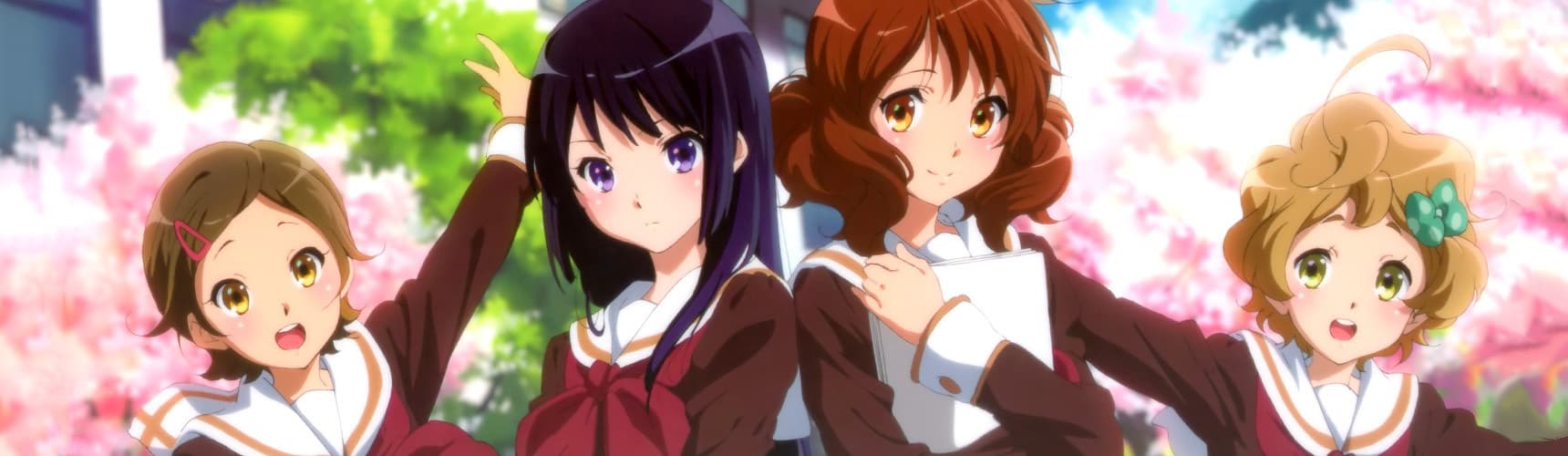

I'd like to start off this review by saying that I am, indeed, a band kid. Not the derogatory kind, I mean I'm literally a band kid. I've been introduced to a number of instruments throughout my life, the most long-standing (and my personal favorite) being the flute. I'm in a marching band (respond to that how you will) and am very proud to say that I love music, playing in an ensemble, and just sounding good. I actually wasn't always like this, but more on that later.
Being the type of person I am, I was immediately hooked on Hibike! Euphonium and would get giddy understanding the musical references that were obviously going to be included in a show about band kids, almost watching this anime as if I were part of some "elite group" of people "in the know." But the more I watched, the more that giddiness turned into real attachment to the contents of this series, not just because I recognized the word "ictus."
This review will contain spoilers for both seasons 1 and 2 of Hibike! Euphonium, so if you have not watched yet, please do so before continuing! Even if you don't come back to read this, the series is simply amazing, and I'd love for everyone to experience it at least once.
EXTREMELY SPECIAL SHOUTOUT TO @ericz1 for reading over this literary shitshow and helping me edit!! His reviews are top-notch, GO READ AND UPVOTE THEM Y'ALL >:DD
▶ VideoHibike! Euphonium follows the story of Oumae Kumiko, a first-year at Kitauji High School for the duration of the first two seasons. The opening scene of the series takes a step back, first presenting to the viewer a pivotal memory for our protagonist: her final middle school band competition. Though her school only won a “dud gold,” Kumiko quietly celebrates the achievement, only to be immediately taken aback as her fellow musician, Kousaka Reina, mutters that she is “so upset, [she] could die.” She proceeds to question why everyone is happy when they didn't even make it to the next competition, thus ending their "dream" of Nationals; to this, Kumiko inadvertently blurts out, "Did you really think we could make the Nationals?" This is the precedent of the series, the foundation of the characters that we will follow for the next 13 episodes: passionate, seemingly-naive Kousaka, with dreams that nobody else shares or even cares about, juxtaposed with the lackluster and almost "non-protagonistic" Kumiko, who is immediately willing to roll over and settle instead of shooting for the moon.
The episode moves forward to Kumiko’s arrival at Kitauji, a high school she chose not for any spectacular academics or to be with old friends, but for its “sailor-style uniforms that [she’d] always liked” lol NICE! But in all seriousness, Kumiko’s reasoning for coming to Kitauji was so she could get a “fresh start,” away from her old peers and the things that may have haunted her. It was nothing to do with Kitauji that attracted her—simply her desire to flee. This is who Kumiko is.
Within the first 10 minutes, Kumiko is introduced as a sort of spineless character who drifts through life without conviction. Even when meeting new friends on her first day, she is clearly taken aback by how forward her classmate, Katou Hazuki, is in calling her by her first name, but quickly resigns herself to this without any resistance. It’s a minor detail that otherwise seems irrelevant to the plot or development of the story, but I think it was a very intentional decision by the author: in Japan (and most East Asian countries), it is considered basic etiquette to refer to acquaintances, coworkers, classmates, etc. by their family name, whereas family members and closer friends may refer to each other by their first. While Hazuki is simply being friendly and means no harm, Kumiko immediately makes a doormat of herself in allowing her classmate to skip the formalities so easily. There are many more examples of her very hands-off, "Jesus-take-the-wheel" personality, but the point is that Kumiko is a coward, not to mention unsuitably unremarkable as a protagonist.
▶ VideoIn a lot of ways, however, I think this was the perfect way to start off her story. I was a lot like Kumiko in middle school, and still am sometimes today. When I initially started band, 11-year-old me was already dead set on a medical career and being a hardcore academic. Music was a hobby, a “haha funnee,” something to drop once I got to high school so that I could make room for the classes that actually mattered. Today, as a high school junior, I actually have no idea what I’m going to do with myself, and it’s a scary uncertainty that lurks in the back of my mind a lot. Like Kumiko, I don’t have a lot of conviction, and like Kumiko, I simply didn’t care about band—until I entered 9th grade, ironically enough. That’s why, as someone who’s pretty spineless herself, I think Kumiko’s growth is so beautiful. She doesn’t change personalities overnight; she doesn’t have a single conversation with a supporting character that suddenly makes her say, “I’ve got it!” and transform into this awesome protagonist. In fact, for the majority of the series, she stays (as Asuka once put it) “wishy-washy,” watching everything play out from a safe distance for fear of hurting others and of being hurt.
Notably, the rest of the band is actually quite similar. For the first few episodes of season one, each section is revealed to have their flaws, and the band as a whole is continuously flamed by the merciless Taki-sensei. People don’t practice (I’m looking at you, horns), the students are hostile towards their new advisor, and nobody takes “going to Nationals” seriously; as club president Haruka said, it’s more of a slogan than anything else. Despite having declared the goal for themselves, as per Taki-sensei’s philosophy, and despite the best efforts of the third-years who had seen this laziness destroy the band before, most of the members stay stagnant.
But not Kousaka.
Once again, Kousaka enters Kumiko’s life as a fiery, self-assured, and maybe sometimes antagonistic presence. Of course, she also serves as a living reminder of Kumiko’s half-assed participation in their middle school band, with Kumiko being unable to even speak to Kousaka for the first half of season one. In the early stages of their relationship, you could almost call Kousaka the antithesis to Kumiko. Funnily enough, this kind of “anti-Kumiko” was exactly what Kumiko needed to progress. I think the obvious example would be their hike up the mountain together during the Agata Festival, where Kumiko learns for the first time why Kousaka plays trumpet (and also where we get some top-notch yuri to scream over).


It’s this sentiment that lights a fire in Kumiko. Sure, she’d shown improvement during the club's preparation for SunFes, but there’s a sudden shift in Kumiko’s presence in the band. With auditions for the competition group coming up—a concept newly introduced by Taki-sensei, encouraging them to buckle down and actually practice (COUGH HORNS)—she seems to be more driven than ever before. Of course, she wasn’t totally apathetic towards the band up till this point, but it’s clear that something in her had fundamentally clicked.
It’s difficult to put it into words, but I think seeing that progression from a timid, largely inconsequential background character to someone who works her tail off to achieve the goal that she now truly believes in is just incredibly satisfying. Oftentimes we watch these types of anime where things miraculously start looking up for the protagonist and scoff at how conveniently their world works, but Kumiko’s world is focused on the effort and hard work towards getting that gold rating. It’s a premise that feels so obvious but makes anything that much better: watching a character’s journey and how they build up to the results they want is what makes something enticing, not just the gratification from seeing them win (though that is pretty great, too). Hibike! Euphonium does this exceptionally well, creating characters that start out with a mindset that is actually quite grounded in our world—that “band isn’t important”—before showing how their passion and drive slowly builds up and unifies into a singular goal. Not just a slogan of a goal, either, but a desire, a full-fledged declaration that everyone believes in and is working towards.
Well, almost everyone.
Hibike! is pretty enough as it is: band kids be happee over band and start tryharding to go to expensive stages. Fun times that can be wrapped neatly into a little bow. But just like our parents when we stay up till 3 am, the series reminds us that it’s not all fun and games as it starts to explore something more realistic: these students’ futures. Again, it’s a very common (and to an extent, justified) belief in our world: “band isn’t important.” Fun if you make it fun, but not important. Even if you say you want to become a professional musician, most of the time, that notion will be discarded by your family and friends unless you were a child prodigy or you have the assets to pursue that dream. In most cases, students will go to college, find a more “realistic” major to enter a more “realistic” job, and that will be that—not to mention this series takes place in Japan, where academics and financial success is a high priority.
This fact of reality is served through Aoi Saitou, a third-year who, having failed the high school entrance exams, is now desperate to get into the college of her choice. To her, band isn’t something she’s “particularly insistent” about. It’s just a club, a “haha funnee” for her to get her kicks and then move on to something more serious. It’s a stinging perspective, but one that I don’t resent nor disagree with; even though I don’t know what I’ll do in the future, I’m relatively certain I wouldn’t make it in the music world in all its competition (which could honestly be a whole different rant). I’m well aware that my time in band and my connection to music will likely fade soon, which is exactly why when Aoi quits the band, I can’t help but sympathize with her.
▶ VideoI often see people say, “What was the point of having Aoi as a character at all? She didn’t do anything in the series, she didn’t contribute to the band,” and so on. While it’s true that the overall plot of the series would have been the same with or without her, I disagree with the opinion that her presence was meaningless. At least to me, Aoi is a reminder that you simply can’t have the full deck—life deals the hand it deals, and those are the cards we play with. A stark juxtaposition to the fired-up, go-getter attitudes of the other members in the band, Aoi’s singular decision to step down from the heat brings back an element of cynical realism to this series, reminding the viewer of the very opening scene where Kumiko voiced her doubts that they would ever go to Nationals. And in a way, Aoi was also a depiction of strength. It’s often extremely difficult to go against popular opinion, especially in today’s social atmosphere. Aoi herself says this in the second episode after the club voted to aim for Nationals:
“Everyone’s subtly hiding their true feelings and gathering in the safest direction… Because otherwise, we’d butt heads. We’d butt heads and hurt each other.”
Yet in the entire series, Aoi is the only one to go against the grain and drop out. It was foreshadowed from the very beginning when she was the only one to throw away her leaf after talking to Kumiko, hinting at her later “throwing away” her instrument and life in the band. Even when Haruka offers for her to stay in the band without entering the competition group, Aoi says that she can’t just let herself “wander toward Nationals,” not when everyone else is seriously aiming for the gold. Even if others would view it as needlessly throwing away an opportunity, Aoi stood by her principles and acted on them. It’s something every character in this series eventually does—Aoi just happened to have different priorities. Though we never do find out if Aoi made it to the college of her choice (as far as the anime goes, anyway), I hope she got what she wanted out of this, even if she had to walk away with regrets.
That’s the final topic that I think this show executes amazingly: regret. It’s impossible to lead a life devoid of it—whether it be something stupid you did when you were 5 or a decision that you didn’t really want to make when you were 15, we will always do something that we aren’t satisfied with later on. It’s not inherently a bad thing. The fact that we regret things just means that we’ve grown from when they initially took place. It’s a sign of maturity; so when a seemingly mature character tries to do something that she knows she’ll later regret, it’s only natural to want to help her.
I remember on my first run through of this series, when we were properly introduced to Tanaka Asuka in the band room and she pranked Hazuki with a fake hand, I thought that she would just be another endearingly enthusiastic band kid. No particular character arc, just someone to provide exposition and comedic relief with her musical rants. But throughout the series, her motivations were cryptic, her opinions felt guarded, and all arrows pointing at her were constantly screaming, “There’s more to this woman!” So of course, finding out her true intentions and the decision she was forcing herself to make immediately broke my heart. But once again, I think there was a very intentional decision by the author to put Asuka’s arc immediately after Kumiko’s.
▶ VideoBefore Reina reignited Kumiko’s passion for band, it seemed that she didn’t care much for it and was just drifting along. In fact, on her first day at Kitauji, she initially decided not to join the club at all on account of the band sounding terrible, as well as feeling discouraged by her past musical experiences; only when Hazuki reminded her of the joy of creating music did she change her mind. Of course, it’s not like she ever forgot that Mamiko was her original inspiration for taking up an instrument, but over time it became somewhat trivial to her, especially after seeing her beloved older sister quit in favor of studying for college. What Kumiko and her parents didn’t know until it was too late was that all this time, Mamiko didn’t want to quit, and she most certainly didn’t want to go to college with a major she cared nothing for. It was great that Mamiko understood and expressed her passion, but as her father said, it was far too convenient; she was already nearing her graduation, not to mention taking a toll on her parents’ savings for her to pursue higher education. If she wanted to switch paths now, she’d have to go it alone.
Mamiko’s father may have been harsh, but he was correct: there is no way to turn back the clock. She couldn’t go back to being a high schooler, rejoin the band, and choose the college she’d always wanted. For the rest of her life, Mamiko would have to live with the decisions she made, their consequences, and seemingly, the regret that accompanied it all—but it’s exactly that fact that gets her on her feet and starts her on her path to chase what she wants, even after all that’s happened. She could roll over and accept the way things are, or she could show her parents that she’s serious and then make something out of it, refusing to give in to the regret. This is the precedent she sets for her younger sister, and it’s the final gear to make the climax of season 2 so meaningful.
When Kumiko confronts Asuka about rejoining the competition group, Asuka once again becomes cryptic and sly, even going so far as to criticize Kumiko’s inaction in most of the club’s affairs. Kumiko’s response to this is a cultivation of everything she’s learned in the series—the passion and confidence that she’d gained from Reina, the pain of seeing someone dear to you leave from Aoi, and above all else, the refusal to live with any more regrets that Mamiko had inspired in her. At long last, Kumiko stands her ground, reminding Asuka that she isn’t as mature and grown-up as she thinks but is instead just a high school kid like the rest of them. If nothing else, Kumiko wants to play with her beloved senpai, Kumiko wants to hear her euphonium, and Kumiko wants to win the gold together. Not anyone else’s words or feelings, but Oumae Kumiko’s.
▶ VideoIt’s a beautiful delivery of her emotions while holding every intention to reject anything else that might stand in her way, and I think it drives home the conviction that she’d developed over all this time. It’s no mistake that Kumiko becomes most assertive when defending a friend—she did the same when she unwaveringly supported Reina during the trumpet solo audition. Unlike her mousy, feeble character from before, the audience sees that this, now, is who Kumiko is: passionate, sure-footed, and unwilling to let doubt tell her that she won’t make it. The ending of Hibike! Euphonium threatens to destroy this progress as the band places a mere bronze prize at the National Competition (something that definitely would have discouraged me after all the work I would’ve had to put in), but it doesn’t. Kumiko looks to the future, no longer aiming just to get to Nationals but to win next. Is it disappointing? Sure, and it’s not like they’re not upset about getting bronze. But after all, it’s only another opportunity for the whole nation to hear Kitauji’s sound again.
Someday, Japan will hear Kumiko’s euphonium. And they will never forget how warm it sounds.
▶ VideoIf you've read this far, huge thanks to you! I really appreciate you hearing me out and listening to my thoughts, and I hope to make more of these in the future ^^ In the meantime, like I said, @ericz1 has some really great reviews, so you should go check those out as well. Jya ne~
Additional comments: