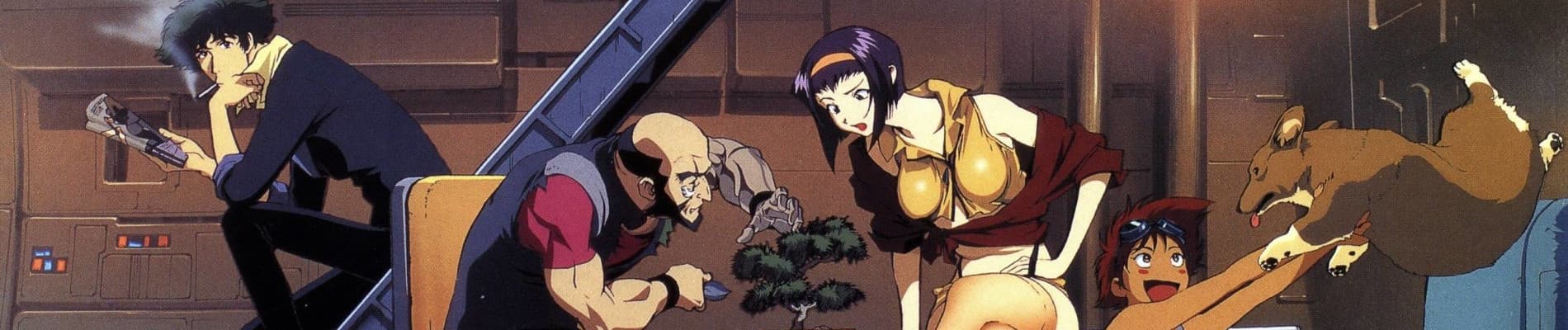
Cowboy Bebop
a review by mirphy
a review by mirphy
In recent years, Cowboy Bebop has become quite divisive. Whilst many older fans adore the series, a lot of younger anime viewers tend to dismiss the series as 'overrated' and 'not that great'. There is a reason for this that I would like to outline in the review, and that reason is actually why I consider Cowboy Bebop to be an episodic masterpiece. Why is that? Let me explain:
There is a concept in media that has rarely been seen and even more rarely mentioned. The idea is that whilst on the surface, a series is very light-hearted and fun, but once you begin to delve into the details of the world and certain plot elements, it changes how you view the story completely. A YouTuber named Rycluse proposed a term for a similar idea, where, in short, a video game would present itself as innocuous and plain and could be completely as such, but as soon as you begin to go off the beaten path is where the "hidden horror" is revealed.
Obviously, Cowboy Bebop can't achieve this since it's only one anime and even its supplementary material doesn't cover this ground, however, it does achieve the prior idea, where the story on the surface is a fun, episodic series with a bunch of charismatic badasses, but once you start to look at the details presented in only a handful of episodes, your entire perception of the series is changed. To clarify, this isn't simply where a series starts off as a seemingly light-hearted story where it then takes a much more darker turn, such as Madoka Magica (though that does not mean it is any less deprived of merit); this is where the entire story can be viewed as more innocent, but it is only when you start to look closer where the true intentions of the story is revealed. That is to say, whilst Cowboy Bebop is often remembered for its fun cast, iconic style and its tragic ending, the tragedy of this series runs far deeper than simply The Real Folk Blues.
The primary drive behind this narrative device is the setting of Cowboy Bebop. The setting is an inherently flawed part of Bebop, and I don't mean that in terms of quality, I mean that as in it's permanently damaged from the one defining event in its history. The history of the universe of Bebop is entirely centred around the partial destruction of the moon from a hyperspace gate going haywire which then forced all but the lowest of the lower class into space to colonise the rest of the solar system in order to make a new home. There is a big reason why this is the only detail overtly told because the world of Bebop is mostly "show don't tell". We do see a few well-populated cities that seem to be doing well for the most part but, for a majority of the time, we see more run-down places rather than big expensive skyscrapers.
This is very intentional for two reasons. For one, it grounds the story firmly in an enhanced reality, as although we have spaceships, robotic limbs and false eyes, there's a familiarity to the places which the Bebop crew hunt bounties in. The locations on Earth shown in Mushroom Samba in particular feel close to a classical setting for a western film, with a drab desert town with cracked windows and dingy stores, which, in turn, make the science fiction elements of the series more believable.
The second reason they do this is to establish that, despite everyone being fairly normal, there's an underlying sense that they're less fortunate than many of the cities we live in today. This is that "Hidden Horror" at play, and it's not something you may pick up on upon first viewing the series. Many people will focus on the fun action or the cool style and that's entirely reasonable, those are some of the series' best qualities, but there's far more going on than simply flashy fight scenes.
Whilst the setting is the primary drive of the "Hidden Horror" of Bebop, it is by no means the star of the show nor the most blatant execution of the idea, as the characters are still what make this series as good as it is. These characters need no introduction as each are iconic in their own right. However, there's a lot more going on with these characters than you may think.
Faye is my personal favourite. She's sassy, hot-headed and generally a bit of a fuck-up on first viewing, but she's very well-written. Whilst a lot of other series use women's sexuality as merely eye-candy, Faye uses her body and the art of seduction to her advantage. Faye lost her memory after being preserved in cryostasis for several decades, with the medical bills pilling up for that treatment putting her into a lot of debt. So, she uses one of the few things she has left to get where she needs to be, which is her good looks. This speaks to the greater theme of Bebop's characters where they all are putting on some sort of facade.
This runs deeper than her simply putting on the act of a seductive mistress, as whilst we think she's actually a cunning badass, under all of that, she's just a child. Faye is distinctly very petty and will often lash out against others more frequently than the other members of the cast, which comes full circle when she finally uncovers the truth of her own past. This is why I love Faye so much, not only does she have easily the most emotionally poignant story in the series, she even has a small character arc going on.
Before episode 23, she's constantly trying to be a hardass, acting like she doesn't care about anyone else; however, upon the discovery of her past and the regaining of her memories, she starts giving in to her more compassionate side. She assists Julia in escaping the Syndicate assassins and finally opens up to Spike about not wanting him to die. She's a 3 dimensional character, with a subtle character arc and an emotional climax. I couldn't ask more from a female character.
Jet is in an interesting position in the series, because he's the only cast member who has much to regret about his past, but manages to overcome it. He acts as an odd parental figure within the cast, being the one who cooks, operates the Bebop ship itself and takes care of the cast when they or their ships have been injured. This is a constant throughout Jet's personality, as all of his side stories revolve around him chasing someone else from his past since he does care about them, but is too much of a hardass to admit it to himself. This is also present in the other cast members but it's the most blatant with Jet, probably because of his role as a carer.
Jet has many regrettable things from his past, such as his lost love or the betrayal of his best friend. However, what separates him from Spike and Faye is the fact that he's managed to overcome this grief and strife, and is arguably the most sound of mind of the crew because of this. In that way, he's the ideal end of these characters -- Faye was definitely on track to becoming more like Jet -- but Spike just couldn't get over everything that's happened in his life.
Never is Jet's obvious care for the cast more relevant than in The Real Folk Blues, where he chooses not to go after Spike since he's always causing trouble for Jet, however he still asks about him and clearly shows concern in his voice. This sorrow for what Spike is going through is only enhanced by the fact that Jet can't help, since he was injured at the start of The Real Folk Blues and can only offer advice to Spike before letting him go. His duty as a carer is forced to become a secondary concern for Jet and this becomes instrumental in why Spike dies at the end of Bebop. Who knows? Maybe if Jet was in good condition, he would've gone with Spike and we would have a much happier ending. Jet serves a very important role within the relationship dynamics of the show and I could never imagine the series without him.
The man of the hour. Everyone loves Spike. He's cool, good with guns, knows kung fu, has a cool job and generally has that appealing "I do what I want" attitude. However, Cowboy Bebop goes out of its way to show that many aspects of Spike's personality are flaws and not to be admired. These flaws can be seen in the other cowboys of the series, Vicious, Andy and Vincent.
Vicious is Spike's direct link to his past, he is the reason Spike is forced out of hiding and back into the Syndicate's eyes due to an implied love-triangle between themselves and Julia that split them apart. He is wrathful, uncaring and craves power, which are traits that can be seen in Spike to a much lesser extent. Spike can be quick to anger, is very apathetic and is constantly chasing money, but what separates the two is the fact that Spike does care about others, deep down. This love for others, however, is in constant conflict with Spike's other desires, which are getting money and doing what he wants. This culminates with the two dying together, but Spike manages to live just a little bit longer. The reason he pursued Vicious in the ending of the series is out of revenge, since Vicious' men killed Julia, the love of his life. This shows that, whilst he is still flawed, in death, he realises what truly mattered to him in the world, which was the people he cared about.
Andy is a very funny character. I'll touch on him briefly since Steak Bentley did an amazing video discussing him and his relevance to the overall story of Bebop. Andy is a representation of Spike's pride. He is quick to judge, clumsy and kind of a dork, but, unlike Spike, has no real skills or investment in being a bounty hunter. Spike doesn't really win against Andy, he loses by pure chance and comically announces that Spike is "the real cowboy", which definitely leaves room open for Spike's eventual downfall since the battle with his pride was never truly finished. This is all whilst a terrorist -- who is clearly based on the Unabomber, Ted Kaczynski -- attempts to get a message out to the public on the dangers of constant expansion, which is definitely a topic which needs to be meditated on, but Spike and Andy don't care since their pride is more important to them than the world around them. This is also an example of Spike's apathy, which is explored much more with the 4th cowboy, Vincent.
I wrote about Vincent in my review of the movie, but to keep it brief, the movie goes out of its way to show how apathetic Spike is to the world and its people, until Vincent appears. It's presented that Spike decides to go after Vincent because he wants the 300 million woolongs placed on his head, though I believe it's because he sees himself in him, with how Vincent refers to death as being one big dream during the train scene, which Spike relates to, having "died" himself and almost feels like he's living a dream ever since then. In a way, Vincent's apathy actually works in reverse to invest Spike in the world and its people, even committing himself to stopping the incoming catastrophe that Vincent is planning. It's in this rare moment of care where Spike's true colours shine; he is a loving individual that's simply too prideful to admit it.
This idea of the "hidden horror" doesn't just extend to Bebop's main characters, it's all throughout the show and it may be hard to catch on a first viewing. The best stories within the series revolve around flawed and vulnerable individuals and what eventually happens when they're forced to confront parts of themselves. From the Heavy Metal Queen learning to open herself up to other people again, to Mad Pierrot experiencing pain for the first time in years and breaking down. On a passing view, these may all seem separate from each other, but through theming, the whole work comes together and eventually expands beyond the confines of the series itself.
That is to say, Cowboy Bebop is more than the sum of its parts. Due to how the series naturally wants you to re-watch it to find more details that make the characters and world richer and more interesting, it's almost like the second viewing is when the true story begins. For example, did you know there's a chance Jet may be Native American? It's not confirmed but he's very knowledgeable in folktales and culture and in The Real Folk Blues, the shaman even refers to him as "Running Rock". This isn't to say that Jet is 100% definitely Native American, it's just a little piece of dialogue that you could easily miss which opens up new possibilities for the world and these characters.
Despite all of the praise I have given in this review to stellar character writing, Cowboy Bebop is by no means a perfect series. Many of the beginning episodes feel like they lack focus and I have a particular dislike for one episode. Episode 11, Toys in the Attic, or, as me and my friends like to call it, "The Fridge Episode". We call it this in reference to The Fly episode from Breaking Bad, which is commonly thought of as one of the worst episodes of that series due to it having very little relevance to the plot. This episode is similar in the fact that it has no relevance, but more in the way that it has no relevance on how we view these characters and sometimes even feels contradictory in what it's trying to say. You could maybe get some meaning out of the creature representing the past or tragedy but I find those comparisons flimsy at best.
Cowboy Bebop was one of the first anime I truly got into. It was not the first, nor even the second or third, but it has stuck with me until even now, unlike other series I had watched at the time. Above all else, it is a visual and auditory masterpiece with an iconic and instantly recognisable style. But there is so much more to it than just that, it's not just about how cool the characters are or the memorable score or the iconic quotes.
Cowboy Bebop is about life. In life, there will be good times and there will be bad. You will be vulnerable and there's a good chance you will have regrets. Some people manage to accept their flaws and wrong-doings and continue on living, others simply can't get over certain things and end up losing their precious time on this planet because of it. That's why I think Cowboy Bebop resonated with people so much; it speaks to the human experience in such a way where it sucker-punches you, but if you go back, you may realise that it was almost inevitable. That's why I consider it an episodic masterpiece. It uses it's structure as an episodic series to enhance the story, rather than it just being a stylistic choice.
Regardless of what has happened or will happen, we must always move forward, because time and everyone else won't wait for us.
39 out of 41 users liked this review
