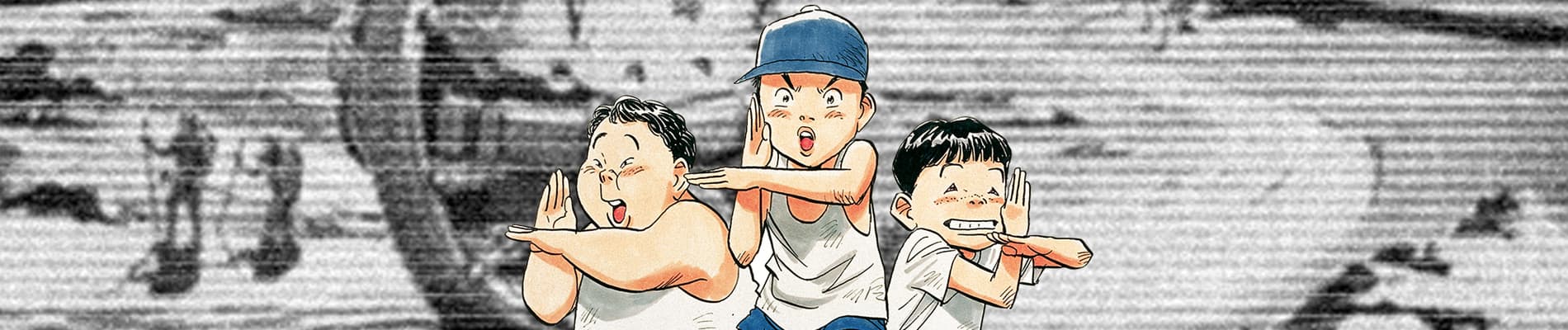
20th Century Boys
a review by Illuya
a review by Illuya
It's the sound of the alarm clock. Twice its saccharine melody has infiltrated your tired ears. Your eyes have not managed to open yet; you have not managed to open them. They are beings of their own, battlements soon to be breached by the early morning sun. But they are not yet ready to welcome its light.
You dreamed tonight. Big dreams. During your sleep, you were something larger: a writer, a film director, maybe a musician. And you were on the set—you were on a late-night show, questions hurled your way by an enthusiastic host in a suit. You were something larger than yourself. But now that you're awake, the spotlight is gone. The dream is over, baby! Welcome back to reality!

One day, while out on a walk, Kenji comes across a poster. An eye at its center, a crudely drawn hand stares back from the glossy white paper, index finger pointing upwards. Tracing its shape, Kenji is taken back to his middle school days. As it turns out, the symbol is one created by him and his friends; and soon, the events of the present start to resemble the games they played as children. Except now, they're very much real. Someone else—an evanescent figure known only as Friend—has stolen their symbol. And it’s being used against them.
Kenji’s childhood pals are as ill-prepared as him. Yoshitsune has become a salaryman. Maruo’s got children of his own. And Yukikji’s busy hunting drugs as a police officer. With a conspiracy shaping around them, will they manage to rise up and become the heroes of their childhood dreams?
From the beginning, 20th Century Boys' most impressive feat is the dexterity with which it jumps between past and present—and between Kenji and a host of side characters. Naoki Urasawa already displayed a talent for rendering the complexity of his narratives approachable in Monster. But here, he goes absolutely wild. Time skips most authors wouldn't dare are frequent across the 22 volumes, and the story just six volumes in ends up very different from the one presented at the beginning. Just like in Monster, the story of Kenji doesn't take long to become much more than that as a variety of characters are introduced, some of them even momentarily taking on the role of main character.
The premise is absolutely ridiculous, too. As Kenji probes further into the conspiracy, the situation he finds himself in is one out of a children’s TV show. Led by the evanescent Friend, a cult prophesying a doomsday scenario is on the rise. It’d have been easy to depict them in a joking manner, yet the manga takes their juvenile ambitions seriously. And the result borders on terror.

However, not all plot points land equally well. Particularly towards the end, Urasawa starts relying on cheaper narrative tricks, such as the repeated instance of memories suddenly resurfacing and changing the whole picture. In the first half, perhaps even for longer, the dialogue between different time periods is impressive. But when there's only four chapters left, the finale still on the horizon, and the characters are just realizing something about the past—often something trivial—it feels cheap. And that's perhaps the manga's biggest flaw. As talented a mangaka as Urasawa is, brevity has never been his strongest suit. There's always one more side story he wants to tell, and one more, and one more... "Oh shit, the manga's just about to end!! How am I supposed to wrap up in time?! "
The ending is, honestly, a letdown. The showdown is over quicker than one of Kenji's childhood memories, relies on too many plot conveniences, and ultimately fails to convince. But I also don't hate it. It provides the resolution I'd been hoping for, just not as well as I would've liked.
Yet art never exists on its own. Though I do subscribe to the idea of the "death of the author" so far as personal interpretations go, you can often learn much about a story through the person who told it. And with 20th Century Boys, it happens that many of its flaws can be connected with the situation Urasawa was in at the time of writing it.
When 20th Century Boys began serialization in 1999, Monster (having kicked off in 1994) still had another two years of its lifespan remaining. To put it bluntly, Urasawa was tackling two series concurrently. And neither of these were side projects, either—after all, we're talking about his two most famous (and perhaps most acclaimed) works. When Monster finished in 2001, it would only be two more years) before Urasawa would take on yet another project in the form of Pluto—mind you, while 20th Century Boys was still very much an ongoing thing.
This considered, the manga’s decline in quality starts to make sense. Urasawa has stated that he doesn't plan out his stories from the start, preferring to see where they take him over the years. That way, he’s taken aback by the twists himself. He describes it as “the story [telling him] where it wants to go next.” I’d imagine this to be the source of his most surprising moments of storytelling. Yet when under high amounts of pressure, it’s perhaps not a very sustainable method. It's no wonder he would eventually suffer from a shoulder injury.
None of this is to say that 20th Century Boys, by nature of its production challenges, suddenly becomes flawless. The ending is a letdown, regardless of why that is. But I also believe in understanding—or at least trying to understand—the author of a work and what went into it. And incidentally, Urasawa's struggles with wrapping up the manga reinforce its most important theme.
He's... ordinary.
Urasawa already tackled the issue of morality in Monster. Through the antagonist, Johan Liebert, he showed the depths a person can descend to when deprived of love. And he gave us Dr. Tenma, the protagonist, as a response. A kind-hearted, altruistic doctor with a rare optimism about him. The question posed, then, was whether Tenma could be bent towards evil.
In 20th Century Boys, we once again encounter the duality of good and evil. Yet here, what Urasawa is asking is not whether Kenji can remain good. No. It's what exactly makes him so.
And the answer is found in the fact stated earlier: he's plain as hell.
Choosing a normal person as protagonist creates an interesting juxtaposition. On one side, we’ve got the threat of the Friends: cartoonish, extravagant and quite silly. On the other side, we’ve got Kenji and his friends: ordinary people caught up in an extraordinary situation. What we’re given, in a sense, is a confrontation between tones. And the miracle is that it works. Whether incidentally or not, Urasawa doesn’t simply blend these approaches together; he uses them, in a thematic sense, to pit the ordinariness of the ordinary characters—the heroes—against forces of an overwhelmingly unrealistic nature. And he shows us that, even in such a scenario, these characters will keep fighting for what they believe in.
Because that’s what good guys do.
To be a hero, then, is not to be outstanding, like some kind of supernatural phenomenon sent in to save the world from peril. It’s also not about having a plethora of wealth at your disposal or magical powers or fancy words to say. It’s simply about being good.

The so-called superhero we encounter in much of modern entertainment is one which, in 1977, was diagnosed as an “American Monomyth”. This term was coined by Robert Jewett and John Shelton Lawrence in an eponymous book and describes “a selfless superhero [who emerges] to renounce temptations and carry out the redemptive task.” It is the idea of a singular character who, by nature of their otherworldly abilities, is able to solve an existential issue with which normal forces have been unable to contend.
To anyone who’s dipped their toes in the MCU, this concept will sound familiar. In 2008’s Iron Man, Tony Stark is a sardonic billionaire using a technologically advanced suit to fight against a terrorist group. No ordinary individual could possibly attempt this. And that’s exactly the point. Stark, like most superheroes, emerges as a mythical figure. He becomes an emblem of this impressive force which will suddenly appear and fix everything.
However, Marvel (at least not pre-MCU Marvel) doesn’t always go for this concept. Spider-Man, in contrast with Iron Man, is a stand-in for the downtrodden: he’s a poor, down-on-his-luck orphan. Even so, he is set apart by the mystical powers which the bite of a radioactive spider grants him. He becomes the idea that even a working-class individual can save the day. This version of the monomyth, therefore, is a much more optimistic one.
It’s also one swept under the carpet in the MCU. Spider-Man is still of the lower class, yet he’s conveniently given suits and other equipment by Stark. His story is changed from “poor guy receives superpowers and tries his best to save others” to “poor guy is given a bunch of expensive equipment by a billionaire and tries (but mostly fails) to save others.” Rather than the serendipity of the spider bite, which serves ultimately only as a starting point and not the essence of Spider-Man’s heroism, the hero as depicted in the MCU owes his heroism to the benevolent billionaire. Others have criticized this already, but there’s a clear trend within the MCU of equating heroism with the extraordinary. Both Iron Man and Spider-Man fall into the trappings of the American Monomyth.
Where does 20th Century Boys stand, then?
I won’t pretend that the manga evades all the issues diagnosed by Jewett and Lawrence’s theory. However, there’s a great distinction to be made between the heroes of the MCU and the heroes of Urasawa’s manga. While Kenji does match the prospect of an individual appearing to save the day, he’s hardly defined by his individuality. His strength lies in his friendships with others, and despite his keen heart, he wouldn’t be able to oppose the Friends on his own. Furthermore, unless you count his slightly crappy singing, he has no special abilities. He never got his spider bite. And he certainly doesn’t have the money to build himself a powerful suit. Yet he and his friends still manage to be heroes.
And thus, we arrive at the central message. No matter how much hardship you experience—no matter the disappointments you go through—you can still afford to be a hero, to be kind. As Kenji says, “it’s hard being evil. It’s a lot easier being a good guy.”
In the original manga, Kenji is very much an exalted figure. His heroism is admired by everyone close to him, and it’s hard not to be charmed by his unfruitful pursuits of his passions. What 21st Century Boys does is explore why the Friend could possibly be after someone as kindhearted as him. And hey, it does it pretty well! For the many cheesy moments in this pseudo sequel, the moments spent exploring the Friend’s origins are genuinely touching. Moreover, they add some welcome nuance to the rivalry between him and Kenji—and that’s without spoiling too much.
The central theme here is a further definition of what it means to be good. Urasawa proposes, in a sense, that sacrifices and heroism are mutually exclusive. In our fight for good, we shouldn’t sacrifice the wellbeing of anyone. This was already stated in 20th Century Boys, with Kenji urging his friends not to die and to run away if they sense any danger, but here it’s extended to even include one’s enemies. A hero is kind to everyone. A hero would never sow small seeds of evil for a greater good to eventually blossom.
Furthermore, there’s an idea here of the hero as an imperfect being. Everyone makes mistakes; unlike the superheroes of the American Monomyth,, a hero in 20th Century Boys is not someone who stands above other humans, their radiance somehow cleansing them from any flaws.
This message feels oddly potent in a manga so riddled with flaws. Despite the sudden ending, despite the at times odd pacing, despite the unresolved plot points, I can’t help but love 20th Century Boys. It took me over a year to read it, slowly collecting volumes whenever I could afford it, and to be now at a point where I can look across all its content and evaluate it is a weird feeling. Yet there’s the sense, for me, that it was all worth it. For the single letdown of the ending, there’s tens of surprises along the way to make up for it.

Earlier in the review, I talked about how crazy an idea the manga revolves around in the first place. To achieve that—and to only stumble a few times along the way—is a massive achievement.
The goal of heroism is not to be perfect. It’s to be good. The goal of art is not to be perfect. It’s to experiment.
So go out there. Try to make a difference for someone. And if you fail? Well, there’s good in that too.
31 out of 32 users liked this review
