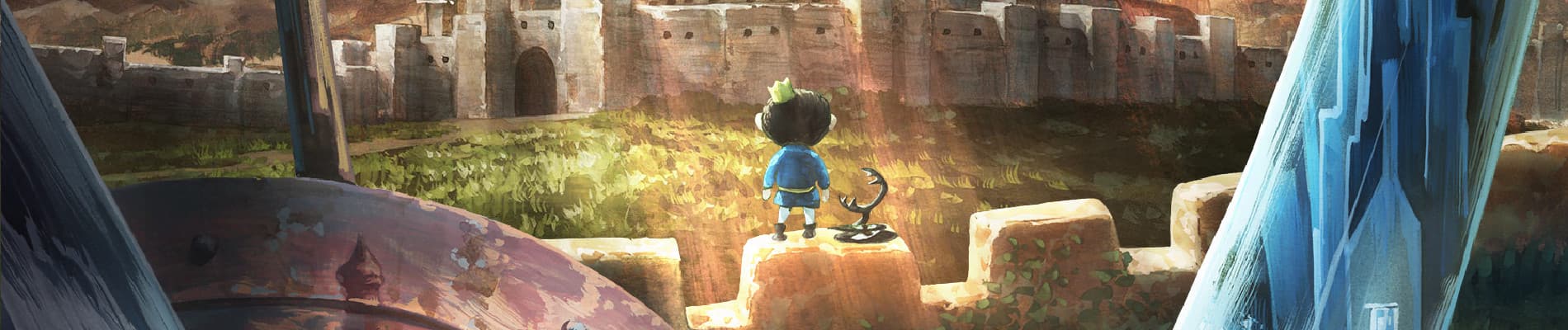
I wish I could spend this whole review showering WIT Studio with praise for the gorgeous animation, outstanding sword fight choreography, consistently on-model character designs, and grand orchestral music, as many already have and will continue to. But unfortunately, while these features certainly made Ranking of Kings a spectacle and never boring to watch, the presentation isn't enough to make up for the disappointing writing.
(Spoilers in a marked section of the review.)
Underdog stories have always appealed to me, which drew me into Ranking of Kings premiere. The plot follows Boji, a young prince who is deaf, mute, and considerably weaker than most kids his age. He is first in line to inherit the throne after the untimely death of his giant father king Bosse; the problem is, no one takes him seriously. Citizens and knights consider him a weakling unable to carry the crown. Even his sympathetic stepmother Hiling views him as a hazard rather than a potential king. Upon meeting his only friend, a shadow creature named Kage, his journey to claim the throne begins. Boji is immediately likeable because he strives to achieve his dreams despite the odds stacked against him. It is satisfying to see other, stronger people judge him, then him beating them in a duel with his hidden skills. The artists so fluidly animated his graceful dodging and subtle rapier swipes that it's hard not to be amazed by him. Characters around Boji progress throughout the show as they learn to sympathize with him; they become better people when they regret their wrongdoings towards him and gain faith in his capabilities as king. Boji's cruel half-brother Daida is the main antagonist of the first arc—doing everything he can to prevent Boji from claiming the king's throne. Daida is guided by a dark spirit living within a mirror, not unlike the evil queen's Magic Mirror from Snow White.
Ranking of Kings' tone is deceptively joyful at first, in part due to the colorful background art, smooth character designs, and bright lighting, but it quickly becomes dramatic. Every few minutes, a character is crying, usually Boji. The first and second episodes had me tearing up because of Kage's depressing backstory and seeing Boji get beat up for the first time. I was numb to it after the third time he got his ass whooped. Not to mention, any time a named character is in danger, you know for sure they'll be saved at the last minute or healed after a foe beats them half to death. There are only so many melodramatic speeches and surprise rescues I can take before calling out emotional manipulation. Boji is not an overpowered protagonist; however, he is wrapped tightly in plot armor, and tears aren't enough to distract from that glaring issue. A bloodthirsty enemy could chuck a dozen boulders at him and miss. What he lacks in physical strength he makes up for with nimbleness that allows him to evade damage. The times he gets bruised, you can count on someone to heal him.
A director can weaponize crying in tandem with tension built up by the script. Overusing sentimentality lessens the effect over time because these scenes lack a long-term setup or a satisfying payoff—a problem many people had with To Your Eternity. One of the most egregious uses of emotional manipulation is showing last-minute flashbacks to redeem villains. After a character has betrayed the hero, saving them is a complex undertaking. Still, the author takes a shortcut to redemption by blending sentimental flashbacks, sobbing, and self-pitying monologues from the villain to manipulate us into forgiving them. Demon Slayer is another fantastically animated, awfully written, anime that attempts to redeem monsters moments before their death with a corny backstory. They don't do the work to make up for their faults—these sudden twists and turns make the story seem lazily written with minimal forethought.
(Spoiler section)
Boji is a very empathetic boy to a fault—even wanting to spare bloodthirsty killers, wolf beasts, and people who attempted to kill him. The furthest he goes is forgiving Miranjo, the evil spirit living in a mirror who convinces Daida to betray his family. Although Miranjo killed Boji's birth mother in front of him, he has no good reason to forgive her. Miranjo created a potion to turn Daida into an empty husk for King Bosse to reincarnate into—trapping his soul eternally alone in a void Essentially a fate worse than death. Miranjo is willing to kill anyone to stand by Bosse's side once again as she used to. When Boji nearly loses a fight, Miranjo advises the retreat, suggesting she feels empathy for him. Witnessing him fight an immortal knight futilely gives her flashbacks to her mother, a kind woman with a solid moral compass. Eventually, we learn she caused the deaths of tons of innocent people, carrying out the order herself. That the author would attempt to redeem her through pitiable flashbacks is appalling. There is no justice served. Instead, everyone lets Miranjo off with a slap on the wrist and a marriage proposal from Daida to keep her safe in the 22nd episode. The author desperately tries to make us love her, as all the other characters curiously do, and fails spectacularly. She is a floppy noodle of an antagonist and would have easily been a more significant threat by tweaking the flashbacks and reactions from characters. Bosse reincarnated as his son Daida is another limp antagonist. To call his, and everyone else's, motivations confusing would be an understatement. He switches between wanting to murder everyone and healing them just to fight again. The adaptation failed to convey that he is a psychopath who loves manipulating his enemies' expectations or that the author had no idea what direction to take each character. In other words, pick a lane and stay in it!
Boji’s mentor tells him 'believing in yourself, and 'self-confidence' is what granted him power, which would contribute to the show’s themes if it were entirely true. Boji trains to fight with a sword, but his high skill level comes from his royal genes. Aptitude derived from luck at birth is similar to My Hero Academia's quirks. Due to these natural abilities the story is more about reclaiming is ‘rightfully his’ then rising up as an underdog. The obstacles he has to overcome are other people who stand in the way of his path to the throne. Many of his allies double-cross him for personal gain, usually out of loyalty to others or for money. However, when they witness his fiery passion in battle and unwavering empathy, they have no choice but to stand by his side! One or two betrayals-turned-allies are understandable. Unfortunately, the author doesn't stop at two and keeps going; it's predictable, obnoxious, and makes sense that someone with a victim complex writes the story. Thankfully the egotism of the author doesn't seep through into Boji's character—who is arguably the most respectful portrayal of a disabled person I've seen in anime. However, the author's biases do radically impact the series in episode 18 and onwards, causing one of the worst declines in writing quality I've seen in an anime since Wonder Egg Priority.
In the 18th episode, King Bosse retells Miranjo's origin story in a lengthy exposition dump. (One of my favorite parts of the script is how lore was delivered naturally, NOT by a talking head reading off a script.) Miranjo lived with her mother in the Homura kingdom, a stand-in for Japan, and the Gyakuza Kingdom, a stand-in for Korea. The comparison is immediately apparent when you see how the Gyakuza houses are identical to those in pre-industrial era Korea. Bosse explains how Homura gave the Gyakuza all kinds of benefits, such as teaching them magic, but they took advantage of them by stealing, murdering, and deceiving. The author portrays Homura's colonization of Gyakuza as a net-positive and their rejection of their 'generosity' as ungratefulness. At the time, Bosse witnessed the merciless mutilation of Miranjo by Gyakuza civilians, which spurred him to murder all of them he could find—ethnic cleansing. Their motives are, as Bosse explains: "But different countries have different cultures." Blaming culture for socio-economic problems is a frequent tactic used by Japanese nationalists when criticizing Korea. Western viewers may miss this allegory, but all it takes is briefly seeing the Japanese audience's response to the series to understand how appalling this message is by portraying the Gyakuza as sadistic criminals who mutilate innocent children. There is no room to interpret them as anything but pure evil—making Miranjo their victim of theirs was a tactic to make us pity her, then eventually excuse her actions. There's no nuance to these villains; they're corrupt because they're a manifestation of the author's demonization of Korean people. These villains stand out mainly because, time and time again, the show redeems even the vilest of individuals. This is not to say redemption is necessary, but nuance is.
(Spoilers end)
The show’s central themes are self-confidence and forgiving those who wronged you—the latter was horribly executed for all the reasons I've said. Everyone, no matter how horrible, is forgiven except for one ethnic group. At the very least, Boji’s coming of age journey to gain self-confidence works. Labeling Ranking of Kings "Average" is generous at best. Without the artists' spectacular audiovisual heights, it would most certainly be an immediate skip. As the writing quality rapidly declines, the visuals become even more impressive as if to compensate for the flaws. For the ones with a brave heart and solid moral compass, watch on, but prepare yourself for disappointment.
31.5 out of 45 users liked this review