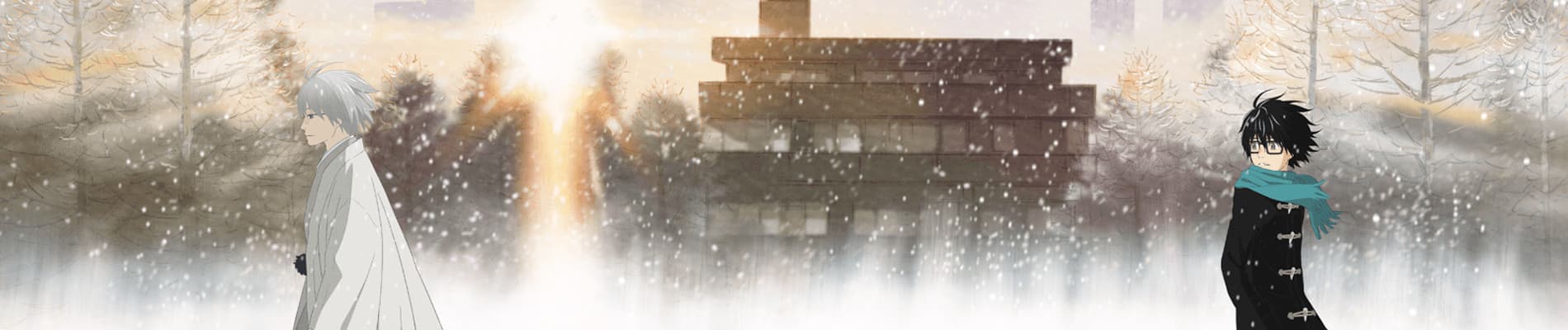

I wanted to talk about 3-gatsu no lion and I figured using the Anilist tags of the franchise could help me structure this review. I will not explicetely talk about scenes that may give spoilers without the spoilers mark but I'll still talk about the progression of the story as a whole thus there will undoubetly be some implicite light spoilers so be warned.
This review deals with both S1 & S2.
COMING OF AGE : How does Kiriyama matures through rehabilitation and family life ?
At the beginning of the story, Kiriyama is a gloomy, shy and self centered individual. He's broken by his past and shogi is the only thing that rattaches him to the present. Except for shogi, he doesn't devote himself to anything. Many characters try to form bonds with him but he rejects them because he thinks of himself as undeserving of their love. We can observe this by seeing how reluctant he was to drop by the Kawamoto house or by how he interacted with Nikaidou. How did a character stuck in the past grew?
Firstly, wiith rehabilitation. Japan society and work culture will reveal it's many negative aspects if you commit yourself to work too much. However, for someone with vital needs for responsibilities and human connections the beauty of Japan's culture will unveil itself. Kiriyama goes to a shogi department practically everyday, this forces him to talk with many people. He has to show respect to his elders and colleagues, use tutoring, ask for advices and live in a community. All these things make him take his responsibilities. How he lives and acts will affect persons other than himself, which is something he desperatly tried to avoid by moving out of the Kouda house. Along the story, Kiriyama develops an image to sustain, for himself and for others.
Secondly, with family life. We all know it, living with other people is hard as much as physically and mentally draining. Nonetheless, it is a necessary process for the human experience. The Kawamoto sisters and grandpa (and cats) become Kiriyama's found family. It's what truly saved Kiriyama, why ? Because people depend on him and he depends on people. Trying to live up to what others want from you can become a hellish burden but having no one excpecting nothing from you is also a sort of hell. It would be nice if every human were able to think of themselves as sufficent to validate themselves but that's not how we work. We need others to validate us, it's essential. That's why having people depending on you feels good, it gives a purpose, it gives a meaning to your actions, it makes you realise that you're not useless and that you can accomplish many things for others. It would also be nice if every human were able to carry the "burden" of their lives by themselves but that's not how we work. We need help from others, we need relatibilty and we need bonds. That eases the weight of living and makes us realize that we're accepted, that we belong somewhere. Along the story, Kiriyama develops relationships to deepen.
To end this section in a philosophical fashion, Kiriyama was engulfed in his past to the point he couldn't be interested by all the things that the present offered him. Thanks to many introspections he made throughout the two seaons : Instead of dwelling on his past and using shogi to distract himself from it like he used to do, Rei now uses his past as way to work on his present self, which is what maturing is all about.
IYASHIKEI & TRAGEDY : How are the two opposite slice of life subgenres actually essential and complementary for the storytelling?
Iyashikei : Primary aim is to heal the audience through serene depictions of characters' daily lives. (Spy x Family, Wotakoi, Yotsuba To, Tonikaku Kawaii, Shikimori-san, Barakamon etc)
Tragedy : Centers around tragic events and/or unhappy endings
From the descriptions alone you can see how opposed these genres are. Even more so if we're focusing on their subgenre-use for Slice Of Life animanga. In general, even if the SOL contains both subgenres, it clearly favors one and use the other as a sort of extra setting (We still have crazy works that cunningly blend the two like Shoujo Shuumatsu Ryokou where the serene depictions of characters' daily lives precisely centers around tragic events but that's another subject for another review).
Why do both subgenres work for this anime ?
Firstly, Iyashikei is the cure for the nekketsu shonenification of SOL animanga.
- I love nekketsu shonen (OP, Naruto, Bleach, FT, DB, MHA, Black Clover etc) for infinite reasons but for being realistic is not one of them. To exemplify what I mean by "nekketsu shonenification" let's take Shokugeki no soma. It's a famous manga revolving around food (100%) that made many believe it was a SOL but it's actually a complete battle shounen manga.
Spoiler, click to viewclick to hide
- Nekketsu shounen : Literally means "boiling blood", it is a sub-category of shonen. In this works, we follow the hero's initiatory journey of self-transcendence. He will brave all the obstacles to reach his goal or become the best in his field. Here are some recurrent clichés of the genre: an orphan looking for his father or wishing to surpass him; a naive but brave hero with a big heart; the hero's first enemies will become his allies; the hero has a strong sense of justice; the hero always gets up stronger because he refuses to give up (here we touch the deep meaning of "nekketsu"). We also often find tournaments, competitions or other things of the kind...- Shokugeki no soma, despite being a cooking related manga, follows these patterns to the letter. It may be easier to accept for shounen that already have fantasy/fantastic elements to it but since SNS was supposed to be about "normal" humans, many critisized how irrealistic and ridicule the characters and the story were. I love SNS but the critisicms made agaisnt it are undeniable (I mean, not every story has to be realistic but whatever).
Real life isn't an adventure and not all of us have a huge dream or goal. Living life is actually more similar to iyashikei SOL, it's about the little moments and the mundanity. Many SOL follow a pattern similar to the nekkestu shonen formula and it's fine but if you read SOL to see more down-to-earth and relatable characters and conflicts, iyashikei may feel more real.
Secondly, tragedies are the cure for the iyashikeification of SOL animanga. At this point, this section might seem like a bad joke but I'm serious. Many iyashikei take the concept too far and the stories end up being irrealistic over-cheesy self insert stories. In these cases, SOL tragedies may seem more realistic and down to earth than their counterparts. While everyone has it's preferences, San Gatsu no Lion manages to blend both subgenre in a way that feels even more realistical, had it been it hadn't contained both.
The fact that the narrative is an iyashikei allows the viewers to feel immersed in the world and close to the characters and the story being a tragedy permit the viewers to share the lives of the cast and their troubles at a profound level ; both subgenres merged together, letting the audience see this work of art not as a fiction but as a transcript of real people's lives. Outstanding writting which is the necessary element that makes San Gatsu storytelling so good and real.
SHOGI & PHILOSOPHY : How is shogi the prefect philosophical metaphor for Rei's life and life in general ?
"I know that a beast lives within me. It's a rampaging beast that'd bite off everything in sight to survive. When the battle begins, no matter what, it's hand reaches out for the path to survival. Even if it means misery for others. No matter what kind of world awaits." - Kiriyama Rei Seaon 1 Episode 10
How does this quote resonates with Kiriyama Rei and San Gatsu no Lion philosophy ?
Firstly, this refers to his past with the Kouda family.
Spoiler, click to viewclick to hide
Kiriyama Rei lost his parents at a young age, therefore he had no choice but to live with the Kouda. This caused many problems for the family as the children were jealous of Rei due to his shogi skills acclaimed by their father. Furthemore, Rei's general behaviour, which was originally meant not to bother anyone, brung the kids displease upon him. Due to his precense and other factors, the Kouda family has been severly fractured. One interpretation could be that he blames himself for the whole situation, comparing himself with a calculating beast that destroy others life for his own survival, which is correct but not all there is to it.Secondly, it refers to the shogi players in general. Stating that shogi is a chessboard game is true but it's ignoring everything around it. Being a shogi player is a job and whole tournaments, events, tv channels and lives revolve around it. Shogi players put everything they have Into this chessboard game to get money, bring food to their families, perfect themselves in one domain and so on. Even though, winning implies making someone else lose. Being a shogi professionnal player is a dangerous job, the stress is considerable, some players age faster, lose hair and it affects the health of players who already had weak constitutions to begin with. Many players suffer from depression due to not being able to climb up the ranks. Knowing that their opponents have gone through the same suffering as themselves, they still fight eachothers, trying to win no matter what, ruining people's lives and bringing themselves under even more stress and suffering.
Kai Shimada 8-dan is the perfect exemple to illustrate the idea I conveyed.
Spoiler, click to viewclick to hide
He left his hometown, he lost his girlfriend, he lost his health (and his hair) and now has terrible frequent stomachaches. He gave himself completely to shogi and it consumed his life, it consumed him wholly. Before going at an important match, he dreams about what his life could have been if he hadn't persevere in shogi.Even in his deam, he was still playing shogi to find happiness. Even in his deam, he still had stomachaches. Since the day he discovered shogi, his life couldn't be the same. Both outcomes of him playing shogi and him not playing shogi will result in him suffering as his love for shogi will find a way to cause him stomachaches. Then, which route is the true nightmare? To know if he's done the wrong choices, to know if the other life would have been more preferable... He can only persevere in the life he's already chosen and see it until it's through, like a beast, never backing down, "No matter what kind of world awaits".
Another perfect example would be Sakutarou Yanagihara. He's the oldest active shogi player.
Spoiler, click to viewclick to hide
And living up to this title isn't an easy task. In the first section, we discussed about how burdenning expectations could actually be positive. This old man is the living incarnation of this idea. As the oldest active player, many of his colleagues that couldn't make it to the top asked him to achieve the dreams they couldn't achieve. They all excpect him to be immortal and to fight for them."These "excpectations" are "cords". With hundreds and thousands of them tied onto me, with time they've become so heavy, that I can't even move. But they also bound me and weigh me down so I don't run away from the fear of getting covered in flames. Ironic isn't it?"
Having people expecting things from you is a curse but this curse gives you a purpose and the will to live. By this logic, having no one of excpecting nothing from you is far worse and destructive. You could say it's the power of friendship but well written. To really confirm it though, you have to see it until the end and devote yourself completely, "No matter what kind of world awaits".
Last example is the lyrics of the second opening theme.

Shogi was the savior and the downfall of Kiriyama Rei. It allowed him to ignore things around him and his problems, making his situation worse but it's now thanks to shogi that he's able to grow and meet more persons.
To synthetize, shogi is like life. We might live in community but there's still competions in every area. We can't all have the same things and roles. So, in order to get what they want, shogi players will enter hell and beat everyone there, ignorant if the result will take them to a better place or a even greater hell but the only way to find out is by actually going through all of it. Nevertheless, to accomplish that they will need the support of others who will burden them and by burdening them, they will simultaneously give them even more reasons to hold out. And that's what life is all about.
THANKS FOR READING
In conclusion, we've seen how March Comes Like A Lion perfectly develop it's coming of age aspect with social themes. I'm really fond of how the author emphasizes the importance of family and human bonds in one's self journey. Many self-improvement preachers deny this aspect and the so called self-improvement becomes a sort of coping mechanism, to become "better" than other people despite not fitting in.
We've also seen how the storytelling stood out from other slice of life anime by effectively writting merging both iyashikei and tragedies as narrative tools and settings. This aspect is really important because it make the story feels much more real. I genuinely felt like I was going to the shogi department with Rei and sharing his life.
Lastly, with many examples, we've seen the philosophy of March Comes Like a Lion. This made many moments very emotional and breathtaking.
Spoiler, click to viewclick to hide
I remember almost crying when Kiriyama goes back to his house and the mother says she's happy he's not her real son so he doesn't end up like her son who gave back on long life term goals and only focus on instant pleasure and disrespect others.Last thing I haven't mentioned is the godlike production of Shaft, my favorite studio that makes everything even better. Like for the Monogatari Series, the visual direction of 3-gatsu no Lion make it look like the visuals aren't simply a tool to convey the story but it's the story itself. Due to many symbolysms and representations, the story can be comprehended through images alone and that's called cinema.


I can't put all the praise on Shaft though. I checked the manga and such representations of characters state of minds are also present. Shaft and Umino Chica is the ultimate combo. The anime is very truthful to the manga but the manga's pace is faster, it's something to consider if you want to dive in the manga too.
I also have to mention the musics... This anime is the contender for the best osts and ops/eds of the media. The second opening remains one of my favorite things ever created to this day.

3-gatsu no Lion easily is one of the most well written shows I've ever watched and I recommend it to anyone in search of a good coming of age!
(any sort of feedback is appreciated)