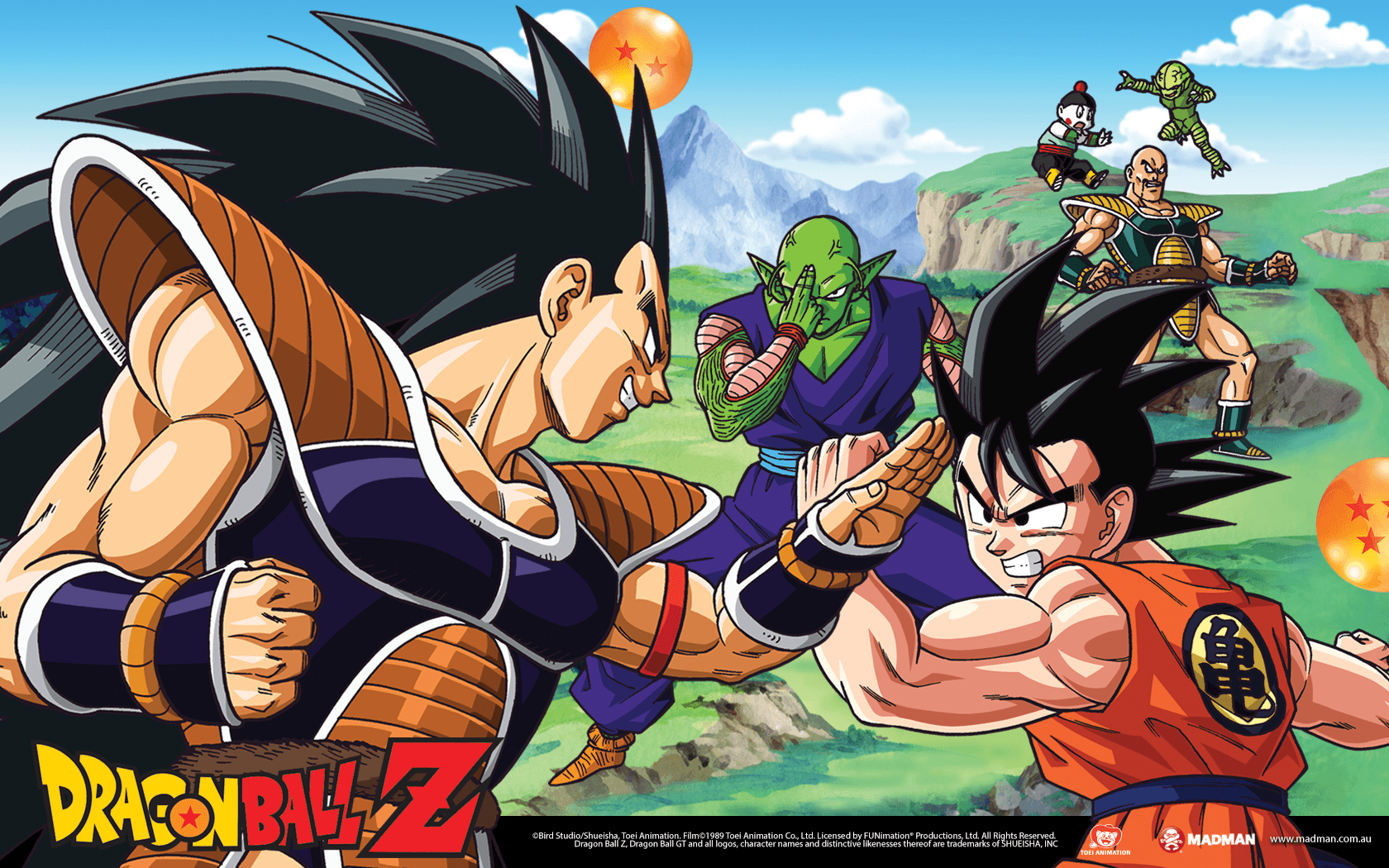

Need I even explain to you what Dragon Ball Z is? Frankly, without it, anime may not have ever even made an impact outside of some longass island nation and the West would still be viewing animation as nothing more than a way to advertise toys. People love to compare it to a certain group of three series that all ran together in Shounen Jump together, but in reality, it's DB that made profound impacts on THOSE franchises. From general inspiration to even supposedly DB's mangaka being the reason another series made it to existence, it's obvious that Arika Toriyama and his legendary story are nothing if not groundbreaking. But really, just because something is known across all walks of life, does that REALLY mean it's a goddamn masterpiece? And if so, how the hell do you manage to improve perfection?
SAIYAN SAGA

Four years had passed since Son Goku's defeat over Piccolo Jr. at the 23rd Tenkaichi Budokai, and Goku has settled into a peaceful life with his wife and 4yo son Gohan. However, when introducing Gohan to his friends from throughout the years, somebody with a tail just like Goku used to have arrives and proclaims himself as Goku's brother, spouting what seems like utter nonsense about Goku being sent to destroy Earth. After teaming up with his former enemy and defeating this "brother" guy Raditz at the cost of his own life, two more of these "Saiyan" dudes are on their way to the planet. Goku will soon face an unknowable, otherworldly opponent that brings along with him the truths and horrors of the blood that flows through him. Pride and punches will clash in this galactic uprising between peasant and royalty!
The introduction of Raditz and the reality of Goku's origin may seem like a shock considering the last two arcs of Dragon Ball had both on the menace of Earth's history King Piccolo and his offspring respectively, but the introduction of galactic threats actually fits with the escalation of the threats in Dragon Ball. Goku had previously conquered not only the mythological monsters of Earth's past but mankind's greatest military might of the present, the Red Ribbon Army, as well. At this point in time, the Earth had nothing more to challenge Son Goku. All the while he was still a man of mystery considering his unique attributes and the abilities they had given him before being removed. My only gripe with the direction the series took with this move was that such an interesting idea as a long-lost brother was only ever meant for the reveal of the Saiyan Race. Obviously, the focus was on the future generations rather than the past. At least, that's assuming that Goku is the only moving part of the story of the Saiyans.
This arc also marks the introduction of who would eventually serve as the secondary protagonist to Z and the franchise going forward, the Prince of All Saiyans: Vegeta. In this arc, however, he serves as the main antagonist. Vegeta serves to not challenge just Goku's ability as a fighter but also his entire ideology. In Saiyan culture, something Vegeta holds near and dear to his heart and subscribes to wholeheartedly, people are born with an unmovable level of potential and are subjugated accordingly based on their level of strength at birth. Power is an unmoving hierarchy at this point to Vegeta and his race. The strong will always be strong and the weak trash will ALWAYS be weak trash. However, as Goku had come to learn and will be teaching Vegeta, the weak can become the strong through the proper application and improvement of their abilities. Nobody is ever just stuck at the level they reside in at any one point in time. This theme of self-improvement permeates the entirety of the Dragon Ball franchise and, alongside the early Tenkaichi Budokai arcs of the first half of this story, it's at its most pungent and obvious in the Saiyan arc. Even to the point this shit is present in the MOTHERFUCKING CHOREOGRAPHY!


I MEAN GOD JUST LOOK AT THOSE FRAMES! Vegeta, the top of the Saiyan hierarchy, stands over and looks down upon the low-class scum Kakarot. Goku, a warrior trained and disciplined in a manner that has led him through many perils, looks up to see an obstacle he had to improve himself to even have a chance to overcome. A sight he's long become accustomed to, only now it's literal as well.
All of these combine into an elegant blend of thematic and visual perfection. In my personal opinion as someone who loves the theme of self-improvement in Dragon Ball with all his heart, this is where the original story peaks. But much like Kami's Lookout is to the Dragon World, the peak isn't just a small spec that's all downhill in every direction. The Saiyan Saga began the single greatest stretch in ALL of Dragon Ball. As a fucking franchise, not just the original story.
NAMEK SAGA

Many died in the vicious battle against the Saiyan Invaders, and on that list was Piccolo. Given his connection to the Guardian of Earth, Kami, his death resulted in the Earth's Dragon Balls becoming inert. Without the Dragon Balls, the damage caused by the Saiyans can't be undone. However, Piccolo and Kami weren't just demons. They were Namekians, and their home planet has its own set of Dragon Balls. As the only hope to restore their friends from a fate they didn't deserve, Son Gohan, Krillin, and Bulma chart a course for Planet Namek with Goku not far behind once he recovers from the previous brawl. Vegeta, after recovering from his humbling defeat at the hands of Goku, also makes a beeline to Namek in hopes of using the Dragon Balls to wish for immortality so he can overthrow his boss, a galactic emperor. Said emperor, the terrible (Frieza) is already on the planet gunning for the Dragon Balls. A trying threeway scramble for the Dragon Balls will lead to life-and-death battles, unforeseeable alliances, and the awakening of a warrior of absolute legend!
For being an arc based entirely on the home of the Namekians, the real focus of the arc is the history of the Saiyan Race and Vegeta's quest for both freedom from and revenge on Frieza. Frieza feared the limitless potential of Saiyans, so he just BLEW THEM ALL THE FUCK UP! There were 4 survivors: Raditz, Vegeta, Nappa, & Goku/Kakarot. As basically no time has passed since the Saiyan Saga, Vegeta is still willing to do anything to get what he wants. Including murdering Namekian villages and ripping through the Frieza Force like a hot knife through butter. The introduction of the Zenkai Boost, while seeming like a cop-out drama generator at first glance, serves to further the theme of the story. No matter how hard you get hit, you can get back up, learn from it, and be better because of it. The phrase "What doesn't kill you makes you stronger" is classic because it's true, and it's quite literal in Dragon Ball.
When Goku finally arrives on Namek, the story shifts more toward the effects Frieza had on Vegeta as well as Goku's acceptance of his Saiyan heritage. Vegeta, a man with EXTREME pride in his people and blood, is seen breaking down crying not because he's going to die, but because Frieza will continue to get away with the genocide of his people. He BEGS Goku to kill Frieza. Nothing else matters to him, not even his pride, more than Frieza paying for his crimes. And if anyone should bring Frieza down, it's a Saiyan. It should be Kakarot.
And Kakarot it is. The legendary Super Saiyan is not just something that embodies everything Frieza feared. Not only was it finally the moment a kind and tranquil soul like Goku's fucking SNAPPED. It stays as a final testament to Goku's acceptance of his own person. He may have been raised on Earth, but he is 100% Saiyan. The reason a Super Saiyan hadn't been born in 1,000 years was that all the Saiyans had been monsters compared to Son Goku. His tranquil soul and empathetic heart were awakened by rage. A rage that could only arise from his best friend being lost forever at the hands of the same bastard who also murdered his entire race. It's one of the few times in the series someone has a major effect on Goku instead of the other way around, and Super Saiyan isn't just the textbox example of a "bullshit power-up". It may not have trained for like the Kaio-ken, but it was earned in a narrative sense six ways from Sunday.
ANDROID SAGA

All seems well after the humiliating defeat of Frieza at the hands of the Super Saiyan, however, he seems to have survived the detonation of Namek and is hell-bent on destroying the home of Son Goku. He is quickly dispatched by a mysterious teen from the future with an ominous message. A sole survivor of the destruction of the Red Ribbon Army will unleash Androids with indescribable power that would put Frieza to shame in 3 years. Son Goku will also contract a heart virus and die before the Androids appear. Things don't quite go according to prophecy, however, and there's a new threat connected to these Androids. One that could very well be the end of Goku. It's time for the next generation to take the lead as ghosts from the past and future corner the Z Fighters from every temporal angle!
This arc immediately shows that it'll be going over some previously treaded ideas again, namely the focus on the next generation that featured heavily in the Tenkaichi Budokai arcs and the more obvious return of the Red Ribbon Army. This arc also does a lot of new as well, don't you worry. The Android Saga features the most focus on the terror of an ordinary Earthling in the face of a seemingly all-powerful murderous creature. They even made a whole game about that! Crazy... anyway, they also give Vegeta more redemption through his genuine connection to his new wife and his son, the time traveler Trunks. The genuine rage near the end when Trunks is killed at the finger of Super Perfect Cell is a great marker as to how far his character has come since the Saiyan Saga. Piccolo also gets a conclusion to his arc that was started in the Namek Saga through his acceptance and being one again with Kami. However, those ain't the character arcs people think of when they think of the Android Saga.
Dragon Ball Z, while Goku is the main protagonist, can really be seen as the story of Son Gohan. From his first ever fight to the defeat of Cell, we've seen Gohan go from a scared toddler to a preteen who's come to terms with all the crazy shit happening around him. However, the exposure to all of this violence made him develop a disdain for combat. A far cry from his father, who literally let the monkey man who nearly nuked the planet go because he wanted to run hands again. Gohan was the next generation, the one who could and did surpass all who came before him, and mentally he wasn't ready to take on the mantle of Earth's Defender. Just as Master Roshi had prepared Goku and Krillin to fight for what's right when he wouldn't be able to, it was time for Goku to prepare his son for the inevitable situation that he be forced to stay dead. He died once already in the Saiyan Saga. If he died again, which he did, he couldn't be brought back with the Dragon Balls. The next generation had to be ready, but try as he might, Goku could never even see the mental barrier Gohan was faced with from his previous experiences on the battlefield. Then, it happened. He saw exactly what was going to happen if he kept running from his newfound ability and responsibility. Everyone was going to be murdered by Cell, one by one. Suffering. And the first to go, the one that Gohan saw with his own eyes: Android 16. His head was crushed under Cell's foot like a wrecking ball through drywall. And if Gohan kept running from his own power, his ability to stop this madness... everyone he ever cared about will meet the same fate. He snapped, just as his old man did back on Planet Namek. And just like his father, he mopped the floor with the one who broke him. The new defender of Earth was born. Once again, the young now takes the mantle left unfilled in the senior's absence. Goku's beginning was Roshi's end, and Goku's end was Gohan's beginning. You know, Dragon Ball was SUPPOSED to end here. And if it did, it would've been real fucking poetic.
KAI'S IMPROVEMENTS
Now that we're done with all the major story stuff, I can make this stuff concise without missing critical info. So, why watch Kai over the original Dragon Ball Z? There are a couple of reasons, some relating to the flow of the story, others related to the presentation.
- As may be a BIG point to a huge amount of Dragon Ball fans, the English dub went through a complete rewrite for Kai. And honestly, THANK FUCKING GOD! The original Funimation dub for Z, especially its script, completely changed and transformed a lot of the characters and overall the vast majority of lines were dogshit. The VAs, while a lot of them reprising their roles, are also a lot more comfortable in their roles and sound much more natural considering when Kai dropped, they would have been doing this shit for like 10 years now.
- Speaking of the dub, quiet moments. They ACTUALLY EXIST! The Falconer score had some real bangers, but it was far too overpowering even for Dragon Ball Z in my opinion.
- Even if you watch Dragon Ball subbed, there's still an auditory reason to look into Kai. Toei had thrown out the master audio for the first three Dragon Ball animes and all releases of '86, Z, AND GT use muddied, low-quality audio tracks. For that reason, whilst no dialog was really changed in the Japanese version, the lines were all rerecorded and the audio quality difference is PALPABLE!
- This specific section of Kai is the absolute best Z has ever looked outside of two very limited DVDs that cover only the Saiyan Saga. And even then, the 2011 run of Kai covered here is also the most accurate coloring you'll get in a non-Super home release of Dragon Ball. ~~I'm not ready to talk about the TFC coloring, dear god~~
- Finally, filler. People don't tend to like it. When done intentionally in service to the story as opposed to just adding SOMETHING in order to drag out the show because you caught up to the still releasing source material a long time ago, adding stuff into your adaptation can be a good thing. Dragon Ball Z definitely falls into the second camp, if you couldn't tell by how specific I got. Kai improves on the show running as slow as Christmas MASSIVELY. There was so much filler footage in some sections that Kai ended up cutting them in HALF in order to match the manga.