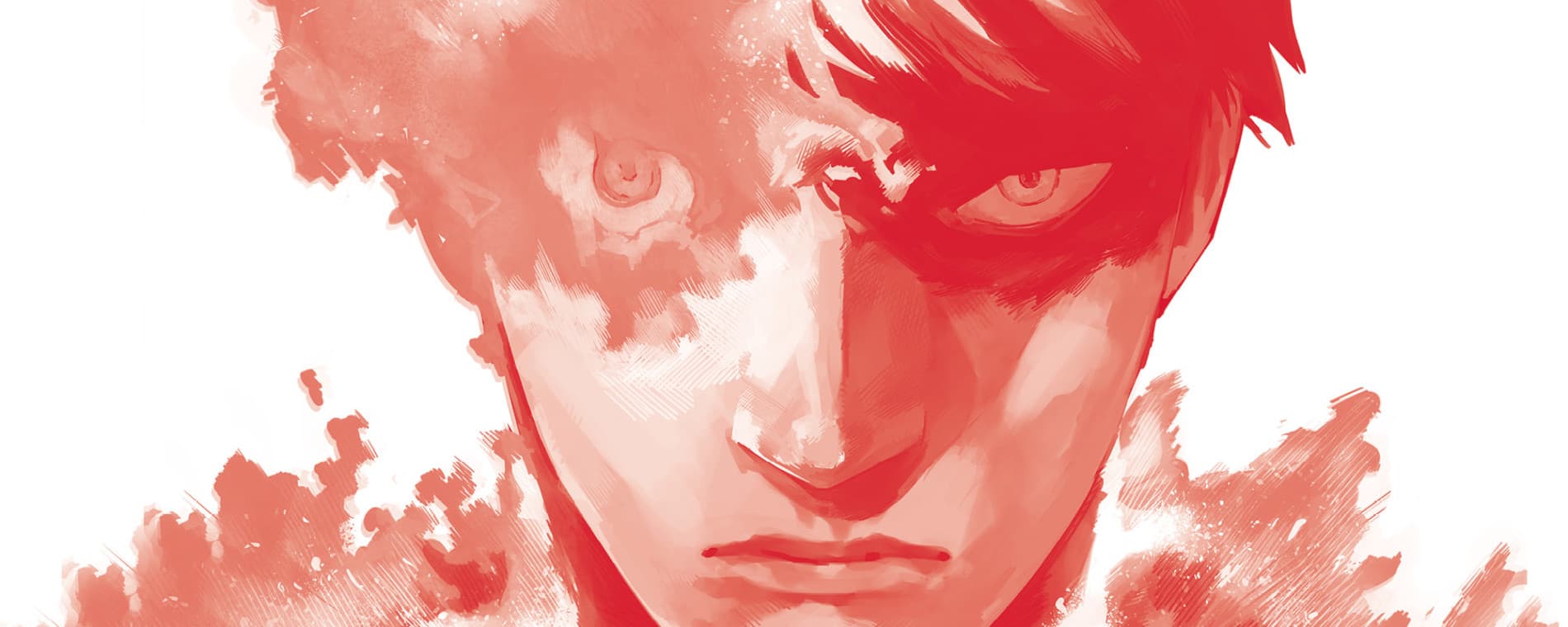
Fire Punch
a review by Douzeries
a review by Douzeries
Ever heard of Blaise Pascal? He’s a french philosopher who wrote a pretty interesting thesis. Sure, it was originally meant to promote christianity but let’s ignore that detail right now.
--------------------------------------------------------------------
According to him, every single activity we carry out is meant to distract our minds from what’s really troubling us : death.
This includes playing video games, reading manga, watching movies, going out with friends, working out, listening to music, pretty much anything. As it is quite the radical way to categorize things I don’t think everyone will adhere to the idea. Still, I think we can generally agree to some extent with what he was saying.
We hate boredom.
In a study, participants were left in a room for 15 minutes. Their belongings, such as phones and pens were taken away. There was nothing else in the room other than a button. They were informed the button would shock them, would they press it. They were also informed that they would get money by not pushing the button and…most of them pushed it. They’d rather shock themselves rather than just sitting there doing nothing for 15 minutes.
I won’t insult you by explaining the dopamine rewarding system but what all these studies show is that we’re ready to spend hours of our precious lifespan watching shit tok tok we don’t even really enjoy just for our minds to feel entertained.
Now, the logical question is the following : Why do we hate boredom so much?

Pascal says that when our current occupation isn’t diverting enough the attention of our brain is free. The thing is when the attention of our brain is free (=boredom) our thoughts naturally ponder toward negative thoughts.
Imagine being forced to stay in a white room for 24 hours with nothing to do but think.

Naturally, thoughts such as : “What’s the meaning of my life?”, “What should I do before dying?”, “What am I even doing?” and “Is there an afterlife?” will say hi. Unpleasant thoughts that remind us of our finitude. We’re scared of facing ourselves.
Following that logic, it’s not nonsensical to see activities as “distractions”.
It’s a no-brainer that being addicted to short term pleasures is meant to be a distraction from your life but what about more “noble” distractions? Is devoting yourself to a greater goal an act of bravery or a cowardly delusion?
Well if this introduction piqued your interest, you might be even more interested in Fire Punch, a manga consisting of 7 volumes written by the famous Tatsuki Fujimoto.
____
PASCAL X FIRE PUNCH

In a world where the Ice Witch blanketed the world of snow, we follow the story of Agni, a “Blessed”, someone with supernatural abilities. He lives with his little sister, who’s also a Blessed, in a village full of elders. Due to this new Ice Age, it’s impossible to find animals nor to harvest, thus, Agni, with his regenerative powers, cuts his own flesh to feed everyone…yeah. Good reminder that Fujimoto is the writter of the story.
One day, a soldier from a mysterious kingdom finds the village and under a misunderstanding, burns them for cannibalism. The thing is that the soldier is also a Blessed who can basically cast Amaterasu. His flames won’t go away until nothing but ashes remains. If you’ve been reading thoroughly you’ve realized the vicious scenario already.
Agni, a boy blessed with the ability to regenerate, has been cursed by flames that won’t fade away until their target is ashes. His sister, who had weaker powers, dies but Agni survives, burning and regenerating all the time non stop. After 8 years, he manages to breathe again and gain full consciousness. He sets his mind to hunting down the soldier to take revenge. It's the journey of a broken and crazed child in the body of a man that can't really live nor really die.
How does Blaise's thesis (unintended pun) resonate with the story?

Firstly, in Fire Punch, pop culture equals religion. If everything we do truly are distractions then wouldn’t the greatest, most elaborated kind of distraction there is, be pop culture?
Fiction takes us away from our cold reality to bring us to a warmer place where we can fantasize and dream. Many, many people, especially anime fans, use fiction as a heavy escapism tool to attain what they can’t have in real life. That’s why self-insert isekai are so popular, you’re handsome and cool, you have broken powers, you have your own harem etc. People in need for human connections can find their happiness in books or series that make them feel as many emotions as they would have had by associating themselves with people without the danger of being hurt. Anything related to suffering reminds us of our finitude and our arriving deaths. Escapism allows happiness without its counterpart : pain. Escapism allows life without thinking about its counterpart : death. Religion is a way to live your life without thinking about death. That's why it’s a pretty genius move to compare pop culture with religion.
(light spoiler panel from Fire Punch)

Secondly, revenge is a distraction. The first obvious symbolism of Agni’s fire is revenge : Agni's hatred and will for revenge is symbolized by the flames. It hurts him to no end and its damages propagate everywhere around him and it's something he inherited from his aggressor. Now that takes another meaning if we compare the litteral coldness of the world with finitude/suffering/death and agni’s fire/revenge with a distraction. Agni is forced to live but there’s no point in living a life where everyone you ever cared for is dead and you constantly suffer. That’s why it’s necessary for Agni to distract himself from the coldness of the world by the warmth of his revenge/flames even if it burns and kills him. Distractions are a way to avoid thinking about death but it can still lead you to death, look at boxers or the korean guy who played LOL for 23 hours straight and literally died of it. Our distractions are meant to keep us away from thinking about our death but it can also make us die. We can’t escape it. We can’t escape the end.
FUJIMOTO & CINEMA
panels from CSM, Goodbye Eri and Fire Punch showing characters in theaters

To conclude, I think there’s a huge cinema metaphor within all of Fujimoto’s work that is hard to explain but basically : Since we can’t really be certain if what we’re doing is the right thing to do, we’re like actors playing games, pretending to be people, pretending to care about things to divert our eyes from something else. We don’t know who we are, why we live etc but we are the ones giving meanings to things so we’re like movie producers, portraying things in a way or the other, according to what we want to believe or understand about this world or our lives. The point of our lives might be that at the end, when you’re looking at the screen displaying the events of your life through your own interpretation, you can laugh and say : Mhm, that was a good movie!
All of Fujimoto’s works complement each other and understanding one makes you understand the other. And I think Fire Punch is definitely a story that should be given attention.
Despite all of that, I don’t think it’s a manga for everyone. As usual, the way Fujimoto writes horrible events in a careless fashion is very disturbing. His humor and cynicism can make Fire Punch very uncomfortable to read (but well that’s kind of the point). And even ignoring how the story is told, the story itself is traumatizing, like, look at that Berserk looking ahh taglist

and I’m not even showing the spoilers tags.
If you want to read, read it. Last thing I’m gonna say is that while most fiction desperately try to make you forget your own finitude, Fire punch wants to remind you of death. And that’s…something.
41.5 out of 43 users liked this review
