
Content Warning: Discussions of fascism and violence
Tbh for a while now, I had been craving a depressing anime, no happy ending, no emotional closure, just depression. And I think this kind of scratched that itch. JIN-ROH: Wolf Brigade is a chilling story of fascism and dehumanisation under such a system.
So yes the show has a lot of Fascist references, most notably the fact that the franchise its part of is quite literally set in an alternate history timeline where Nazi Germany won WW2 and occupied Japan before denazifying back into liberal democratic Weimar Germany. However, there's way more to this as well.
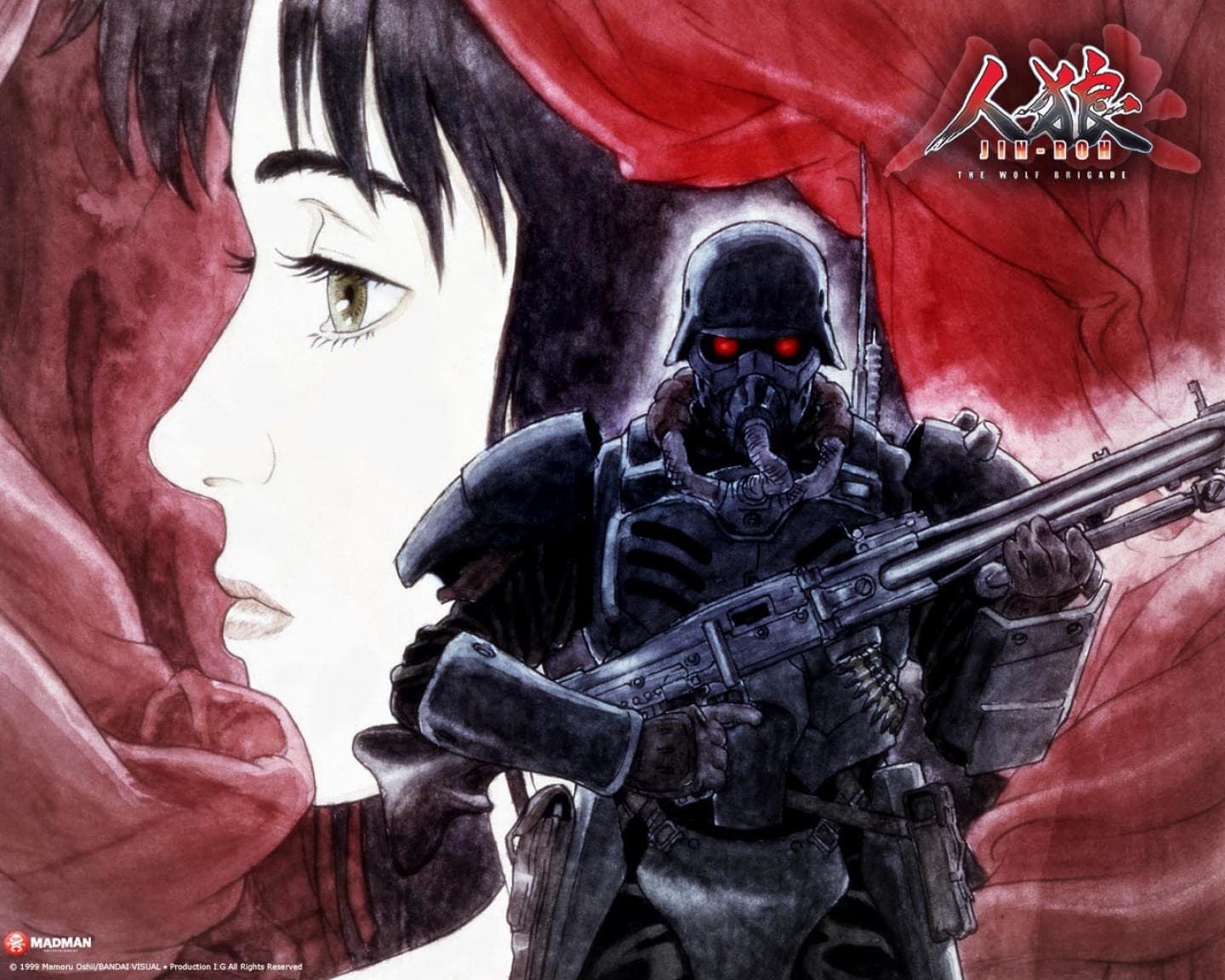
The first 2 minutes quite accurately describe (albeit through narration) the introduction of fascist elements into liberal democracy i.e. as a response and a force of reaction and counterrevolution against the rising revolutionary threat of the working class masses, even if not done with as much of a focus on or from the perspective of said working class as I would have liked. This manifests in the form of the "special unit" of the police, known as the "Capital Police", kind of like the equivalent of the Freikorps in Weimar Germany, being established leading to brutal repression of protests and uprisings. The protesters would subsequently go underground and then unify to form the Sect, a (not stated but I would assume communist) guerilla force, leading to widespread Sect-backed riots pitted against the Capital Police, who are used to exterminate Sect strongpoints and bases. The Capital Police are always heavily armed, sometimes with machine guns, fully uniformed, even wearing a face-covering visor with glowing red eye slots, it is clearly made to look intimidating, and also just as importantly indistinguishable from another. This erases all individuality from a person in uniform, making everyone look exactly the same and this follows the fascist ideas of a strong police state, and as well as adds to the image of uniformity, where every individual gives up their individuality in service of the nation. It goes about this from the perspective of one of its enforcers, a member of the Capital Police, Fuse. Because of this, a lot of framing is done from the Capital Police's perspective. They are the ones “defending law and order" while the Sect are "terrorists". However, this framing of perpetrator and victim will be challenged, changed back and forth a lot throughout this movie.
img100%(https://files.catbox.moe/jfeg25.webp)
This brings me to the most prominent parallel that Jin-Roh makes, and that is with the story of “Little Red Riding Hood''. This is first introduced in a literal sense, just a few minutes into the movie in which there is a girl, known as a Little Red Riding Hood courier, dressed in a red cape and everything, delivering a satchel bomb to a frontline rioter, who throws it at the riot police. It is important to note here that the civilians are the ones attacking the riot police, and not the other way around, in an attempt to present the rioters as at fault too, seemingly engaging in “bothsidesism” or creating a false balance in a society where the power dynamics between oppressor and oppressed are anything but balanced. The Capital Police then wipe out the Sect cell, but not before our mc, Kazuki Fuse, meets that same Little Red Riding Hood courier from earlier. He is ordered to shoot her, but hesitates and allows her to detonate a satchel bomb that she’s carrying, killing herself. It is only in the aftermath of this incident, where the parallels really begin.
He ends up meeting Kei, allegedly the older sister of the deceased girl. She gives him a book, titled “Rotkäppchen”, or more commonly known as “Little Red Riding Hood”. Upon reflection and recollection of the event, or even in random unrelated scenes, there are several shots of Fuse against the backdrop of wolves, alluding to the original Little Red Riding Hood, painting Fuse as the villain or the wolf in the story, attempting to ensnare the victim, that is the courier girl.
img49%(https://files.catbox.moe/upxwk6.jpg) img49%(https://files.catbox.moe/2mq03z.jpg)
The story continues down this line of framing. Kei tells the story of Little Red Riding Hood in the background while Fuse conducts a Sect extermination exercise. One night, Fuse has a nightmare, in which Kei is brutally murdered and eaten by a pack of wolves. Images of Fuse gunning down another woman are also depicted side by side, with the nail in the coffin being this shot of Fuse being sitting amongst a pack of wolves. The last subtle thing that the show does to cement this framing, is how towards the end of Kei's narration of the story, Fuse starts to interject and say the wolf's lines for her.

The interesting thing about the Little Red Riding Hood parallel at this point of the movie to me, was how seemingly limiting it is. There is no redemption for the wolf in the fairy tale, there is no nuance or any sympathy evoked for the wolf. The wolf is just the bad guy, cuz yes. To condemn Fuse to the role of the wolf, would create this unchanging "villain-victim" dynamic between him and the couriers, which tbh would not be that bad even if simple. Nevertheless, I was curious how the movie would go down handling this parallel.
I could not have been more surprised to find out the next twist. Fuse receives a distress call from Kei, seeking his help to rescue her from a kidnap. However, it turns out that Kei is not actually the earlier girl's older sister, but rather another courier. She was captured by Public Security, the intelligence branch of the police, seeking to maintain public order through Counter-intelligence instead of violence. They intended to use her (a courier and Fuse's supposed enemy) relationship with Fuse as a means to defame the Capital Police, in a sort of interservice rivalry. She is thus kidnapped and used as bait to lure Fuse to be captured. This is where the parallel turns on itself head on. The situation has now reversed, the turns have tabled, now it is Kei's turn to be the one to ensnare Fuse to his doom. The movie's imagery thus shifts accordingly, this time painting Kei against the backdrop of wolves.
img100%(https://files.catbox.moe/znjtpm.jpg)
The switch up in framing, in my view, puts on display the little remaining humanity that Fuse still seemed to possess at that point, such that he could care enough for Kei to still move and rescue her. This thus helps expand the justification for the switch up in framing. Not only is Kei the one luring Fuse into a trap justifying her framing as the wolf in this case, but Fuse seemingly out of a blind love or care, goes and saves her without question, reflecting the humanity in Red Riding Hood. At this point of the movie, it had seemed that Fuse was acting completely on his own, independent of any orders from the capital police, and thus moving to save someone who was supposed to be his enemy, for no good reason other than out of care for her.
Fuse thus proceeds to rescue Kei, defeating a lot of Public Security soldiers in the process, and this is where the last major twist occurs. While escaping from Kei’s captors from Public Security, it is finally revealed that Fuse is part of a counter-intelligence unit within the Capital Police, known as the “Wolf Brigade”, who knew about the plot to defame the Capital Police. They have now exposed this plot of Public Security, and now they have an excuse to wipe them out and consolidate their power. They subsequently provide Fuse with full Capital Police body armour and a machine gun, who promptly proceeds to mercilessly gun down everyone, including the leadership of Public Security. Fuse had known about everything all along, the identity of Kei, the plot by Public Security, everything. All of those earlier impressions that I got about Fuse still having some form of humanity, were completely swept away. His actions were not out of his own free will, but merely to serve the interests of the organisation that he was in, he was but a cog in the system. There is a remark made by one of the wolf brigadiers in which he described their group as “wolves disguised as men”, and this is perfectly timed, to reflect how Fuse’s apparent care for Kei, was not genuine at all. His humanity was but a farce, very much matching the description.
The final allegory to Little Red Riding Hood comes in the last scene, where due to Kei's circumstances, she has to "disappear" (i.e. die without record), and Fuse is thus told to shoot her. In a final desperate moment, Kei hysterically screams the last lines that Little Red Riding Hood says to the wolf, "Mother, what big teeth you have!" before Fuse quite literally shows his teeth, and pulls the trigger. This once again finally reinforces each of their positions as perpetrator and victim. In this manner, Fuse finally ends up embracing the role of the wolf, the bad guy, the villain, stuck within the unchanging and self-serving system that he’s in, the Capital Police, whereas Kei is immortalised as a victim, who died a tragic death.
img100%(https://files.catbox.moe/kqnv0v.jpg)
Jin-Roh: Wolf Brigade ultimately explores the effects of existing systems on our humanity and conscience, and comes to the conclusion that they mean jackshit in the face of systemic grooming. The organisation that Kazuki Fuse belongs to, the Capital Police, requires him to give up his humanity, in service of “the greater good”, to “uphold law and order”. It accurately captures Fascist narratives very well, and lays bare the horrifying consequences of systemic oppression, and their justifications. I enjoyed this anime thoroughly, for its deeply depressing borderline nihilism, the brilliant visual aesthetics that accompanied it, or maybe just for the fact that it gave me so much to write about. In any case, this was definitely a unique experience, and also my first Mamoru Ooshi work, I look forward to more.