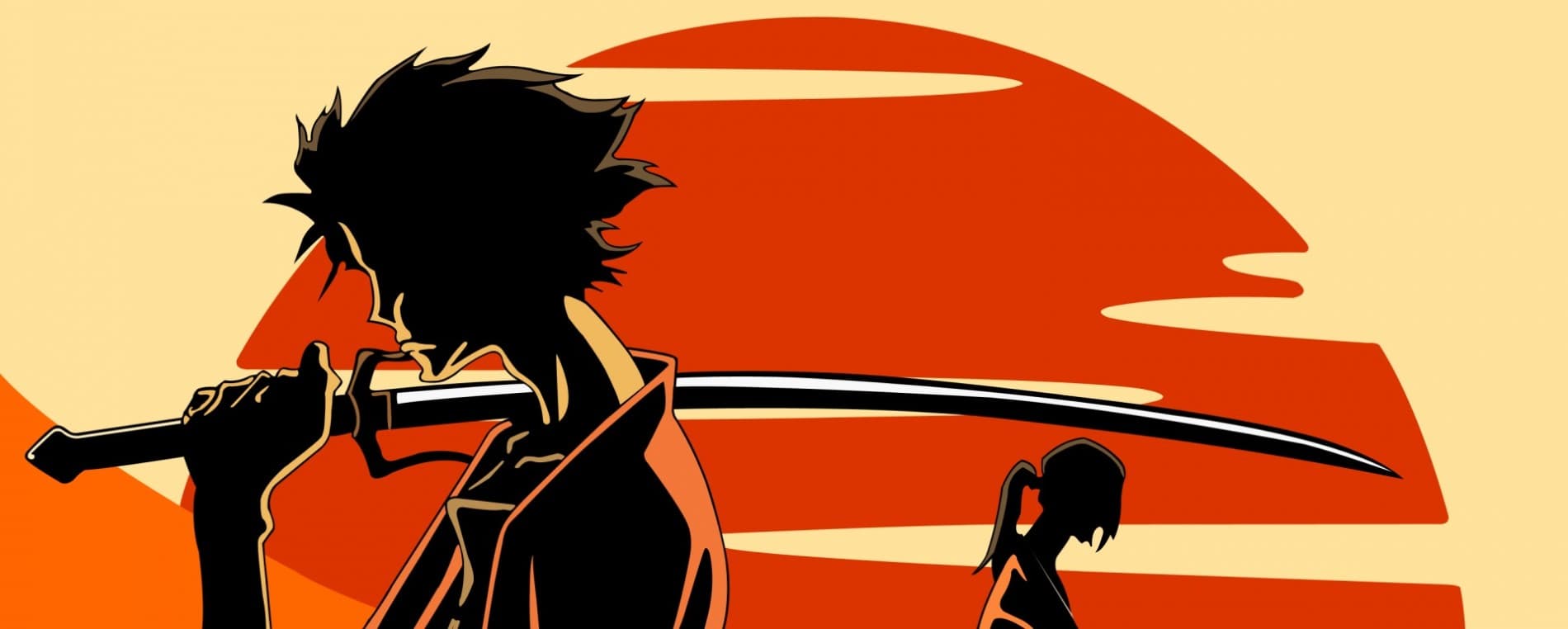
Samurai Champloo
a review by hdtcoa
a review by hdtcoa
__WARNING: FULL SPOILERS FOR _SAMURAI CHAMPLOO___
Mugen was born on an island where only exiled criminals lived, a place so horrible there is no distinction between it and hell, at least in Mugen's mind. The idea of communitarianism plays a large role in his identity. He is a product of his hellish birth environment. A complete lack of training, combined with a very large amount of innate talent, leads to his fighting style - and more importantly his personality. Mugen breakdances his enemies to death, leaps and twirls interwoven with his deadly strikes. This of course reflects his wild personality - unrestrained, feral. Left on that island to fend for himself since young, his survival instincts have been honed to the point that it is the only thing he lives for and lives by. He finds fighting and violence the only things in his life which give him purpose.
Jin may seem like the exact opposite of Mugen, but deep down they are the same - they only find purpose in fighting and violence. His parents died early, and so martial arts was the only thing which raised him. Once again, communitarianism is important to his identity. His whole life was spent training just to get stronger, just to protect himself, a belief further compounded by his master's betrayal. If I can't fight for even my master, then who do I fight for? And so, he becomes cold and clinical, easily finishing off his enemies with quick, efficient strikes.
Fuu, at the end of the day, is really also looking for fighting and violence. Yet, unlike the other two, it is not her only purpose in life, or at least the only purpose she knows she wants. Her final extrinsic goal may be to give her pops one good ol' swing on the noggin, but what she really wants is to confront him, confront him about why he left. Of course, communitarianism again. Unfortunately, Fuu cannot muster the courage to go on this journey. It's dangerous, she tries to justify for herself, but what she's really scared of is finally gaining that genuine purpose in her life. If you have a purpose, you have a responsibility, and responsibility is scary.
These 3 aimless souls come together to find this sunflower samurai, but what they're really finding is their purpose. "The journey is more important than the destination." Their destination, their final goal, may be to find that sunflower dude and for Fuu to beat him to shit, but what will be infinitely more valuable to them is the purpose that their journey will give. But what's the one thing stopping them from gaining this purpose? Their past. And they all confront and overcome their past in brilliant and unique ways.
Mugen's obvious one is in the Misguided Miscreants episodes. There, he comes face to face directly with a relic of his past, Mukuro, the one who tricked him first. He faces him head on, and despite falling into another trap, he ends up victorious. He saves himself through sheer will and determination to survive, but this time not to continue fighting, but to protect his only two friends. His final decision to move on comes in the form of killing Koza's implied lover. She doesn't really love him though, and like she already said, she can't survive alone, so she needs to rely on him to survive. But Mugen rejects this. He now knows, surviving and fighting is not life's only objective. To find your purpose, you need to take responsibility for your own life, and so Mugen gets rid of the crutch preventing Koza from finding her purpose. Mugen decides to begin living for himself, and for his only two friends.
Jin's comes more subtly, over time. He fights multiple former students, and all of them die to him, whether directly or indirectly. But the first step towards his realisation that his life doesn't have to be controlled by senseless violence is in Gamblers and Gallantry (E11). There, he experiences love for probably the first time, and chooses to let her go for the better, helping someone else find purpose. As the series progresses, he slowly starts encountering more reminders of his past, before finally culminating in the last two episodes. There, he faces the Hands of God, the man directly responsible for the events causing him to kill his master. At first, he fights to avenge his master, avenge his death of the past, but he is still bound by the past and so cannot win. But the second time, he realises that it is the present he should be fighting for - his only two friends. Thus, he sacrifices himself, and his finding of his purpose is rewarded with victory and miraculous survival.
Fuu fails to complete her goal, she fails to beat dad up. However, her journey has built up to her realisation at this moment - simply by striving to meet her father, she has overcome her past and gained purpose. Through her journey, she gained her only two friends, yet she has remained dependent on them the whole way. The three of them may have found the same purpose, but after their journey together ends, Fuu has the most work to do. She must become independent, and thus she splits up with them to live her life herself, find her purpose herself.
By the end, the trio have found their own purpose, and begin their lives anew. But this does not mean their journeys are over. Their main purpose in their journey was to protect one another, and now, as they walk away from one another, they must find a new one. For the 3rd time, they split up at a crossroads, a crossroads of life. They each go on their separate ways, to find new purpose, to continue living. Life has no final destination. We can only continue going on our endless journey, in hopes of finding new purpose and finding new friends. Maybe one day they'll meet again, and go on even more crazy adventures, but for now they must contend with their lack of one another and gain a new purpose.
Even though I usually only look at themes for my analyses, I really have to make an exception for Champloo to highlight its brilliance from a technical standpoint. Obviously, the most prominent thing about it is its hip-hop soundtrack. It's groovy and atmospheric, most of the time perfectly blending in with the situation. Most of the soundtrack is very minimalistic, choosing to immerse you in the action instead of overwhelming your senses. So many times I didn't even notice the tracks playing at first, but on rewind I really noticed their impact on the atmosphere. Yet, when it chooses to be more in your face, it hits hard. The best example I can think of is at the end of Misguided Miscreants Part 2 (E14). Mugen, stumbling and staggering from the traitorous explosion, completely obliterates that poor dude, all while a grandiose, percussion-like beat is playing. I've already talked about this moment thematically, but goddamn the choice of music really underscores the importance and pure fucking badassery of this scene. It hits like a truck.
Then there's the art and animation. The character designs of the main trio are brilliant. Mugen's red coat thingy (idk) show his fiery personality (obviously), while the simple shirt, shorts, sling bag and sandals show a taste in clothing for practicality, reflecting his pragmatic and basic instincts. His hair is always messy and unkempt, showing his rowdiness (obviously), and the way he sits and stands is with an invariable lack of manners. Jin's design is the exact opposite of Mugen's, to (obviously) reflect their also opposite personalities. His haori is blue to show his colder and more withdrawn personality (obviously), and the rest of his clothing is very traditional like a regular samurai, showing his greater level of discipline and respect towards Japan. Fuu's clothing is a very simple kimono, but the important thing here is the "heirloom" she carries from her father. A Christian pendant in the form of a skull - representing the life-threatening danger of being a Christian in that era of Japan, as well as foreshadowing for her father's fate -, a pair of dice - representing how fate was a major part of her journey -, and a dog - representing her endless loyalty to and friendship with Mugen and Jin. And of course, the animation is fucking awesome. The action sequences are more quality over quantity. Most are over in a flash, but they are flashes of pure badassery, a wild flurry of swords clashing and men dashing. Backgrounds are drawn very nicely too.
On a whole, the Champloo's is a series that is greater than the sum of its parts, but some episodes are truly noteworthy. Baseball Blues (E23) is when comedy as we know it peaked. Gamblers and Gallantry (E11) is not only a moving tale of love and the mistreatment of women, but also a truly humanising episode for Jin. The Misguided Miscreants episodes (E13 and E14), which I have already mentioned multiple times, is so unbelievably good in its characterisation of Mugen that I have to praise it again. Beatbox Bandits (E9), Lethal Lunacy (E10), and especially Bogus Booty (E15) were probably the most entertaining ones for me. They were exhilarating from start to finish, giving us some real stakes, as well as some of the best action sequences and comedy in the whole series to boot.
Overall, Samurai Champloo is about breaking free from your past and finding your purpose in life by fully embracing your continuous journey in the continuous present. I knew it was gonna be funny, I knew it was gonna be fun, I knew it was gonna be badass, but I did not expect Champloo to have this level of thematic richness. So rare is it that a work of art can be this simultaneously profound and entertaining on such great levels.
26 out of 27 users liked this review
