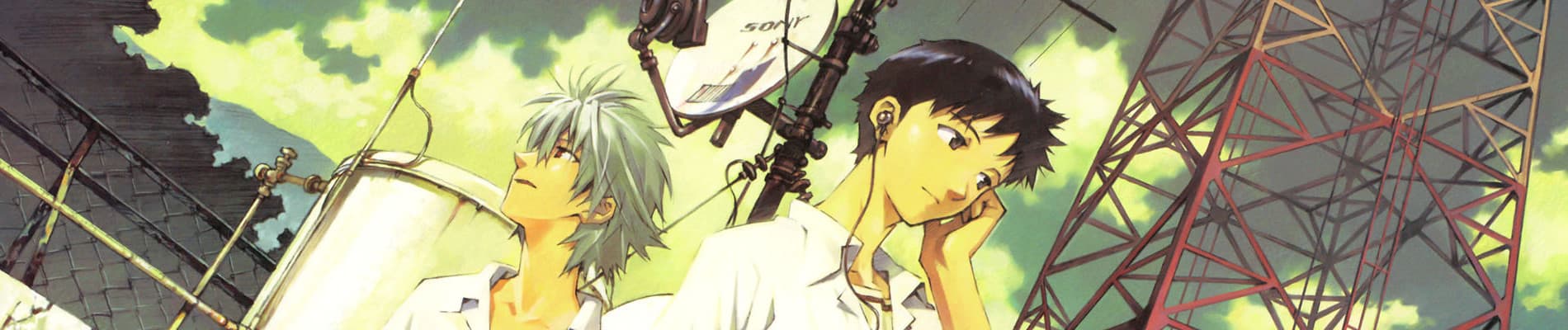
Let me preface this with - if you haven't seen the anime, I can't really say if you'll enjoy it less or not, but you'll certainly be unable to appreciate a lot of what it does with the source material. I'll also be running on the assumption you've actually watched the anime first, because it's hard to talk about this manga at all if you haven't, and you really, really should! So, unmarked spoilers for that abound from this point forward.
The Neon Genesis Evangelion manga is, to oversimplify, a loose adaptation of episodes 1 - 24 as well as End of Evangelion. Most of the context is the same, the series hits many of the same plot points, and for the first few chapters it will feel like an outright retelling of the series, albeit working on an older version of the story. However, you will pretty fast discover that this is not one-to-one with the Evangelion you know. About halfway into the manga's equivalent of the first episode, we get to the part where Shinji refuses to get into the Eva, with the team wheeling out a heavily injured Rei, and a light fixture falls from the roof. However, it doesn't fall above Shinji, with the Eva throwing its hand out to save him - no, it's falling onto poor Rei, and Shinji throws himself to get her out of the way without the second thought!
The manga pretty quickly establishes this Shinji Ikari isn't the same as the one from the anime through changes like these - sure, his confidence is still at an all-time low, and he's still deeply depressed, but this Shinji has significantly more self-agency, he's more openly emotive, he's more ready to act for the people he cares about. Throughout the series, we're presented with a Shinji who's more willing to open his heart to others and let down his ego. It's a nice change of pace after going through the entire series with a clamped up Shinji and opens the series to different emotional plotlines that the anime could never have explored. It's not necessarily better, but it's not worse either - it's different, and it's the manga's biggest strength. You're not experiencing Evangelion in a different format, you're experiencing a different Evangelion.
The story has a lot of fun altering how its characters react and interact with each other. Asuka is a lot less aggressive yet more independent, Misato is a lot more motherly, Shinji's other classmates get different arcs entirely (mostly) by just changing how they percieve others. The biggest beneficiary of this is Rei, who in the anime more or less completes her character arc in Rei II when Shinji encourages her to smile. In the manga, she's given a lot more character and a lot more things to do - she has significantly more dialogue than she does in the show and has ongoing plot threads through to the end of the series that aren't just the fact she's a clone. It's one of the things I'd say the manga does outright better than the anime.
It's hard to talk about this manga without talking about its production. The sole person to work on it, Yoshiyuki Sadamoto, is also the guy responsible for a majority of the main series' designs, from the main characters to the iconic Evangelions themselves; he's probably the guy who understands it the most aside from series creator Hideki Anno. The series was also conceived as a way to promote the show, but due to production issues with the show, released an entire year prior - it then was updated periodically over the next two decades, with the final chapter releasing well after the third Rebuild film. Those two factors, combined, make the fact this deviates very heavily from canon so interesting.
You can tell that once the series finished airing, Sadamoto felt the agency to make more significant changes to the story - all the significant plot changes are found in Volume 4 onwards, such as the manga's equivalent to the episode Asuka Attacks! being completely rewritten so none of the characters are on the ship to meet Asuka and instead meet her later, or how Kaworu is bumped up to main cast - oh yeah, Kaworu goes from being a one-episode character to being there for a FULL THIRD OF THE SERIES. His character (and his relationship with Shinji) is the most radically altered from his anime equivalent, in part to account for him appearing much earlier in the story but also in part to give him more things to do than invading NERV. It's hard to talk about these changes a lot more in-depth without spoiling them, but it's at the very least one of the most interesting changes made to the source material.
That's it for non-spoiler stuff. I do have a few criticisms - trust me, the praise isn't unanimous - but they're so spoiler-heavy and mostly late-game that you might as well just dive in. If you're interested in them, I've tagged it in a spoiler section at the bottom (alongside some other big spoiler thoughts) but trust me, just go in blind. All in all, it's not a particularly long series only clocking in at under 100 chapters, and if you even only somewhat enjoy Evangelion you should really give this one a read. It's in my opinion, incredible, and in some places improves an already pretty amazing anime (and if you're checking this out you probably already agree with that sentiment!).
Slightly more nuanced but spoiler-heavy section:
45 out of 48 users liked this review