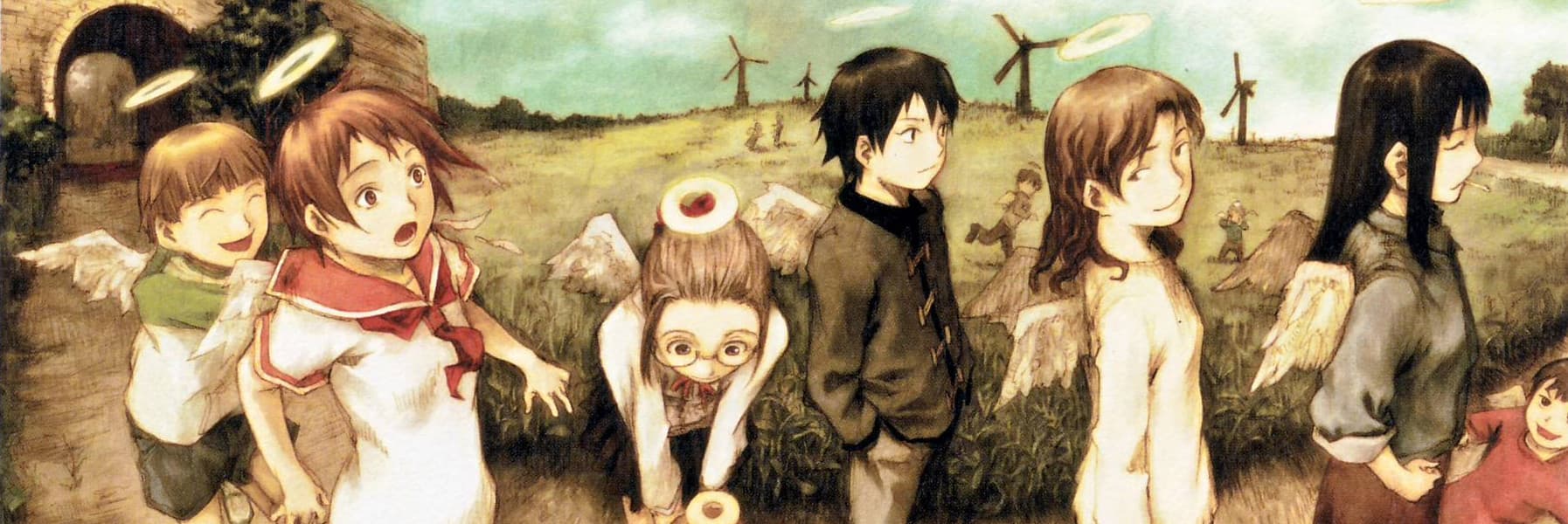
Haibane Renmei
a review by SpiritChaser
a review by SpiritChaser
Haibane Renmei felt like a horrifying story at first because it answered a question I've always had about death. That being, if we keep our memories in the afterlife. The series outright says no for the most part. Alongside the mystery of the Haibane, Rakka appears as someone different from the rest. No matter how much the same people are in the world, there will always be those few who see things differently, and who often make an impact in our history. Rakka became someone who came to question this new life. She sees that the Haibane all came to terms with forgetting who they were in their past lives, that they are fine starting over in this new place, despite that at some point, they will once again disappear for good.
It was wonderful for her at first. You can see the point where, despite Rakka's sadness in forgetting who she was and who she loved, she finally decided to open up, and to try to embrace this new life, after Kuu literally pulls her out of her insecurities and into the open. Slowly but surely, Rakka felt that she could find happiness. She finds a home, gets a sense of belonging, and begins adjusting to her life as a Haibane.
Despite this, sometimes she looks out into the town at night, and wonders if she lived an honest enough life to deserve this. Alongside this, her memories did not completely go away. Still, reality came crashing down when she began to learn more about the Haibane.
In Rakka's case, she witnessed a flight from a distance, and learned about this to the point it shattered her. She figured what is the point of being alive here if she won't remember who she was, and is going to go away again to who knows what other world.
I saw where Rakka was coming from. I would be frightened because I find value in the memories and people I meet. It makes it even worse to know that not even life as a Haibane could feel it mattered if it also leads to a strange place afterwards where this is more mystery as to what really happens next. Where did we come from, and where are we going to go?
Reki is a person who acts differently than how she really feels. Abe wrote her as a way to show the sorrowful ways he used to be before things got better for him. There were many parallels between Rakka and Reki. In the Doujins that Abe originally made before the anime, there are more examples to show for this. Reki reminds me of Kusonagi from the Sky Crawlers, in that they both know the truth about what their destinies are, hide it from the people, and eventually come to a self-destructive ultimatum.
Some of the Haibane, such as Reki, knew what their time of flight meant. Maybe as a way to not worry the others, Reki did not tell them about their time of flight. Not only that, when the Haibane prepare to take their flight, they do not tell anyone about it. This reminds me of the theory that some dogs hide from their owners shortly before death to spare them grief.
Another point about the wings is when Reki explains them. They are not white, or black, but charcoal grey. I think it's a good representation of the overall look and structure of this series. That is because there is a lot of mystery; a lot for all sorts of people to come up with interesting interpretations. Things aren't obvious. Things are not Black or White. There is a mysteries charcoal grey in the middle to a lot in this series.
The tallest walls in Haibane Renmei were not the myterious walls themselves that surrounded them, but the mental walls Reki had to overcome about herself. What is interesting about potential darkening of a Haibane's wings is that it is similar to the mental state of a human. Stress can ruin your body; our organs. Like them, it's about finding our own salvation to return our body to its healthy self.
The bond between Rakka and Reki is clearly a precious one. Sometimes, I person can so convincingly tell you how they think they really feel, but deep down, we feel it has to be a lie because there are too many contradictions. It didn't make sense to Rakka. Their dynamic is one of her trying to understand Reki's innermost feelings
Haibane Renmei was a very personal project for Yoshitoshi Abe. He said the story worked because he picked the right time in his life to write it. It started as a doujin because his creative process was something he felt would not work with the demands of the manga industry. He wanted to tap into his memories and subconscious. As a result, he wrote ideas down on the spot, and developed them from there. He didn't intentionally write this to follow any kind of religion, but he did find the story religious itself. This is because he explored the memories of his troubled passed, and how he came to find clarity.
To me, Haibane Renmei is Abe's Angel's Egg. This is because of their religious similarities. The huge difference is that while Angel's Egg felt more like the manifestation of a man's dying faith turned into a surreal animated film, Haibane Renmei is more optimistic and hopeful as a story about finding salvation.
When it comes to the background art, I appreciate how immersive, expansive, and detailed it is. Such as in Texhnolyze, which Abe also worked on, the background art gives you a really good mental picture of the world of Haibane Renmei. It feels as if you see everything that Rakka sees. Not only that, later on in the series, there was a great deal of effort of showing you the world again as it was covered in snow. This adds to the world building, and how the viewers are given an adequate understanding of the average life of a Haibane. I felt a familiarity to the setting because of the background art, and if I were to be there, I would know where to go, and also where not to go.
I wondered to myself if I'd be fine living in a world like this as a Haibane. There are some aspects of their lives that seem questionable. Humans exist in this world also, though many of them see the Haibane as lucky charms, or objects. This bothered Rakka because they were seeing her as less than human.
Rakka becomes more isolated when she considers her situation. The worker in the café realized that she was eating more at his business. The Haibana realized she wasn't really eating with them anymore. They also noticed that even after a month, Rakka still could not deal with loss in this world. You can see the lack of acceptance and delusion in Rakka.
She still tried talking to the deceased, and continued to clean their room. She was unable to let go. She was so caught up in this she was hearing voices at times.
It is one thing to start over in a new world as a brand new person with no recollection of the past. On the other hand, there is something else that bothered Rakka. She seemed to have kept some form of memories about her former life. Still, there was something about these memories that left hope inside of Rakka. Someone overcame this world to reach out to her. Something seemed to feel as if it had defied the impossible.
One of my favorite characters is the crow. It felt comforting, with a sense of relief, that though Rakka only had vague memories of the people in her former life who loved her, There was a sort of miracle that took place. Rakka wasn't as alone as she thought at first. Even though she couldn't remember clearly, and even though she felt beyond depressed severely, there was someone out there who called for her. Someone out there who remembered her, and pulled her out of her misery. An unknown hero. The viewers don't know who is deserving of praise, but the love of the crow is inspirational.
Haibane Renmei is a bittersweet story, but it warms the heart to see how the characters find resolve, get out of their miserable situations, and come to terms with acceptance so that we can finally move on with our lives. I love the things that the crow stood for. That we should love someone, but to also love them so strongly that it encourages them to do the same for another.
We need to clear the smudges on our feathers. Many of us are carrying Black wings too, in a sense. I have black wings. I'm in a fight against myself, and I don't know if I can win, but I am going to try. I don't have a crow. And not all of us need one.
They say the stronger the water, the stronger the swimmer. The harder the battle, the stronger the warrior.
(There is an AMV video essay version of this on my page from my YouTube channel for anyone interested.
42.5 out of 46 users liked this review
