
Disclaimer: This review contains light spoilers, but they shouldn’t negatively impact your viewing experience
> “Why is it that we can never say the things that are most important?”
Communication is hard. Even if you know what thoughts and feelings you want to relay to others, choosing to do so can be an entirely different matter. Even if you intend to speak your mind, the wrong words may escape your mouth in the spur of the moment. Even if you manage to express what you were trying to say, you never know for sure how your partner interprets your message and how to interpret someone else’s – such is the very nature of communication. It is all a black box.

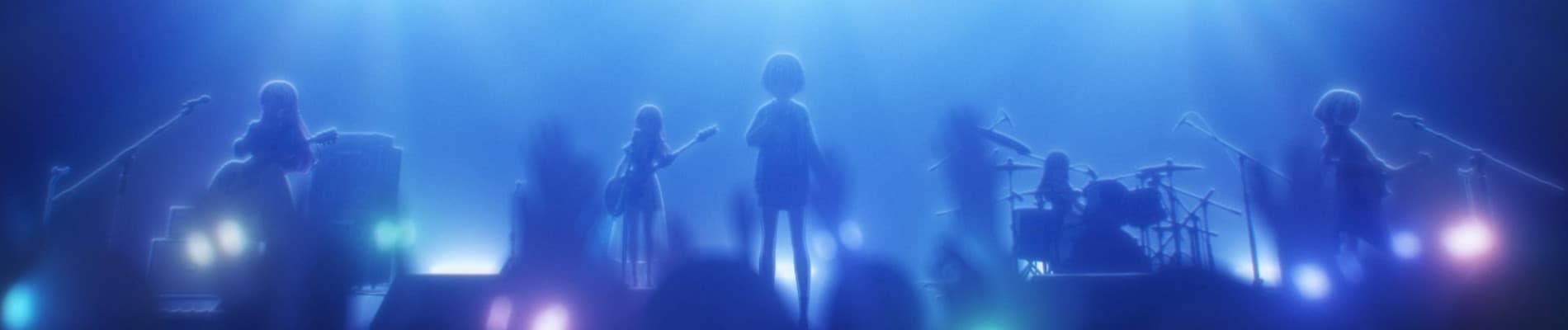
This is especially true for Tomori, a character who undoubtedly exhibits neurodivergent behavior. As such, making sense of other people is often a Herculean task for her, especially because people are often alienated by her quite unusual interests. Although she made a few friends in school, she can never shake the feelings of loneliness, and the dissatisfaction with her own eccentric behavior brings forth a desire to be like the others – “human”. However, there is hope: when she is suddenly approached by a stranger from her school, a talented musician named Sakiko, who appears to embrace Tomori’s hobbies instead of outright rejecting them, she can’t help but join her band CRYCHIC. Random scribbles, screams of Tomori’s heart from the midst of her depression, are turned into melancholic yet beautiful songs thanks to Sakiko’s music with the help of the three other band members – Mutsumi, Soyo, and Taki. Everything seems perfect, and the five of them successfully pull off their first live performance without any major issues. But then, disaster strikes: Sakiko, the girl who founded the band and is arguably the central piece of it all, suddenly announces her retirement. Soyo, CRYCHIC’s bassist, can’t give up on it so easily, but her friends Mutsumi and Taki do. And so, to Tomori’s shock, the band, the only thing that was ever dear to her, shatters in front of her tearless eyes.

This incident, despite laying in the past, not only represents the foundation for the predominant drama in It’s MyGO!!!!!, but also introduces us to the characters with some of their flaws and establishes some important character dynamics. Tomori is eager to express her true feelings, but is unable to do that on her own. The impermanence of what she believed to be permanent became painfully obvious. And after this event, she is once again exactly where she started: disconnected from the people around her, incapable of properly expressing herself and still unable to achieve her goal of becoming “normal”. However, the experience with CRYCHIC also noticeably damaged her psyche, and she’s now blaming herself for the breakup because there were complaints after the concert about her passionate singing. One thought permeates among the former members: the regret of not having properly communicated with each other before things reached this point.
In the present day, a girl named Anon joins Tomori’s class in the middle of her suffocating school year. Despite initially showing little interest in each other, the two of them quickly discover their common interest in bands. Anon has a stark interest in joining a band because it’s all the talk in class, but Tomori has grown too insecure and declines an invitation to form a new one. Only after one of the old CRYCHIC members, Soyo, decides to join Anon in an attempt to get closer to her old bandmates, does she seem to take an interest. But then, something you seldomly see in anime takes place: Anon gets Tomori, Soyo, and Taki, the three members of the former band, to sit down together and talk out everything about the CRYCHIC. This simple idea turns out to be a perfect opportunity for the three to finally put into words what weighs on their mind and clear all the misunderstandings that arose in the midst of the chaos. I find this solution to the difficult relationship between the three particularly interesting because of how straight to the point and down-to-earth it is – the drama is not dragged down for episodes on end. Sitting down together and having a chat can work wonders. As such, proper communication is established as the principle of the new band. But of course, not all wounds can be healed so easily: Tomori, in an attempt to not make history repeat itself, persuades the others to swear that they will stay with her for their whole life, further revealing her insecurities. They decide to at least stay together until the first live performance, a chance which would soon arise. And so, the unnamed band has been founded and the rehearsals begin.

However, it is quickly evident that Anon is not a very experienced guitar player, especially compared to Raana, another guitarist who suddenly joins the band on her own because its other members pique her interest. Controlled purely by the desire to have fun playing music, she is a very unreliable person, but every time she appears on the screen, it is bound to be humorous. This might make one dismiss her as a character who is there entirely for comedy’s sake, but there is more to her character than that. Throughout the series, Raana acts on her own on multiple occasions, sometimes even against the wishes of her bandmates. But every time, her actions ultimately result in a positive change in other people, which makes me believe that she is doing this intentionally to help her friends. She might not be the best at verbal communication, but makes up for it through other means, even if it might not seem like that on the surface – and that arguably makes her the band’s most reliable member.

As Anon starts to practice the guitar to catch up to Raana, she quickly realizes just how hard of a skill it is to learn, and decides to go with the easiest solution: giving up. As we learn, it is not the first time she backed up from a major challenge, and she gets called out for this multiple times. However, using Tomori’s own insecurities as an excuse, she attempts to obstruct the other members, which inevitably leads to a rising tension in the band. Anon has an emotional outburst, but Tomori manages to remind her of her own conviction back when she was persuading Tomori to join the band. Together, they want to find a path even if they’re lost, and move forward, together. This convinces Anon to take her newfound hobby more seriously, and expectedly shows major improvements. It is only a band-aid for the band’s suboptimal interpersonal relationships, but a step into the right direction – take many steps in the right direction, and you end up where you want to be. The idea of the girls being “lost” surfaces multiple times during the series, and turns out to be a fitting descriptor for each one of them in one way or another. This is even acknowledged by the girls, who subsequently decide to name the band “Maigo Bando”, literally “Lost Child Band”, which later gets turned into “It’s MyGO!!!!!”.
If you are familiar with the other entries in the BanG Dream! franchise, you might notice that It’s MyGO! is quite an unusual artifact. Most notably, it often prioritizes its deep-rooted drama over comedic sequences, even if it still is, at its core, a very positive and life-affirming series. Over the years, BanG Dream! has accumulated a large number of bands whose interactions and dynamics shape most of the story, a recipe that has proven itself to work thanks to its absurdly diverse cast built for comedic relief. But that’s also precisely what makes It’s MyGO!!!!! such a fascinating anime: it intentionally breaks away from the franchises’ formula for success, and instead focuses on only a handful of characters. This break is what enabled them to build the dramatic case study that is this particular entry without having to deal with other bands interrupting the flow of the drama. Regardless of whether this works for you, I believe that it is a fascinating and commendable decision.

It’s MyGO!!!!!’s focus on the drama and the disconnect from the rest of the franchise enables it to dive deep into the five main characters’ personalities and issues. It particularly stands out thanks to its intricate and diverse cast, as well as its positive representation of neurodiversity that enriches the bands. All the while, it still offers numerous comedic elements that make it identifiable as a part of the bigger BanG Dream franchise. The question of how to best communicate your feelings is raised multiple times, and music as a potential solution is simply beautiful.
Maybe Tomori was the most ‘human’ all along.