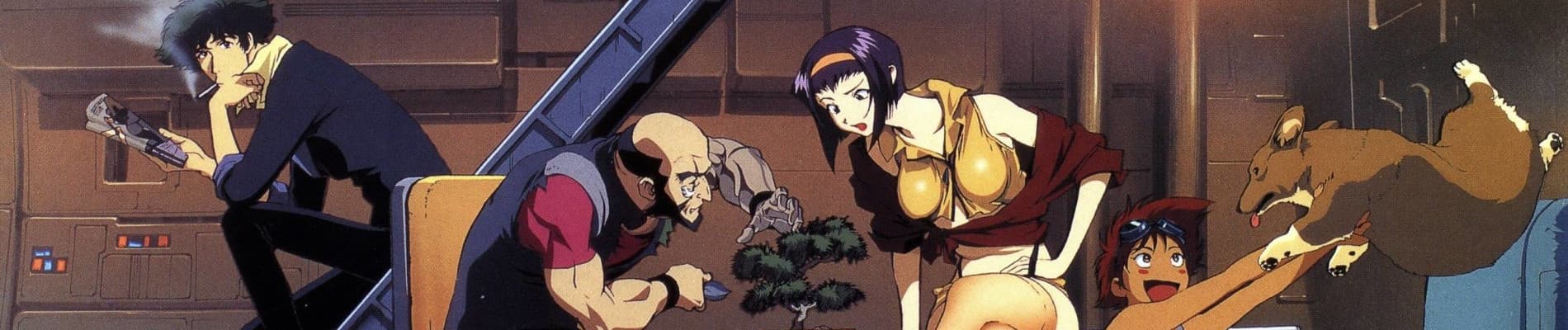
Cowboy Bebop
a review by DemianCrow
a review by DemianCrow
Shinichirō Watanabe consistently creates compact, engaging narratives that remain thoughtful and didactic to a greater extent than those told in shows ten times the length of his; he is a genius at episodic storytelling. This is a fact that he may not have known at the stage of his career when Cowboy Bebop was created, and as such, he faced a dilemma. That somewhat common dilemma being that one could make effectively flawless episodic TV, and yet it would lack the critical recognition and support any subpar show would receive as long as it followed a necessarily linear account. In order to become fans, most viewers require an obvious start and a grandiose ending; the character development must be signposted with a reference at the start and another at the end so as to be grasped more easily, as well as pointed to when uncreative people attempt to explain why your show is good.

The substance gap trap occurs when the director makes the wrong choice and gives into the pressure, or perceived obligation, to spend time on an overarching narrative. By the last couple of episodes, Cowboy Bebop had proven itself and expressed all there was for it to express. However, there is a certain expectation for that to not be the case, and so Watanabe plays along.
Every single "plot-driven" episode in the series is a slump. This includes ones that are interspersed throughout the show prior to its ending. When the simple but usually clever in expression character of Spike switches to story mode, it's a toss up between a completely unremarkable line of dialogue or one that is definitive verbal garbage about dreams and death. Vicious is even worse, dishing out the corniest tactless dialogue with the consistency of entropy in a closed system. Somehow, he is not even cool - seemingly an impossibility in a show as badass as Cowboy Bebop. The "morals" expressed by Spike's storyline are either incoherent or unimportant. This is a shame and also impressive, because the vast majority of the show is wonderfully direct, and the last thing I'd describe it as is trite or uninspired. Even the more minor "plot-focused" episodes, such as those regarding Jet and Faye, are excellent; yet the one focal narrative bottles it.
 /cdn.vox-cdn.com/uploads/chorus_asset/file/22943099/c756a7d5841d523843e07568959f2f7a.jpg)
I don't actually want to come off as overly negative because this is the show that made me fall in love with the artform, and it is still mostly spectacular. My fear, however, is that anything positive I could say has been said many times over. Cowboy Bebop masters a range of visual genres, ranging from western and sci-fi to psychedelia, making its stories infallibly universal. It blends several musical genres seamlessly to paint a picture of both American and Japanese localities and a space as wide as the universe; it sounds like melancholy and scarcity, as well as companionship and adventure. The character design is striking, and the voice acting is even more so. Stylistically, there are very few shows that can match Cowboy Bebop. It creates a definitive aesthetic, is thoroughly fun to watch, and delivers a range of memorable lines and sequences ranging from action to heart-to-heart dialogue. But I do mean it when I claim it truly had nothing of substance to say in the plot department - and it didn't have to either! Luckily, this is something Watanabe deals with a lot more aptly later in his career. At this point in his career, though, his talents are regrettably capped at a chiefly stylistic level - even if the show and its fans want to pretend they are not.
35 out of 54 users liked this review
