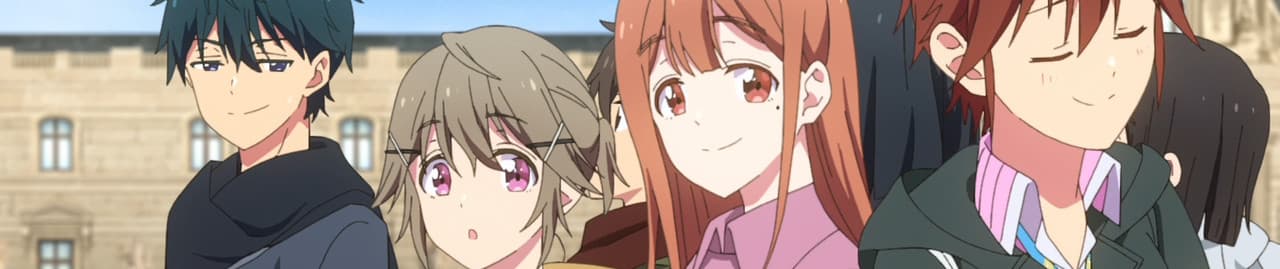
One day, around one year ago, Youtube recommended me the first epiosde of season 1 on Crunchyroll's official account. On a whim I decided to take a look and much to my chagrin, was immediately hooked. At first I approached Masamune-kun's Revenge in an ironic manner. I couldn't quite believe I was actually intrigued by a premise so obviously geared towards wish-fulfillment and pseudo-harems (Makabe Masamune after having been cruelly rejected by his only childhood-friend and crush Adagaki Aki obsessively trained to better himself, win her heart years later and cruelly reject her this time around). In any case, I binge-watched the entire season and was hungry for more. Thankfully the manga was already finished by then and I could experience the story in its entirety through that medium. As such I did not watch this season blindly. None of the turns and plottwists surprised me anymore and therefore I was able to focus on different aspects of the show.
One such aspect was the animation and artistic quality. I'm far from a sakuga expert but there are various scenes during which the model-fidelity left a bit to be desired. These moments make it hard to preserve one's immersion in the world of the story. In terms of animation the show sits comfortably at a level you'd expect from this genre. Some still-frames are shown for a couple seconds more than one would like but the subject material obviously doesn't necessitate huge animation budgets as most scenes don't exhibit large amounts of motion.
Another aspect this season was lacking in was in the opening. Now, both season 1 and 2 don't feature the greatest openings of all time. Visually as well as musically. However while the visual aspect of the opening was very comparable to its 1st season counterpart I really didn't like the song accompanying it. I'm not familiar with Ayaka Ohashi's work but the song "Please, please!", especially during its opening part (it does get better), was an active negative. Visually, the opening is mostly made up of character shots to quickly introduce the cast. This is obviously nothing new, however the repeated use of character shots in animations that hardly beat still poses both inside this opening and the anime-medium at large is quite uncreative and boring.
Now one might think I actively dislike the show, seeing that I haven't had a really positive word for it up until now but I just wanted the negative aspects out of the way before I talk about the highlights which are characterization and themes.
In contrast to its predecessor seasons 2 features more dramatic elements in combination with romance than comedic ones. The comedy is never really gone but it does play a more subtle, subdued and ultimately secondary role. Accordingly, we also get a deeper look into our main characters and their motives. While season 1 explores the paradigm drawn by the original and admittedly whacky premise season 2 quickly leaves this boundary, the increasing stakes and tension not permitting the story to remain in such comedic liminality forever. And as such it reaches a critical mass sooner than one might realize. But the show knows that sometimes stories don't necessarily need to follow the traditional dramatic arch to the letter. However, these story structures exist for a reason and while I think this show breaks them for a good cause the execution suffers slightly towards the end. Both the original manga and in turn this anime series would have greatly benefitted from a couple extra chapters/episodes.
It feels like discussions around liminal spaces have greatly increased in frequency these last couple years. It is such a liminal space, though not visually, that occupies our characters' attention and focus during this season, a past one might not be able to return to. Leaving pop-culture interpretations aside, liminal spaces can be seen as borders between two distinct areas. Season 1 is such a space in the life of our two main characters, a space between a promising past that ultimately ended in tragedy and a future that has yet to be defined. As mentioned before, season 2 does not allow them to linger long in this uncertainty. It pushes them to concretely specify the future they want to walk towards and forces them to come to terms with themselves. How much do past relationships affect us now? How much should we let them affect us? Can we rebuild failed relationships? Are we chasing an ideal long gone or does it still exist? If not, can it exist again? If not, does it matter if our emotions are based on the present? Are they? It is the pain inevitably created by working through these questions that fuels the dramatic machine of this season and is also what makes it far more relatable than the first despite its idiosyncracies. In fact it is not only our two main characters which are drawn into this vortex of past and present, its tendrils reach most of the relevant (and even some not so relevant) side characters. Whether it is Neko's continually unrequited love and its origins or Aki's fanclub that has to come to terms with the reality that she herself might have changed a little.
In contrast to people that watched season 1 when it was airing (2017) I did not have to wait very long for this sequel. Nevertheless, I'm very happy that this show, similarly to its characters, has come to a conclusion. And while life goes on for both us the viewers and the characters (in a sequel manga) this space in time has been filled and will not seem empty and uncertain no matter when we look back on it.
18.5 out of 24 users liked this review