
(Video includes audio. Be sure to unmute)
There’s an old sentiment that gets repeated when it comes to consuming art – everyone is entitled to their own interpretations and opinions. In the pure abstract, this is true, but it’s also true that media sometimes requires us to lean more towards certain takeaways than others. I highly doubt anyone would watch Girls und Panzer and come away with the sense that it was critiquing Soviet Union sociopolitical dogmatism—though I would love to see someone actually try arguing that in earnest—or that serial experiments lain was just everyone tripping balls on LSD and that all that stuff about “the Wired” was just a drug-induced hallucination. Yet every once in a great while, there comes a property that, either in its material as written or its presentation as shown, is a genuine Rorschach inkblot test. How you end up seeing it says more about you than it does about the art itself, or to put this into more contextually-relevant terms, more about you as a viewer than it does about the studio that made it.
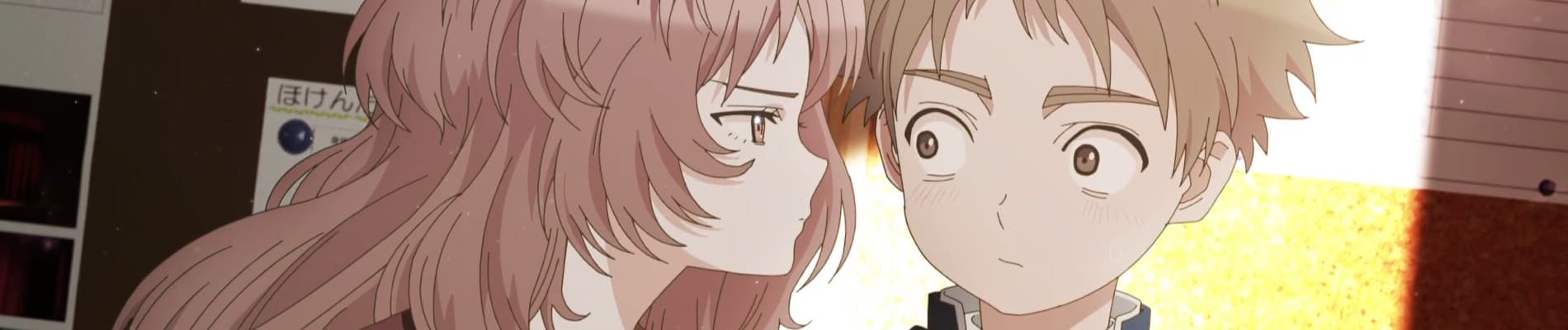
Enter The Girl I Like Forgot Her Glasses, a show whose trailer quickly became the recurring conversation in the leadup to the Summer 2023 anime season. Even before a single episode had aired, everyone seemed to map a feeling onto it. “It looks like garbage,” one would say. “It looks awesome,” another would chime. “It looks like awesome garbage,” shouted a third person. The truth is that all three are correct, because studio GoHands managed to create a show that would be impossible to disappoint, providing an endless stream of frustration for its detractors who saw it as nothing but drudge, comfort food for those who wanted something free and easy with its romantic comedy, and hilarity for those who wanted to see the “most extra” presentation for shockingly mundane material.
(The opening animation already sets up the crazed, chaotic nature of the visual storytelling, with bewildering perspective and aggressive compositing being a fixture of the experience)
And the material certainly is that. Caught within the whirlwind of young infatuation, Komura Kaede is smitten with his next-door seat neighbor Mie Ai. Though not the smartest student or the most athletically gifted, Komura cannot help but find her adorable (and with that many individual strands of anime hair, who could blame him?). One day however, Mie ends up forgetting her glasses, leaving her to rely on Komura for the present situation. From there, the show’s vignettes follow a familiar cycle of Mie forgetting her glasses back at home and Komura being right there to either help her navigate when she can barely see, or try and make heads-or-tails of the myriad situations that cause his emotions to catch on fire. All the while, others are keen to weigh in on the plainly obvious budding relationship unfolding. Azuma, the class’s “cool dude,” makes it plain that he finds Komura’s attraction to Mie amusing, and secretly cheers him on, while Komeya takes every chance possible to ask Komura if he’s kissed Mie yet, and so forth.

(The secondary characters quickly catch on to Komura and Mie’s dynamic, coyly saying or doing things that gently nudge them towards the ultimate endgoal of the material)
Like the innumerable romcoms before it, The Girl I Like Forgot Her Glasses banks on delaying any sense of confession or upfront emotional confrontation between its two characters to pad out the material and indulge in silliness and hijinks. Under normal circumstances, there is nothing here to tilt one’s head, except that because the characters in question are in middle school, it makes a little more sense why they aren’t quite so forthcoming about their own feelings. But the presence of GoHands’s over-the-top form of presentation does change the manner by which the material presents itself tonally. Because everything visually is so absurdly elevated to overcompensated degrees, everything within the written material is given a heightened sense of ridiculousness, even when a situation itself is completely run-of-the-mill.
On the surface, it reads as a kind of [cinemanarrative dissonance]( https://en.everybodywiki.com/Cinemanarrative_dissonance) – the mundane story of the text does not match the insane story of the visuals. In a film textbook, this might be framed as a death sentence; for The Girl I Like Forgot Her Glasses, it is the essential ingredient to fueling most reactions towards it, positive or negative. There is absolutely no reason why Mie’s hair should flap around like it has a life of its own when the window isn’t open, or the sound to go insane when she says something that makes Komura’s heart almost explode, especially when a situation just doesn’t call for it. Perhaps it could be said that the visual styling for The Girl I Like Forgot Her Glasses is to somehow recreate the way in which Komura sees the world. His thoughts concerning Mie almost cause his brain to short-circuit in real-time, and we become privy to his wigging out by gazing into the abyss of weird body proportions, camera angles, and aggressive effects. It is as though his mind constructs reality like the mirrors in a funhouse. That might be amusing for an attempt to find compositional harmony within this series, especially when confounded by questions that seem tailor-made to address something amiss in cinematography.
But buried underneath an endeavor like that is something far more cosmically eye-rolling, the question of “why is this like this” – of all the pieces of media GoHands could have given this treatment to, they gave it to something this plain!? Even Hand Shakers, perhaps GoHands’s most-infamous and well-known property, could offer the excuse of being a battle fantasy. It seems almost like a joke, but one that insists on treating it like a serious artistic decision, all the while you can’t escape the sense that it’s constantly winking at you to let you know that it’s aware it’s trying way too hard, and still occasionally failing outright.
(The original key animations / genga for the infamous sequence from the trailer, animated by Okubo Hiroshi, and how it looks within the finished product. The animation is a triumph not because of how good it is, but because with the storyboarding compositing, it’s a miracle this was ever completed. Note also how, in the completed cut during the final seconds, Komura enters the frame on the right not from the edge of the screen, but just appears instead)
The experience is too surreal to cleanly summarize, frankly. I do not know who decided that The Girl I Like Forgot Her Glasses must look this way, but I find myself not caring to want to know, either. All I do know is that, in the moments where Komura manages to actually score some genuine points (like being willing to lie to Mie’s mom because he doesn’t want Mie to face her disappointment, or skimping out on a day at the arcade with his friends because he’s worried Mie won’t find the post office), I was having a blast watching it all unfold in its preposterously-presented glory. Even though not “every frame’s a (stupefying) painting,” there were plenty, and because of that, I couldn’t help but laugh at jokes I’d never find funny otherwise, or find myself cheering for characters whose actions I’d shake my head at.
Point being, The Girl I Like Forgot Her Glasses is a showcase of GoHands putting in not 100%, but a very particular kind of 100% that offers an endless supply of what-the-fuckery for those who see it that way. When American film critic Pauline Kael wrote in Harper’s Magazine in 1969, “…movies are so rarely great art that, if we cannot appreciate great trash, we have very little reason to be interested in them,” she could only dream of a show like this.
What a beautiful medium anime is, isn’t it?
