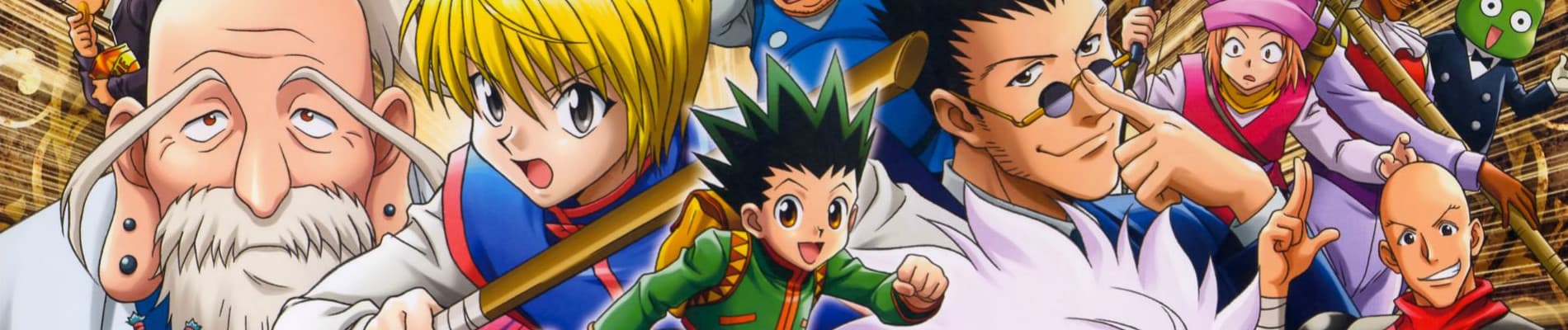
Hunter x Hunter (2011), often abbreviated as HxH, receives less attention on a mainstream level despite its seemingly flawless execution. It has yet to manage to amass a fanbase as substantial as Attack on Titan's. HxH follows the story of Gon, a young boy searching for his absent father, who abandoned him to become a Hunter. Gon decides to pursue the same path not only to reunite with his father but also to understand the allure of this profession that led his father to leave him behind. While the premise of a father-son reunion is straightforward, the unique journey toward this goal sets the series apart.
HxH comprises several well-crafted story arcs, and its standout feature is undoubtedly its exceptional writing. HxH stands out for its intricate storytelling, captivating character development, compelling dialogue, and expansive world-building within the realm of shounen anime. These elements are skillfully interwoven into an absorbing narrative that can easily captivate viewers for extended viewing sessions. What truly distinguishes HxH is the remarkable variety it offers within its story. It successfully explores a range of genres across its six story arcs, including survival, fighting tournaments, crime thrillers, virtual realities, war, and politics. The series seamlessly transitions between different tones, sometimes even shifting mid-arc.
Another notable aspect of HxH is the interconnectedness of its story arcs, with each one naturally flowing from the preceding one, creating a cohesive and continuous journey. Regarding pacing and character development, HxH excels, striking a balance between a lighthearted introduction and gradually evolving into a darker and more complex narrative. It retains the charm of classic shounen while eventually taking a darker turn. Two standout arcs, Yorknew, and the Chimera Ant arc, offer some of the best and darkest storytelling in the shounen genre.
Yorknew presents a dark thriller set in a bustling city, revolving around themes of revenge and bearing similarities to Death Note in terms of suspense and atmosphere. In contrast, the Chimera Ant arc explores the Hunters Association's efforts to control a deadly, man-eating species, delving into themes such as identity, human nature, and survival of the fittest. This arc is the darkest and thematically richest in the series. It compares seinen anime like YuYu Hakusho and shares parallels with Attack on Titan in portraying protagonists facing despair in the face of a vastly superior, hostile species. These arcs bring significant tonal shifts, evident in changes in color palette, music, atmosphere, and the level of violence portrayed.
What distinguishes the series from other battle anime is its unconventional and unpredictable nature. It consistently challenges shounen tropes and narrative conventions. For instance, the main character, Gon, often experiences failure rather than success, and there are no power-ups fueled by emotion or willpower. The series also takes a radically different approach to combat than typical battle anime. Notably, the main protagonist only sometimes takes the central stage in every story arc, and the traditional pattern of losing, training, and winning is subverted. While exercise is involved, it doesn't guarantee victory or elevate the protagonists to the same level of strength as their adversaries. Most of the time, the protagonists find themselves in the underdog position despite their incredible potential, as they are still young and have much to learn.
In terms of storytelling, unexpected twists and developments are a common occurrence. The series skillfully leads viewers in one direction, only to veer off in an entirely different direction, resulting in surprising outcomes. An example of this is how many of the series' arcs conclude in an anti-climactic manner. Numerous scenes and narrative twists defy conventional shounen storytelling or are inherently unpredictable.
Furthermore, its cerebral approach to fights shows the series' uniqueness. These battles are not solely determined by raw power but emphasize actual management, experience, and strategic thinking. If an opponent outmatched a main character in most categories, the likelihood of their defeat is high. Additionally, the main characters are not given particular advantages in combat. This clever strategy is enhanced even more by introducing "Nen," an intricate power system under specific regulations. The idea of Nen, its fundamental principles, the different aura types, and its diverse battlefield uses all showcase the careful consideration put into its development. Understanding Nen often requires viewers to pause episodes and conduct research to grasp its intricacies fully.
The series' appearance and initial presentation create a sense of cognitive dissonance. Its simplistic visual style contradicts the brilliance and unorthodoxy of its storytelling. As viewers delve deeper into Hunter x Hunter, they quickly discover that there is far more to the show than what its cover art and synopsis might suggest. Any preconceptions of the series being immature, straightforward, or generic are progressively shattered as the front reveals its surprising complexity and depth.
Regarding the sound, HxH boasts a collection of outstanding soundtracks that started decently but improved significantly as the series advanced. Apart from a few minor characters, the voice acting in this series is exceptional. It's remarkable for someone unfamiliar with the older series to believe these voices aren't the originals, as they fit the characters exceptionally well. It's especially true for characters like Gon, Killua, and Hisoka, whose voice actors flawlessly capture their personalities.
HxH also excels in its art and animation. It's impressive how a long-running series like HxH consistently delivers high-quality energy from one episode to the next, particularly during intense battles. The series effectively conveys facial expressions, and everything from lighting, shading, and colors adapts seamlessly to the scene's mood or the tone of the story arc. While the vibrant colors of the show may require some adjustment, it generally resonates well with fans of the older series. It's an ideal match for the series, elevating its sense of excitement, cheerful ambiance, and distinct charm as a shounen anime that may appear straightforward yet holds notable complexity.
While HxH's primary strength lies in its storytelling, its characters come very close in excellence. The series features a vast and diverse cast of characters, each with their quirks, dreams, inner struggles, and distinct worldviews. Notably, many of these characters don't conform to generic character archetypes, and any initial impressions of them being generic are gradually shattered as the series unfolds. When it comes to characters, this is where the show truly shines. HxH's villains are exceptionally well-crafted, with individual characterizations that leave a strong impression. What sets them apart is not only their impressive characterizations but also their uniqueness. Each villain stands out from the others within the series and in the broader context of anime. This distinctiveness contributes to the compelling nature of HxH's villains. Furthermore, the series effectively establishes the threat these characters pose to the story and our protagonists, evoking fear and tension in the audience.
However, despite its overall greatness, HxH has its challenges. The series has a weak beginning, taking three episodes to pick up the pace. It only starts to become mildly intriguing in the third episode, after which it continually improves. Additionally, HxH occasionally suffers from misuse of its background music, featuring odd sound choices for certain scenes. At times, these choices feel mismatched or entirely out of place.
Furthermore, some minor issues arise during the Chimera Ant arc, with the series creator, Togashi, and the studio, Madhouse, sharing the blame. Togashi's writing during the middle of the Chimera Ant arc falls short compared to the rest of the series. HxH has established a reputation for maintaining a consistently high standard throughout its run, making it an engaging and binge-worthy series. However, within this 9-episode stretch, a handful of good episodes are surrounded by mediocrity, disrupting the overall excellence of an otherwise exceptional story arc. Ultimately, the enjoyment of this arc depends on one's tolerance for the narration.
On a positive note, most viewers who persevere through the narration enjoy the invasion. Nevertheless, HxH is only sometimes appealing. While its fight scenes are well-executed, they are comparatively shorter and less frequent than those in other battle anime. Moreover, emphasizing strategic battle elements may not resonate with those who prefer more straightforward brawls. HxH relies heavily on its narrative to engage its audience. While the fights aim to entertain and provoke thought, they do not drag on excessively at the expense of the story, ensuring that viewers are not left feeling underwhelmed.
In essence, Hunter x Hunter distinguishes itself as an intelligent battle anime featuring a compelling story, exceptional characters, and fights that require strategic thinking. Setting it apart from most of its genre, the series subverts typical shounen tropes and presents unpredictable plot developments that render it truly unique.
35 out of 49 users liked this review