Blue Giant
a review by Epsev
a review by Epsev
Blue Giant is one of the few works of jazz media actually about jazz. If you're a jazz musician, then this movie will strike all of the right chords for you. Otherwise, it might fall a little flat if you can't relate to the musicians' struggle, or if you just aren't into the music.
Other contemporary films like La La Land and Whiplash also appear to be about jazz; however, it's clear that they're movies that just use jazz to create a setting. In contrast, Blue Giant is only about jazz, even to its detriment.
Blue Giant doesn't give much in the way of a grandiose plot, or deep characters. The movie is about a trio of young musicians trying to climb their way up into jazz stardom. Dai Miyamoto wants to be the greatest saxophonist ever. Shunji Tamada is driven by the desire to improve through his hard work. Yukinori Sawabe wants to make it in the jazz industry and land a gig at the movie's fictional version Blue Note Tokyo.
There's barely any backstory given to Miyamoto and Tamada, and Sawabe's isn't significant enough to make a difference to his overall characterization or the movie's plot. For the purpose of a movie, this actually works out just fine.
These three goals drive the entirety of the movie's plot, and there's no time given for any detours. Typically, this focus would lead to a movie without breadth, but made up with depth. In the case of Blue Giant, there actually isn't much depth to be found. Sawabe's ego gets in the way of his progress; however, even this doesn't lead to more than a minor road bump. The lack of depth to the characters and plot definitely can be seen as a sour spot, but leaving the bulk of the focus on the jazz performances more than makes up. The biggest issue offender is actually Miyamoto, who comes across as very flat for a main character. He doesn't have any deep issues, nor does he undergo a huge conflict. Instead, he's mostly a vehicle for the performance scenes.
It's refreshing to see a film that takes jazz seriously, without bringing up its internal conflicts (fusion, hip-hop jazz, etc.) or its external conflict with pop music. The obligatory "jazz is dying" point is mentioned; however, it doesn't really end up being a huge part of the plot. Blue Giant really is just about jazz musicians making great music.
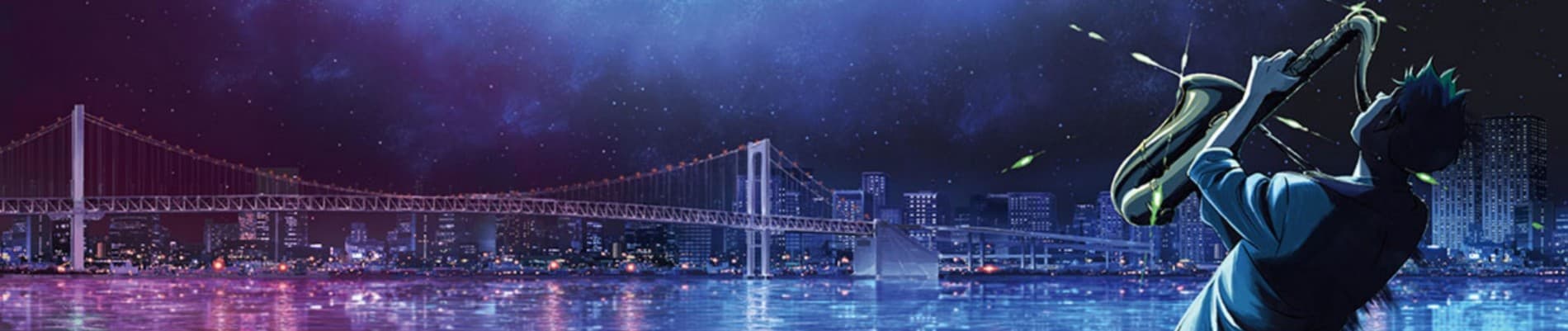
The performance scenes are really where this movie shines. It's immediately evident that Yuzuru Tachikawa, director of Mob Psycho 100, is at the head of this movie. The ~~fight~~ performance scenes start grounded, but very quickly become colorful, vibrant, and abstract. Miyamoto's view of jazz as creative, emotional, and artistic expression clearly comes through in the animation of his playing. At times he appears to undergo a Goku-esque power up, and other times we're taken on a visual journey. Tamada, being far less experienced than his bandmates, is mostly shown without the abstract flair that Miyamoto receives. Instead, the animators took great care to accurately animate the drumming.
At times, the performance scenes fall back on CGI for wide shots. It's jarring the first few times it happens, but the major climax moments of the performances are always well animated.
Hiromi's score for Blue Giant is exactly what one would expect when thinking of modern jazz. The movie doesn't use recognizable jazz standards, and instead relies on all original tunes. Minamoto's playing style is reminiscent of John Coltrane, one of the all time greatest jazz saxophonists; however, he also has a remarkable amount of his own musical identity. The tunes are exciting, flashy, energetic and abstract enough to match the energy of the associated animation. Blue Giant's music isn't nearly as memorable when compared to shows like Sound Euphonium and Bocchi The Rock. This isn't actually problematic though, as the songs give off the same feelings as seeing a live jazz concert. You're not supposed to remember the music because jazz is experiential and every performance is unique. In this sense, Hiromi's score does a wonderful job at complementing the animation and plot of the movie.
It's nice to see a piece of media that actually understands jazz and the musicians behind it. Blue Giant lacks a deep narrative, and instead focuses far more on giving its audience a wonderful visual and musical experience.
Blue Giant put a huge smile on my face, and it brought me back to my high school and college days, when I was a pianist in jazz combos. I thoroughly enjoyed the movie; however, if you don't have an experience to relate to and wanted a more complex story, Blue Giant might just come across as a little lackluster.
I was happy to find out that Blue Giant's manga has 3 sequels that take Miyamoto on a journey across the world. Each of these could reasonably be adapted into movies of their own, making up for his lackluster characterization.
The movie came to American theaters at a contentious time for the jazz community. Laufey, an up-and-coming artist, has been widely recognized as the "savior of jazz" by everyone except the jazz community itself. Jazz festivals are being headlined by non-jazz artists, and even Blue Note has booked artists like Snoop Dogg. Laufey and La La Land are wonderful, but they're not jazz. Blue Giant is jazz.
If you loved Blue Giant and you want to dip your toes into the jazz world, Emmet Cohen's recurring livestreams are a wonderful starting place. Patrick Bartley is one of his regulars, and stylistically shares a lot with Dai Miyamoto. His playing on After You've Gone and Ugetsu is phenomenal. I wouldn't be surprised to see him in the credits for Blue Giant sequels, seeing as he's a huge anime fan and recently moved to Japan.
If you want even more, then consider going out to your local jazz club and giving a listen to whoever's playing in the jam session. You'll see young high school and college aged musicians and learn that jazz isn't dying. It's alive and kicking.
54.5 out of 55 users liked this review
