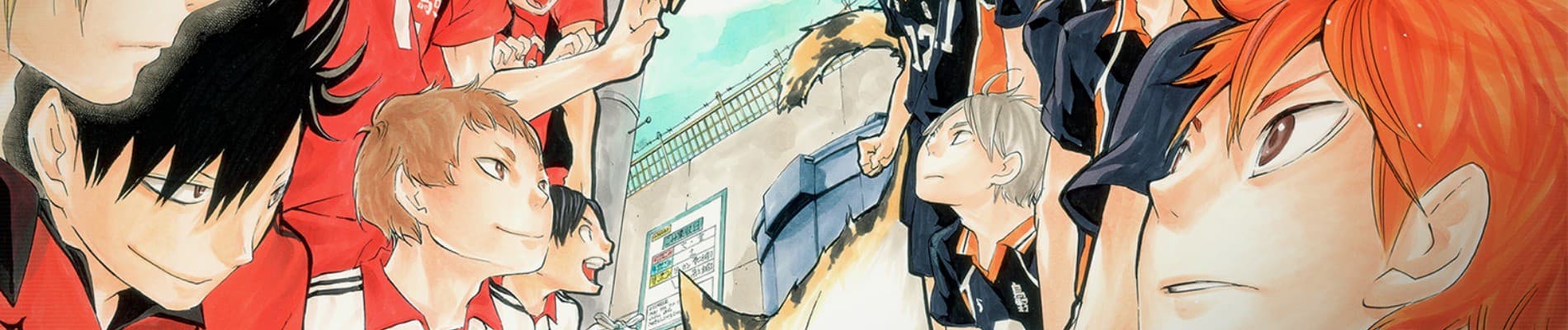
The best thing about Haikyu is that you don't have to be an expert in or even know all that much about volleyball to appreciate what it accomplishes. There is ample discussion of the sport, positions, and strategy, yes; but Haikyu shines brightest in its character writing that slowly weaves strong and impactful relationships, and dynamic art that captures the frantic pace of a volleyball match absolutely perfectly.
Going into a sports series like this, it's easy to make forgone conclusions about what the overall themes and messaging will be, and outside of maybe Blue Lock, you'd probably be right to expect such original sentiments such as "the power of friendship", "working with a team", "having faith in yourself", etc. Things like this are all woven into the stories of many manga because they are universally emotionally resonant and true things to live by. Haikyu doesn't cast these aside by any means, but rather amplifies them and gives them a much more impactful philosophical context to build off of. Over the course of 400 chapters, the groundwork is carefully laid out for every single major character. Their ideology is firmly established and built upon piece by piece in carefully paced bouts that eventually add up to an incredible payoff for each and every character.
Kageyama, Karasuno's star setter, starts as an arrogant jerk who give his aces high, fast, and un-spikeable balls due to his exceedingly high expectations of them. Eventually, he learns to not be a tyrannical "king of the court", instead giving spikers balls that are easy and comfortable, exactly where they want them. However, over time, Kageyama steps back into that role of the king. He pushes his spikers to the limits with balls that are placed exactly where he sees weakness in the defense to give them the best chance to win. But the way this is framed is different; Kageyama has grown since his tyrannical overlord days of far sets, but is still a demanding king. His teammates at Karasuno gave him their trust to do what he wishes with the ball, drawing out the most potential possible from every single set he sends to his wings. Rather than sending spikes that are far and fast because he thinks his spiker should be able to get it, he is sending them out because he knows that his teammates and friends trust him to get them the ball. Nonlinear growth arcs are not a novel thing in manga writing by any means, but I really do think that Haikyu's writing does a masterful job in not just giving every character an "I was weak but now I'm strong/I was mean but now I'm nice" progression, and instead opts to take them on a journey that makes the reader feel like every step was building towards something legitimately life-changing for that character.
To summarize in not nearly as many words, when Kageyama says something like "the cooler my hitters are, the happier I am as a setter" (ch. 399), it doesn't just feel like it's schlocky sporty shonen sentiment; it feels like a line that has been woven into the fabric of his character from the beginning and built upon piece by piece until he became who he was meant to be, and that's what makes Haikyu and its ending in particular feel so incredible to read. Everything that was built from the very first chapter and onwards is wrapped up magnificently in Haikyu's final 30 or so chapters that feel like a complete victory lap for every single character. A culmination of over 400 chapters of sweat, tears, triumph, and joy ends in the best possible way I could have imagined for a manga of this caliber. You don't get to say that often! Fanservice is aplenty with some amazing goodies and character moments that I couldn't possibly spoil because they will put a huge smile on your face should you choose to read them.
The art is magnificent. While sometimes the faces and finer details of characters can look a bit messy or off-putting, the dynamic speed at which the characters move is depicted marvelously by artist and writer Haruichi Furudate. Every spike, set, and receive has this speed to it, but you still feel every tough, clutch bump that hits the players forearms like you were really there on the court. Every time a character winds up to hit a spike over the net, their focus and body control is depicted in a way that conveys their motion and what it takes to spike a ball perfectly. It might not be everybody's cup of tea, especially some of the later art as Furudate continues to evolve his style to be even more fluid, but I think it captures the sport brilliantly.
This review will not and cannot cover all of the thoughts I have on Haikyu, otherwise it would be a billion million words long, but I'll close with saying this: I think Haikyu is a really special manga. I was moved to tears multiple times by things that weren't particularly sad, but so resonant and with so much emotional buildup that it felt like I had reached a meaningful milestone in my own life. That's something I just don't feel often when I read manga or watch anime, and Haikyu had me going through it over and over. As my own personal rule, any time a series moves me to tears like that more than once for good reasons, I have to give it a good score (there are stipulations to this rule but it's a general tenant for myself). This is an excellent manga with amazing characters that will feel like family when it's all over and done with. There are small nitpicks I have with its plot progression here and there, but there's nothing that could convince me to give this manga a score any lower than what it is getting. If you like sports, or if it sounds remotely interesting, this is an absolute must read. By the time you get to finishing it, you'll be wishing for it to never end.
59 out of 61 users liked this review
