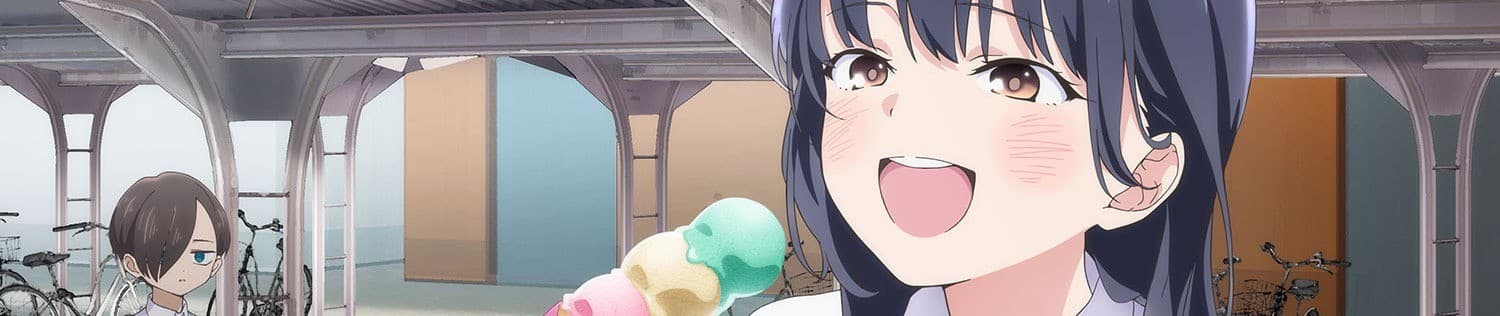
There is an eternal struggle between the way we want the world to see us and the way we see ourselves. "The Dangers in My Heart" seeks to explore that struggle and how it affects our desire to connect with others. It takes place during the waning years of middle school, when everyone becomes aware that the carefree days of childhood are becoming rarer and the idea of adulthood seems more appealing. We start imagining the sort of adult we want to be and start to shape our personalities around that ideal, unaware that we risk resenting any part of ourselves that don't live up to it. Some people find success embodying their new personas but others, usually those who experience some personal setback, decide to retreat into them like suits of armor, using them like convenient excuses for our flaws and insecurities. The Dangers in My Heart posits that this armor only serves to distance us from one another, and it's only until we can find the courage to show what's underneath that we can achieve true connection.
Both Ichikawa Kyoutarou and Anna Yamada are defined by their struggle with their inner perceptions of themselves. Insecure, lonely and full of self loathing, Kyotarou has taken his interest in true crime and crafted his own twisted persona, Imagining himself as a budding serial killer who internally monologues about his beastial urges which he can barely hold back. For Kyoutarou, his hangups are all laid bare as we the audience are constantly in his head. He's convinced himself that the worst possible situation will happen every time and everyone is just one bad move away from complete social alienation and embarrassment. The twist here is that Ichikawa is actually extremely empathetic to other's feelings and will often step in almost instinctively to take the blame if he thinks it'll spare someone else from hurt. But a crucial choice the narrative makes is to disprove him almost every time by showing that things are never quite as bad as they seem and people are a little better than we give them credit for. The romcom genre tends to romanticize the chivalry of their male leads, but here it's clear that while Ichikawa's white knight tendencies are noble, they come from a very unhealthy view of the world and shouldn't be validated.
Anna Yamada is a different story. The story never let us hear Yamada's inner thoughts and instead decides to characterize her almost entirely through action. Ichikawa's crippling insecurity means he can't really be relied on to move this relationship forward, so alot of the story's agency is given to Yamada. We start getting a picture of who Yamada is even if we only see her through Ichikawa's eyes, a confident decision on the story's part. We see that while Yamada may be a little too airheaded and carefree for own good, she's far from a complete ditz. Instead she's someone with very high emotional intelligence who wears her heart on her sleeve but knows that many people see that as someone who's easy to manipulate and as a result deeply values the relationships she's built with people she trusts. Anna doesn't believe in hiding the things she likes, proudly displaying her eating habits and snuggling up to her friends without reservation. But she knows her carefree approach to life can lead to her screwing up and as a result she's terrified of letting down the people she cares about.
To quote Rocky Balboa, “She's got gaps, I've got gaps, together we fill gaps.” To Ichikawa, Yamada's frank go getter energy represents someone he's never allowed himself to be, pushing himself to take chances he wouldn't have otherwise. To Yamada, Ichikawa's habit of stepping up to interact with others despite his crippling shyness is incredibly brave for her as someone with a clear complex around failing and letting others down (one of the best moments in the show is when Yamada refuses to let Ichikawa give her all the credit for his personal growth). Both of them push the other forward, as each episode makes clear that their budding relationship has in some way progressed, even if it was just by a little.
For a story centering so much around the inner lives of its protagonists, where what's left unsaid is as important as what is said, the anime makes great use of its lighting and composition to tell the story even if the animation itself is mostly minimal. The show uses mainly browns and blues to craft a sunset/sunrise esque atmosphere, which feels fitting when so many of the show's big moments feel like they happen in quiet, intimate corners. Big impactful moments are usually highlighted by the sun literally cutting through the shadows and illuminating the protagonists, a not so subtle visual metaphor about how they view the other as a guiding light. And of course, there's the music, which is full of layered tracks that seem to perfectly reflect the character's feelings and emotions, often moving up and down with the flow of conversation and breaking into joyful high notes during big emotional beats.
Like the relationship between Ichikawa and Anna there wasn't a lightning bolt moment that made me instantly fall in love but rather a growing affinity that grew deeper and deeper as I discovered its merits episode by episode. The Dangers in My Heart is a savvy, charming and surprisingly intimate portrayal of not just young love but self acceptance through love.
39.5 out of 41 users liked this review