

As soon as the credits rolled, half the audience stood up and left the venue in confusion. Among the reactions, some said they understood nothing of Miyazaki's vision; some parents were uncomfortable with some of the scenes their children had seen; others said they had almost fallen asleep in the middle of the film. Kimitachi wa dō ikiru ka has the virtue of being a clear counterpoint to Miyazaki's previous productions. Like Kaze tachinu, it feels like a conclusion, but the approach is markedly different, deeply personal and riddled with remorse, something that permeates every frame.
Rejecting the surgically constructed sentimentality that might have been his style, Miyazaki offers a more hermetic narrative. A number of critics have pointed out that the film could easily be divided into two very different parts, the first showing Mahito's inner dilemma before the plot turns into a fairy tale in the second half. It seems to me that such a division completely misses the intertextuality that Miyazaki's team has carefully constructed. From the very first minutes, the film encapsulates Miyazaki's career, building an aesthetic bridge between his early work and Kaze tachinu: the realistic sobriety of the drawings in the introduction contrasts with the cartoonish design of the tanks. These are reminiscent of Miyazaki's old designs found in Zassō nōto and Doromamire no tora. Mahito's initial muteness, petrified by his grief, allows the film to progress through his image.
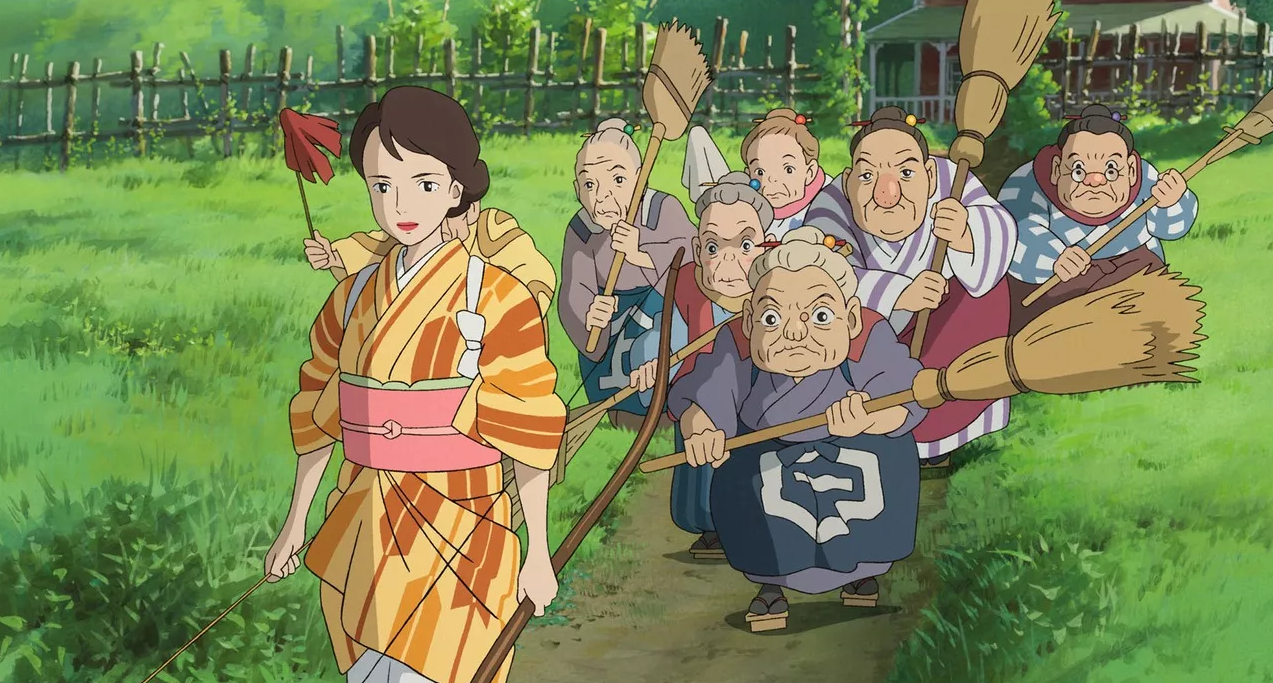
Natsuko's mansion is a fantastic layering of corridors, gardens and living rooms, creating an imaginary geography. Unlike previous productions, where it is easy to picture the world in which the characters exist, Kimitachi wa dō ikiru ka is deliberately confusing. The architecture shifts constantly, from a luxurious main entrance to more intimate passageways, from dusty chambers to Western-style furnished rooms. This eclecticism feeds Mahito's hallucinations, whose fever distorts his vision of reality. His nightmares mingle with the idyllic setting of the mansion: this is where the film reveals its intention. In one dream scene, Mahito goes out to hunt the grey heron, but is soon paralysed as legions of fish and frogs surround his body, threatening to suffocate him. At the last moment, a bow-armed Natsuko, flanked by her army of grandmothers, arrives to scare off the animals and save Mahito, who falls unconscious.
This scene serves both to cement the film's transition to magical realism, which lasts until the end, and to play with the imagery of Mononoke hime: the animals mimic the eerie strangeness of nature, while Natsuko takes on the features of Lady Eboshi. In fact, Kimitachi wa dō ikiru ka is full of references: the buildings have an intricate architecture reminiscent of The Castle of Cagliostro, Lady Himi's world resembles that of Arrietty, while the domestic scenes use the same grammar as those in Howl's Moving Castle. However, there are noticeable differences. The setting is infused with western influences and lighting design reminiscent of 1980s anime production. The tall pines that rise into the sky as Mahito arrives in the world below contrast with the stillness of the sea. On the horizon is a fleet of different boats, modern regattas rubbing shoulders with older vessels. Clouds dominate the sky, great masses of grey and gold, bathed in the light of an invisible sun. This atmosphere, a fallen and mythologised world, is reminiscent of the American romanticism found in the work of Clark Ashton Smith. The great-uncle's antechamber is very reminiscent of Moebius' work, with very geometric lines and layouts: it is no coincidence that the world below is held together by stackable geometric blocks. In a way, Miyazaki and his team are clarifying the spirit that has run through all their films for decades.
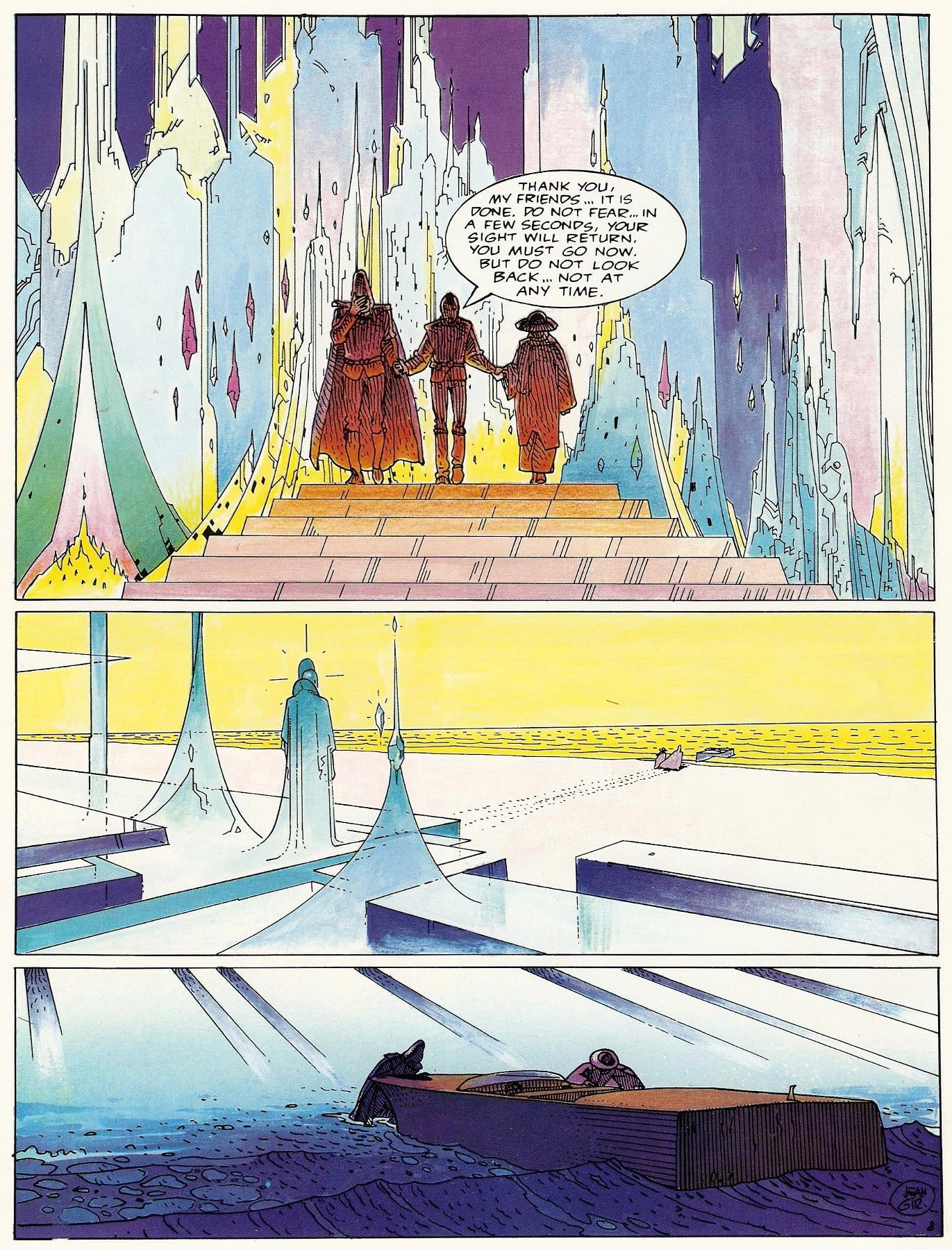
The entire iconography of the magical world of Kimitachi wa dō ikiru ka borrows from Moebius's Celestial Venice, while also drawing on the Moebius-inspired aesthetics of Kaze no tani no Nausicaä and Tenkū no shiro. From this perspective, the film is never divided into two distinct parts: it is a single meditation on an entire cultural production. Kimitachi wa dō ikiru ka is like a long hallucination or an improvised story – for Miyazaki's grandson – using imaginary material as a convenient framework to tell Mahito's story, just as Koperu in the novel of the same name uses his diary to explore his place in the world and how he can live in it. To a degree, Miyazaki takes on the role of both the great-uncle and Mahito, answering to himself and acknowledging his heritage while letting it soar.
Although the plot presented in the first few minutes may lead the viewer to believe that the film will focus on the relationship between Mahito and Natsuko, and the pain he may feel at seeing his father quickly moving closer to his sister-in-law who is taking on maternal responsibilities, this is not the case. Nor is the issue of war and nationalism explicitly addressed. In fact, while Kimitachi wa dō ikiru ka avoids the familiar devices of Japanese dramatic cinema, it does present some elements of an answer, through Mahito's journey into the world below. The relationship between Mahito and Natsuko is initially cold, despite his determination to save her. They meet again when Mahito enters the labour chamber, breaking a prohibition and inviting the kegare into a sacred space. Natsuko's isolation and the many charms decorating the room evoke the traditional cultural habits of satogaeri shussan, imposing a shintō and Buddhist matrix on the film. This scene, which exorcises the mourning of the mother, also serves to reintroduce death and corruption into the film's discourse.

Some time later, Mahito points out that the great-uncle's blocks are not made of wood, but of tombstone, and are therefore surrounded by kegare. This revelation prompts the great-uncle to seek out the pure ones, so that Mahito can continue his work without being haunted by the spectre of corruption. With this interpretive key, we can associate the world below and the wakawaka cycle as using the memories of the dead to perpetuate the living and give the world above a reason to live. More specifically, Miyazaki may be addressing the way in which the heroism of imperial soldiers leads to senseless nationalism and cultural sterility, thus confessing his own tragedy – being the son of an industrial bourgeois and growing up with war as a cultural imaginary. How can he who likes to draw machines of death, and identifies himself with the great-uncle, look Mahito in the eye?
Miyazaki's deconstruction of mythology is also expressed in the portrayal of Lady Himi. Her design is typical of Miyazaki's young heroines, and has been since Clarisse in The Castle of Cagliostro. As much as Miyazaki can be credited with having strong female characters in his stories, her appearance and behaviour reflect a different idea of yamato nadeshiko and may have fuelled the paedophile fantasies of several generations of viewers. Kimitachi wa dō ikiru ka appears as a kind of atonement for this mistake: Lady Himi behaves like the classic heroine of a Miyazaki film, but she cannot join Mahito in the world above. Or rather, she is merely an invention of his mind and must return to her true form – the protagonist's real mother – to die in the flames of the fire, shattering the fantasy of Miyazaki's typical young girl. Instead, the film highlights other female characters whose gender expression may be at odds with the director's habits. Kiriko takes on an androgynous appearance in the world below, while Natsuko's eyes in the delivery room blaze with an anger not expected in a Ghibli film, something that the animation and colour palette help to underline as Miyazaki's touch fades into the other graphic styles. Similarly, the soundtrack is more discreet and understated, less iconic, as if Hisaishi is also disappearing with Miyazaki.

Kimitachi wa dō ikiru ka is perhaps an expression of guilt and frustration at being presented as the progressive voice of Japan, when Miyazaki is only one – necessarily imperfect – expression of it.The film always seems to resist a singular interpretation, forcing an intersection of viewpoints, references and influences. The destruction of the magic stone – which, incidentally, fell to earth during the Meiji Restoration – is a way of shattering the fantasised coherence of Miyazaki's monolithic filmography. In a slightly cruel turn, Miyazaki seems to delight in drawing parallels between the audience and the parakeets that devour the characters without understanding their complexity. The birds consume what is offered to them, perhaps out of necessity, as in the case of the pelicans, but often without thinking, simply following their leaders. They are content to gobble, justifying their actions by the force of circumstances or the transgression of prohibitions. Could this be a foreshadowing of the public's scepticism towards Kimitachi wa dō ikiru ka, which only wants a conventional film that fits in the rest of Miyazaki's repertoire?
It seems to me, then, that the film is a sententious statement about how his films should be received: the interpretation is left to the viewer, who has to draw out for himself what is virtuous and good in the film and its universe. Miyazaki's work is above all a collective dialogue, choral and moving. It is permeated by uncertainty, regret and dreams. For decades, certain characters and scenes have become protective charms and role models. All this is good in moderation. In the twilight of his life, Miyazaki suggests thinking about a future in which he will no longer be there, swept away by life and his own work. This is not a tragedy, but an open door to another world, where other artists create their own universes. It is no coincidence that the film ends abruptly with the mention of a return to Tokyo. Natsuko is dressed in Western clothes, and the credits scroll over a blue background. The future is coming. So, how do you live?