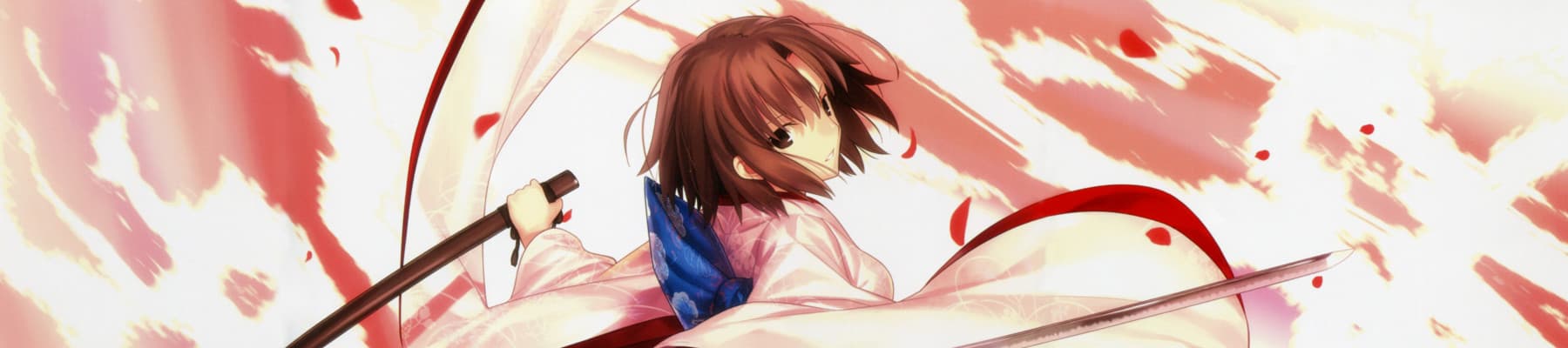
The following review assumes familiarity with the reviewed material. Spoilers below.
To say that the second Kara no Kyoukai film--Murder Speculation Part A--is a bit confusing is an understatement. While the literal events that unfold aren't particularly difficult to parse, the characters enacting them have opaque and blurry motivations, which blunts any possible emotional impact and renders the entire narrative--down to its intended tone, confused and unclear.
Murder Speculation's three main characters are Shiki, a reclusive girl who is the possible heir to her family's fortune and unknown to most is a serial killer, SHIKI, her split personality who is more rebellious and punky, and Kokutou, a shy nerd who falls for Shiki. If these descriptions seem slight, well, we're not really given much insight into their personalities and none of them really grow outside of the fairly short descriptions I've given here. We get some backstory wherein SHIKI tries to explain that he (I am told SHIKI uses male pronouns, and am not about to debate the gender identity of a doubly-fictional person) is in charge of Shiki's "repressed emotions", and in a turn of phrase that I am only very slightly paraphrasing, and is so laughably clunky I desperately want to believe it's the result of a poor translation, says that the "only emotion [Shiki] feels is murder."
Kokutou of course finds out that Shiki is a murderess (fairly early on in fact), but it's here where the film takes a bizarre narrative turn. Rather than going to the police (he is rather close to an individual implied to be the lead investigator in the murder cases), he simply chooses not to believe her. Then, when he actually witnesses her murdering someone, chooses to stake out her house every night in a strange ploy to temper her murderous instincts (recall that the film frames Shiki's impulses as not being her own fault). Unbelievably, this actually works for quite some time, an entire fall and winter, in fact. Then, in the film's only genuine moment of suspense or action, Shiki attacks Kokutou, coming dangerously close to killing him. We're not really given much clue what happens after that. There is a timeskip near the end of the film to a few years later, where Shiki appears to be in a coma, but again the film fails to provide any reason for what occurs within it, and without proper background knowledge of the source material this entire development comes across as confusing.
There is furthermore the issue of Kokutou's character. Whether he's supposed to scan as genuinely kind and endearing (which he very much does not) or as dangerously obsessed with a woman he barely knows to the point of his own detriment (which he sort of does) isn't really clear either. This isn't an inherent problem, and in a better-executed film could be a point of intriguing ambiguity, but it doesn't seem to even be on purpose here, and rather feels more like the film either simply forgot to provide us with some kind of emotional connection to this character, or was simply uninterested in doing so in the first place.
There are certainly positives, mainly aesthetic ones. Animation studio ufotable remain as capable with pen and paintbrush as ever, and their astounding backgrounds bring a haunting sense of eeriness to scenes that desperately need some kind of tonework and emotion. Furthermore, the subtle visual distinction between Shiki and SHIKI, which mostly comes down to body language and some very slight design alterations to make the latter look more androgynous, are a really nice touch, as is her floaty, wraithlike movement in her confrontation with Kokutou. The soundtrack is, of course, excellent, adding another notch to Yuki Kajiura's long belt. Unfortunately none of this can excuse the seriously lacking narrative.
So what we're left with again is a movie that down to its title and its short runtime (a minute short of an hour at 59 minutes), feels like and is indeed largely branded as the second episode of a series rather than a proper film, but the fact remains that while it is obviously a sequel to the first KnK film at least in terms of release order, the fact that its plot takes place earlier in the franchise's chronology and thus neither film provides any real narrative or emotional context for the other makes it fall flat on that axis too. It comes across as hollow. Well-made, certainly, but without any real care as to whether you understand it or not. To be generous, it scans as a "for fans only" affair. There is of course the possibility that later "episodes" will draw on what this one has laid out, but what that essentially means is that this particular film is, on its own, all buildup and no resolution.
72 out of 110 users liked this review
