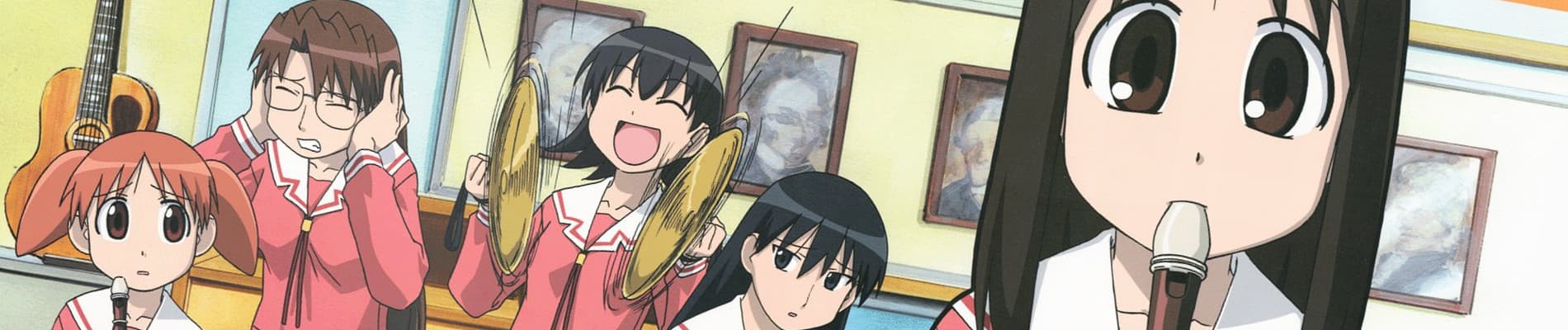
Azumanga Daioh
a review by ballslover89
a review by ballslover89
I enjoy anime. Few things submerge me into a world in such an effective way as an anime with genuine love and thought put behind it. Masterpieces like Perfect Blue, Neon Genesis Evangelion, Breaking Bad, and Fullmetal Alchemist: Brotherhood give the medium the name of quality it deserves. We owe this wondrous medium to the forefather himself: Kiyohiko Azuma, creator of masterful works such as Yotsuba&, the opus I will be discussing today, Azumanga Daioh, and, broadly...
The entire medium of anime.
_________________
The crux of this review will strike at the heart of this work of art; it's soul; it's characters. Each character gives a pondering, attentive viewer a new concept to think about in terms of human morality and the question of fatalism vs humanism; existentialism and nihilism.
The show's simplest characters give the viewer an easy way into the work. This is important, as a strong entry point and some level of accessibility to newcomers is required for master works of this caliber. Chiyo Mihama, a genius 10-year-old girl, lives life on an every day basis. She excels at her highschool-level schoolwork far better than her fellow classmates, hangs out with her friends, and goes home to a very rich, yet seemingly unpresent family. She has nothing to worry about concerning the very base levels of Maslow's Hierarchy of Needs, and uses her time to seek fulfillment in the higher, more humanist levels. She is a kind, yet naive soul, who does good out of her own nature. She is human like you and I and simply chooses to be a being of good nature.
On the same track, the girl just named Sakaki has a similar morality to Chiyo. Though, some may argue her decency exists as a byproduct of inaction. Addressing Maslow's everpresent hierarchy of needs, it seems Sakaki is most concerned with the third level. Though, she doesn't seek this sort of love and connection in her fellow man. She seeks it through the idealistic affection she desires most from animals. Sakaki is more complicated than Chiyo simply through what the allegory her quest for feline affection represents says about human desire: we get close to the flame and we get burnt. However, she doesn't stop. Every time she sees the nefarious cat, whom wishes nothing but harm and ill-will onto her, she tries to forge peace and understanding. Though it never works, she never falters. Sakaki stands for all of the virtues of the ideologies of Stoicism and Existentialism.
Now we venture to the opposite end of the spectrum: simple humans who choose a path of indignity and harm, whether intentional or not.
The lesser example of this sort of destructive and detrimental behavior is Kagura, the newest member of the main cast introduced early on but only implemented later. I don't believe Kagura to be an ill-willed individual. Her wickedness appears in the shape of which it appears in all of us: through a lack of consideration. Through selfish actions like destroying the watermelon that Tomo wanted to break (we will talk about Tomo later) and desecrating Sakaki's simple drawings of cute cats with a more perverse sense of violence and a fascination with the macabre, she presents herself as a good-natured individual with a complete lack of control over the self. Kagura represents the disparity between the Ego and the Id, a Freudian concept. To put it simply, the Id is the base of human desires and the Ego, though a term that has been misascribed to more religious concepts of Pride, is the Id's inhibitor. The Superego is also a part of this dynamic, but it doesn't really apply to the point I'm creating about Kagura's nature.
Kagura is, in essence, somebody who lacks control over her Id. Her base, primal instincts have won a psychological war over her sense of self-evaluation and morality. But she is far from a bad person. After all, somebody truly wicked does exist.
Her name is Yomi, a girl with such a stubborn desire for vindication that she honestly reminds me of the vengeful, horrible men of history, such as figures like Adolf Hitler and Genghis Khan. Her overwhelming Pride disguises itself in clothing cut from the cloth of morality: maturity. Yomi feigns her position as the most mature member of the Azumangans, but this is a farse. Her temper is short and when she happens upon a chance to position herself as dominant or superior, she takes it. Many of her most wicked acts are done for mere amusement rather than as a product of any genuine misconceptions or emotional turmoil. All of these traits unfortunately make sense, as they are all attributes of a sociopath. The willingness to harm for amusement whilst smiling through the gnashing teeth of a facade of charm and maturity is a trait that can be observed historically in wicked men such as Ted Bundy, Charles Manson, and Jim Jones, the orchestrator of the Jonestown Massacre.
Her most depraved act comes in the very beginning of Azumanga Daioh, with her plot to assassinate Osaka (a figure we will discuss later) with a dish far too intense for her frail palate. Even Tomo, a character lacking in what we normal people would consider decency, recognizes Yomi's wrongdoing. An act of evil done in the name of poising oneself as superior is, indeed, horrible, but not unforgivable. That's where the true nature of Yomi's inhumanity rears its abominable head: she shows no remorse. She, like a toddler with no concept of good and selfless behavior, doubles down.
I hope this example of one of her many iniquities has properly demonstrated Yomi's consistent, unflinching immorality, the dark underbelly of the most independent and free concepts of existentialism. When one can carve their own message unto the driftwood cascading down the stream of life, why should they be concerned with doing good by others? In her depravity, she acts as a foil to every other character, especially to Tomo, the closest thing the beast has to a connection with anything besides her own self-image.
Tomo is the exaggeration on the points I discussed concerning Kagura. While Kagura is a decent person who regularly loses to her Id's sweet whispers, Tomo IS the Id. The Ego inhibiting her most irrational actions and the Superego informing her most moral moments do not hold domain over the mind of the irregularity that is Tomo Takino. The most interesting aspect about Tomo is that she is not at all selfish. No, a truly selfish person is like Yomi, a person who sticks themselves to the sides of others in order to parasitically suck the lifeblood from them. Tomo is different. The question of self-benefit does not cross the pathways of her mind.
This irregularity shows itself in a very well known scene; the key scene. In it, Chiyo naively holds out the only key the group has to her gaudy summer home, stating that it would be a catastrophe if they were to lose it. Mysteriously enticed by this idea of danger and pain, Tomo swiftly grabs the key and throws it into the inpenetrable foliage of the surrounding bush. I have deliberated with myself and among peers, back and forth on if this moment could be used as evidence to classify Tomo as evil. I still believe there is no all-encompassing answer to be found relating to this quandry. Good and evil don't apply to Tomo. Tomo is Tomo. She doesn't resemble a human in nature simply by the fact that matters of the self don't hold meaning to her. She could be considered evil by one who considers the effect of a situation to be the only moral issue at hand, but as I am one who owes consideration to the sentiment of a given action, I can't agree with this view. She is not the only character this story with this odd trait of seemingly possessing no ego. However, they are quite different.
Ayumu Kasuga, nicknamed 'Osaka' by her peers due to her city of origin and her thick Osakan accent, is a paragon of good nature. She is spacey, unpunctual, and unconventional in the way she speaks and thinks. This is, however, a trait that heavily endears me to her. For this section of the analysis, I will venture in the realms of my own biases. To me, Osaka is an ideal rather than a person. Osaka understands what few others can with her unconventional wisdom and finds a perplexing joy and wonder in common aspects of every day life. Whether that simple thing is solving riddles, slamming her face into a tray full of baking soda, or picking apart the entertaining factoids and inconsistencies of the Japanese Kanji, Osaka revels in it all.
The ideology I subscribe to is Christian Humanism. This is an ideology that posits that humans can fulfill their own destinies and find happiness in a way that is also not divorced from spiritual things, distinguishing itself from a more common understanding of Humanism as per the thinking of Renaissance men. I believe that joy is not something that is grandiose or hopelessly ideal; joy can be a day out with friends, a good TV show, or plunging into a rabbit hole on a niche subject you've just discovered. In this way, I can relate myself to Osaka.
Osaka is complete, and she is kind. She does not judge, and she will align herself with even the most hopeless castaways on the fringes of society. She does not patronize the young Chiyo for her childish appearance and naive intelligence, she simply accepts her. She does not lose her patience with people like Tomo and Yomi, she simply lives alongside them. Even after Yomi attempts to poison her, she is not angry. When the failed assassination attempt manifests itself into a deadly barrage of hiccups, she does not lash out. Such a capacity for forgiveness and peace, both internal and external, is a standard I strive for. May we all follow the example she sets.
_____________________________
There are many things I simply don't have the time to discuss when it comes to this masterpiece. For example, I didn't discuss the complex moral disparities between Yukari and Nyamo and the themes of growing up and being an adult they bring with them, nor did I discuss Kaori and her Icarus-esque, self-destructive love of Sakaki. I hope to speak on them someday in another fleshed out review. If you have not seen Azumanga Daioh, I suggest you do. And I pray you leave the two-cour experience with your life having been changed for the better, as has mine. Thank you for reading, and goodbye.
39.5 out of 47 users liked this review
