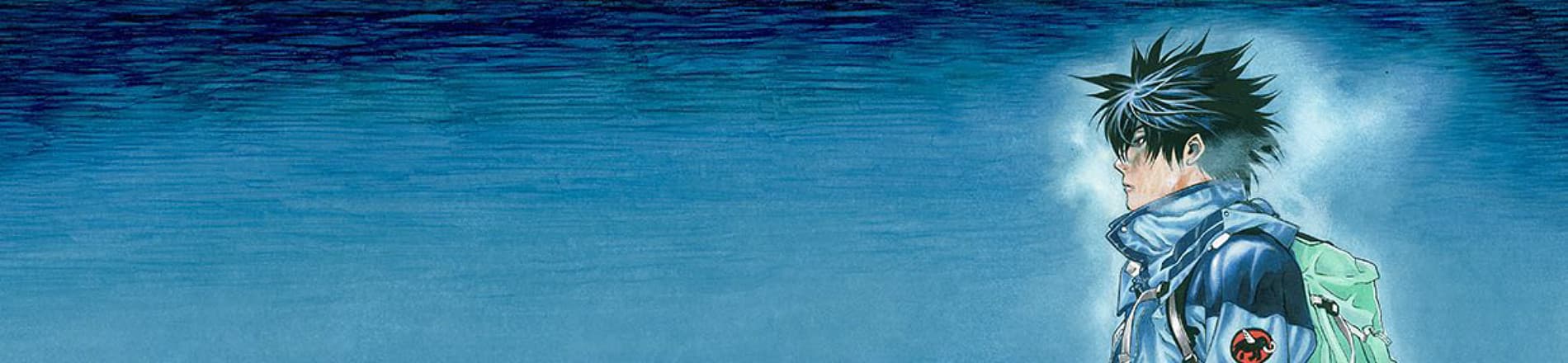
The altitude of 8000 meters above are heights the average man cannot place into a waking picture. Most men are grounded pairs of walking feet, held constant to the Earth by the watchful eye of gravity. We do not feel this sensation of being naturally imprisoned against our wishes; it is the norm to us, a way of life that goes round and round from the North pole to the South. Thus, nobody has an idea of what awaits man above there, on those snowy caps made frigid by frightful snowy winds, unceasing and rebellious. It is an aberration to even have the slightest fancy to meander there with your thoughts– and to put those creeping thoughts into action?
That is where fools are born.
#
I. Mori the Fool
Spoiler, click to viewclick to hide
Mori Buntarou, in his high school years, is a boy placidly content living in his own darkness. Sakamoto made sure that his background or backstory is sufficiently enigmatic to focus more on Mori’s growth as a person engulfed by loneliness to a person who has been enlightened with it. Loneliness, after all, isn’t a one-dimensional status; it is a formless phase that one person must make sense of in his absurd existence, and when we are introduced to Mori for the first time, he isn’t really interested in anything at all. Reserved and quiet, he has all the hallmarks of the typical loner. My first impression of him was someone who usually has a troubled childhood, and add to that, a discordant life with his family.
Such a disconnect isolates a person in this world already filled with lonely people, and an isolated person sees nothing meaningful but the inherent cycle of living forth and dying at last. That’s why I mentioned an absurd existence, one that seeks nothing but forgetting the past and being blind to the future. In the realm of the chaotic present one stands perfectly still, slave to the tumultuous harbinger that is Time. Mori in his first appearance is exactly in that absurd place, unaware and uninterested in the flow of the world– until this moody inertia was disturbed by forceful human interaction. Hajime Miyamoto, the brash brawny climber, interrupts Mori’s peace, and Mori for the first time in his whole life, must have been his first time in a while to respond and assert his own dominion. Like every typical loner, Mori gets defensive, but he gives in to the sweet peer pressure because– what else does he have to lose?
Why do people climb? This is a question people who have never climbed, aka normal people, repeatedly bring up to Mori Buntarou. It’s a common point to bring up, especially when such a sport is reckless abandon of one’s life, to scale heights higher and higher, separated from the security of the ground, and for what exactly? When Mori first scaled those school foundations, he did it out of disregard for anything, because he was already committed to a life of preserving his own peace, and also to dissuade Miyamoto, or other people, from ever interacting with him ever again. However, it bore an outcome he did not expect.
At the precipice of disaster, a man will be driven to recognize something loathsome to him. Just before the final leap, all Mori wanted to be was alone again and freed from the annoyance of human interaction and socialization. But, that final leap beyond the unseen opened up something in his path, it gave him a thrill he never felt before, he screamed out his lungs out of fresh anger and frustration, and he felt his palms ache from the strenuous roughness of climbing the walls. This swelling vigor, this adrenaline-spiked death-drive, echoed by Oonishi-sensei’s observation:
“Did it feel good? Over there you can get closer to the sky”
Over there, a higher summit flashes like a beacon of hope in Mori’s eyes. A life in danger is a million lives lived in the head, and it seems as if a branch whiplashed from that bottomless stream of possibilities and awakened a slumbering demon in Mori’s heart. Life? No, something much more resonant and potent, vindictive and tenacious. The name of that eternal-clinging demon is Obsession, and he will tell us all of Mori Buntarou’s highs and lows. But one thing is for sure– it made Mori Buntarou feel alive, probably for the first time ever in his life.
“And when I saw my devil, I found him serious, thorough, profound, solemn: he was the spirit of gravity—through him all things fall.”
All those who cannot see that the sky is the limit are fools. Fools do not heed the warnings of untimely death or potential disaster, they just march forth like an army of endless ants. That’s what Mori does on his next attempt to ascend. With no regard for his safety, Mori tries and struggles, unable to actually make any progress on reaching the top of the summit. That’s alright, the fool is a jolly being inside. All a fool wants is nothing extraordinary. All a fool needs is a fascination with something eternally out of his reach, and with that he feels an extraordinary joy already. We can see something awaken inside Mori, who goes from this gloominess to a stark realization, that there is something outside of his shell he can pour his whole being upon and mold it to his own liking. But, he is still a fool, and a fool will do everything to have a taste of that obsession again.
And this is what starts to put Mori’s climbing career in such a precipitous situation, because his newfound talent for climbing is swayed by different influences and envied by others. He begins to slowly enter a world of selfish men that want to tear him apart or use him for their own machinations. What Mori only wants is the embrace of the mountains that he sees as his distant god.
Sakamoto begins to put a kind of divine quality to the aspect of the mountains, which I think is integral for us to understand the succeeding evolution of his art style in the future volumes. We will begin to see a universal echo of the man vs nature conflict expound itself more on a visual scale of narration rather than through verbal. Everytime you see a spread of Mori looking at the range of mountains, lulled by the prospects of trekking through them and climbing their lethal heights, you see a man entering a pact of devotion with Nature, to be Her loyal servant through the fire and cold. What shapes and tempers Mori’s devotion and passion for climbing is what filters out eventually all the traces of his foolish debut.
There is one thing that Mori Buntarou can’t figure himself out of, or at that moment, he doesn’t want to face. That is his loneliness
In the manga, the theme of loneliness is its shadow, an omnipresent being, the alpha and omega, the perfect imperfect reflection of the self. Right now at Mori’s novice phase as a climber, he doesn’t have the need to reflect on his loneliness, because he’s lived his life within it. As his shadow, it’s something he knows he can’t shake off so easily, and therefore, is something he must live with for as long as he breathes. It’s a weird thing to sneak in, but Sakamoto does give Mori Buntarou an unpleasant backstory in which flavors Mori’s initial development, but other than that, is left obscure. Though I wished to know more about Mori’s life, I guess the decision to leave the past undiscussed in detail and rather focus primarily on Mori going forward goes with the theme of the manga about descending, and that “descending is much harder than climbing”. As we will see soon, Mori has no choice now other than to move forward. He has clung to the lengthy pursuit of peaks and to that end he will be satiated by nothing other than his love for the mountains. And since he has already fallen in love with the mountains, his purpose seems set for life. But is it really what he wants to be?
There is also a Kierkegaadian mystique to the whole beginning of Mori Buntarou’s story, especially in the first chapter, where he takes his first leap towards the school’s peak. At the very point of ascension is also an equal force of ultimatum. The gateway for everything has closed, and climbing above and beyond is what Mori has chosen with fullest conviction in his heart of hearts, and it is what he will live and die by.
Loneliness and an obsession, these are not necessarily things that lead to a downfall of a person. As we see in Mori, he has an inclination to the natural order of things, and respects the high status of mountains that impose their ancient demarcations of power upon us. He feels a connection to these inert giants, a spirituality that puts his loneliness in a place where it can breathe freely the air of freedom, without needing to wrench it from stranger hands. Thoughts of the cold and frosted air, the oxygen-deprived sensation, the intricate and mechanical preparation of equipment, the intrepid thrill of inching ever closer to death– only fools would be happy to indulge in those!
And yet we look at Mori Buntarou and our eyes are filled with disbelief. He has gone where no eyes have seen and no ears have heard, and lived to tell the tale with every ache and creak of his body. Of course, there is always a price to pay.
Before even considering the scope of 8000 meters that has to be conquered, one must first trek the 7000 meter of ascent before it, and every step upwards is a step towards hasty destruction. All climbers know of this, as do all the fools. Piecing together what their life will be is what gives wisdom to these fools, not the fear of death. One can forget the past and throw away the future– but one can never uproot the existence of the present in him. It will always claw him out from time to time, ravage his internal solitude, and render him naked to the forces of change. A fool can never stay a fool for all his life; he must choose to either be an insane man or a saint.
So, Mori took another leap of faith, and became a saint.
#II. Mori the Saint
Spoiler, click to viewclick to hide
Loneliness and solitude are two vastly different terms. The former is a totality, but the latter is a process of taming that totality. One can stay alone for the rest of his life, but the one who practices solitude does so because there’s a phase beyond his imagination that can only be achieved by himself alone. And to do so, he must concentrate on his will alone. Although Mori has decided to do that, he is still beset by the effort he has to keep up to maintain an acceptable facade of humanity to other people. If he just decides to outright abandon that social part of his, he would not be able to withstand the part where they deride him for being a freak or insult his existence. He’d rather avoid them and focus on his goal, that is:
“To climb the number one mountain in the world”
After the events for volumes 1 to 3, what comes afterwards is now the psychological metamorphosis inside Mori Buntarou’s mind. We will mostly witness these through Sakamoto’s artistic finesse, where he combines environmental storytelling of nature, man, and the modern times, and lets us, the readers, make sense of these fascinating and morbid, almost Lovecraftian, images depicting the deeply bruised connection Mori has with loneliness.
And Mori knows about this, but he is unconscious of how involved he is already with the world. Getting a job to help support his goal, knowing that he has to deal with all the things he hates about work environments, is a great deal of sacrifice, but he is willing to endure it, all for the sake of his dream. While abandoning even the slightest of interaction, in the meantime, he molds his body to prepare for the brunt of the mountains that will come. Truly, Mori Buntarou’s work ethic puts others to shame. Even if he is obsessed, it comes from his purest desire to be lost in the ardor of the climb. Mountains and the everlasting snow– that is where he feels the most alone and undisturbed. There, in the pure whiteness, from the caps to the fields, the neurons in his body can muster all the electrified anticipations and burst them across Mori’s musculature.
In the quietude of the cold, Mori feels purified and washed away of his own insidious nature, a nature which he has shunned for a long time. He blames this nature of his to bring hurt and pain to others wherever he goes.
Thus, we know now one of the reasons why he has this shell distancing himself from others is his self-admonition to prevent others from getting hurt and blaming it on him again. Without knowing fully about his backstory, we can see a side of him that has been pummeled down to the ground repeatedly enough to lose trust in opening to any other living being. Except the mountains. The mountains always listen to the clandestine wishes of the heart, and judge not the man for his morality. In their domain, Mori Buntarou is their corporeal saint, who yearns for nothing but their company.
That means nothing, though, when Mori walks among men. The scent of loneliness can spill into a room like car exhaust, and taint the social mores. To his coworkers, Mori’s attitude and mannerisms are eerie and unnatural, but even with all that indirect protest and peer pressure, Mori persists in his inability to socialize. I say “persist” because he doesn’t want to give in to expending and wasting time and energy to appease faces he doesn’t want to see. He is actively avoiding drawing attention and getting caught up in these webs of attachment.
One of the faces that he really avoids almost reflexively is a woman co-worker of his that awfully reminds him of himself. They are both considered outcasts by society, and they are “connected” by one aspect that Mori eventually has to put into perspective, and that is the inability to decide for himself, wherein he has to base his next move according to the value judgments of other people. Essentially, the whole beginning of his life as a climber started because he gave in to Miyamoto’s nudges, and that little seemingly inconsequential banter turned into Mori’s pivotal development as a person.
Now, he has to come to terms with this weakness of his, and turn it into a strength, before he is engulfed by an avalanche much worse than the spiteful opinion of men. But seeing a facsimile of his lonely existence right before his eyes is something he wasn’t prepared to meet. Every time he sees that woman, he sees himself– he sees a reflection of a form he has no words to say to, perfectly depicted in the manga where he scrambles for word cards to say the right words under the right social mores. And everytime he scrambles away from something that reflects his lonely, despicable nature, he resorts to “bivouacking”, or hiding away from the reality of his identity, sitting crouched up in the corner, staring at nothing but the phantom weight of the darkness obscuring everything in front of him, until all the banter, chatter, bicker of voices become muffled refrains. And he is all alone again.
It’s also noteworthy to dig into the carnal or sexual themes in the manga and how it relates to Mori’s character. His aversion/disclination towards women can be ascertained to a probable traumatic event previously in his life. However, seeing what happens later, I am more inclined to deduce Mori’s behavior as his general attitude towards physicality and affection. These are alien stimuli to him, akin to the unpleasant ennervation of suffocating or pinpricked by a million needles. At this moment, he is not ready to open himself up to the vulnerability of love itself.
The theme of docility and servility serve a double purpose in revealing Mori’s loneliness as a layered psychological complexity. Thus, Sakamoto presents those themes in a double-sided narrative around volumes 5 to 8, switching between the perspective of Mori amongst normal people and Mori among people of similar status to his lonely, self-destructive nature. They are climbers, too, but each one lives in his waking world he projects outwards, resulting in a clash of egos, an undesirable sight especially thousands of meters above the sanity of the urban man. In the wilderness, man’s beastly instinct takes over him, for the freedom to proclaim a sense of power and strength is enticing. But for Mori, he has close to zero interest in domination, something clearly absent from his character. Overall even as he manages to make a decision for himself and not for others, it still comes from a purest assertion of one’s will, not a will to dominate.
There is this part where he somehow hallucinates an incident where four of his climbing partners start to blame Mori for stealing, and then it turns into an altercation where the four of them fight over mutual distrust toward each other, and one by one they fall off the mountains into the pits below. At the top of the mountains where little oxygen enters the brain, it’s easy to see nasty things right in front of you caused by your mind going a bit haywire, but what you see is what is important.
For Mori, what we saw was the apparent state of his internal workings that revealed how utterly disillusioned he was with the fickleness and immorality of human nature, something he wants nothing to do with. Attachments create this gravity around a man, shackling him to the commonplace. A soul who wants to soar beyond Heaven and Earth cannot afford to be sunk beneath the weight of everything commonplace. He must ditch these baggages and be naked as he ascends to the realm of the Gods. Again, to Mori, these are the mountain ranges that tower over all human folly. Whenever he is in the presence of these deities, he is in his most absolute composure and solitude.
“Oh, I have found it, my brethren! Here on the loftiest height bubbleth up for me the well of delight! And there is a life at whose waters none of the rabble drink with me!”
Yet, ever since he joined the company of those four climbers who took on the challenge to traverse the North-Alps ridge, he had a conflict in his heart about being truly lonely, so much that we see him shed tears for the first time. At this point, Mori is introduced to the consequences of his decisions, but the feeling of being rejected? The feeling of being ignored, as if you do not exist? That would be an invisible ache that would trouble you, especially for someone so closed off from the influences and stimuli of the social world like Mori. This is one of the first cracks on his rigid shell, and we shall see more as Mori progresses on his climbing journey.
“When aloft, I find myself always alone. No one speaketh unto me; the frost of solitude maketh me tremble. What do I seek on the height?”
I have talked much about loneliness, but what exactly is solitude when it comes to Mori? When we condense it all down, the moment Mori tries to make sense of this darkness, this loneliness, he was always familiar with, it slips away from him and leaves him in a constant blindness towards knowing the truth. We see this confusion from Mori when he tries to engage in the simplest social gesture, for e.g. in a banter among climber company, or even trying to make a natural smile, he cannot figure out the whys and hows of basic communication. This further complicates things for him when it comes to giving his opinion on what’s best for the team. The first time he gives his input, he is slightly looked down upon and the expected treatment of being the servile dog is what he gets. However, on the second time he does, he is erased and made mute out of his own will.
Establishing his identity through solitude has borne results of unfortunate depths. Mori Buntarou, once asleep in darkness, now ventures out of a rude awakening and into the fore of what being human really is. Is that enough to send him back again into the darkness, and return into nothing all the effort he mustered? No, it is not. Sakamoto Shinichi puts Mori Buntarou in an interesting position to show us how strong Mori really is as a person.
Death is not that strong of a theme yet at this point, but it is invisibly prevalent. Every climber knows of the possibilities of death each time they are up in the mountains, but they still climb. Witnessing the death of one of his climbing teammates, Mori has this brief and silent epiphany about himself, his loneliness, his existence. He manages to rationalize why he is alone, but he does not want to wallow in loneliness, and witnessing death is one of the things that opened his mind to the plethora of other lonely beings like him out there in the lonely world, or as he says, “people have their own paths to take, and I have my own path to take”. The ultimate realization for him is that he has to stick with the path he has taken, no matter what people will say about him, and this is right and justified. By practicing solitude, he will fight against the negativity of loneliness, and his beautiful development can be summarized into what he expresses after all of these experiences: “as long as I’m alive, I’ll aim towards the summit”.
#III. Mori the Beast Spoiler, click to viewclick to hide All those who carry their own burden will find it harder and harder to carry as time passes. We are our own beasts of burden, our own Atlas carrying a globe of unfathomable mortal spirit. One day, even the strongest will lose sense of focus, and what replaces it will be a sense of infinite dread.
Four years after the events of the North-Alps ridge arc, Mori Buntarou perseveres in his goal of climbing the number one mountain, but now with a much more sharpened wisdom, and a determination driven by his obsession and solitude. He now resides for the meantime near the summit of Mount Fuji, where he now spends his time in meaningful work, at least. Day and night, he samples snow on the slopes of Mount Fuji, and he reports his findings to Adachi, a researcher who gave this job. Adachi did not merely give it to him, but on that day when Mori was digging through the debris of the North-Alps aftermath to find his vice-captain’s body, Adachi witnessed a person of great talent and skill right before his eyes. He assured that Mori is one-of-a-kind in this world, bringing up the example of how no two snowflakes are ever the same, and that Mori has something special and unique to bring to this world.
Around the start of volume 8, Sakamoto slows down the pace to center the frame on Mori’s integration into society. Well, attempted integration. Mori is still the same ol’ loner but with a grasp of responsibility–or more like the responsibility of being guilty of certain things that happened four years ago in that North-Alp travesty. The past now starts to dig its fangs into his neck, and it comes in the form of his dead teammate’s pregnant girlfriend, penniless and hopeless. Mori feels a kind of responsibility to take care of her and the child as atonement for his teammate’s death. But the piling up of snow to his waist-level, these are all attachments that will bring him down and render him powerless to pursue and balance his priorities. Add to that, he has an admirer and rope-partner infatuated with his brilliance, a climber named Ayumu Takemura, who is also very obsessed with the mountains, and he reminds me of a young Mori Buntarou, but without the prototype flaws of being like young Mori Buntarou. He is rash in his approach, spearheaded determination towards climbing, an immature aspiration that can be clearly seen with his hero-worship towards Mori Buntarou. Takemura is a walking bomb waiting for the right moment, and Mori just doesn’t really give a damn as usual. He’s busy thinking about the cyclical present and how to escape it. Here, in the world below the peaks, Mori is constantly being hammered into a box, with people saying things like “even if you do things like climb mountains, you can't be part of the society”. The same old refrain back then, the same to this day.
Everything about his life at the moment is figuring this hellscape of intrusion and attachments. His world he once knew is being slowly whittled down into oblivion. Mori this and Mori that. He can no longer bivouac his way through the twists and turns of the world when it has latched onto him, bringing with it all the blemishes, all the mundanity that turns the Saint into a mundane, normal, uninteresting person. Even the nature of his work is profusely monotonous, but it’s still work and responsibility. Overtime, Mori gets into the groove of it, and enjoys the silent immersion he gets from it.
But, life has other plans. Each time Mori opens himself up to the world, the world betrays him in return. Happy memories from the past only stay in the past, and when Mori has this small reunion with Miyamoto after so many years, Mori cannot see him for he was other than the old Miyamoto. The new Miyamoto has become a fraud and failure, a parasite hiding behind layers and layers of crippling nostalgia. Mori can’t easily see past this because– Mori is a simple person, and still a saint at heart. He might have a heart of gold, and for that, he must pay.
Broken trust isolates a person, and isolation is the abysmal phase of loneliness. It’s a hopeless situation wherein you have experienced a great deal of mishaps, and you don’t know if that’s because that’s how broken the world is, or you deserve everything that’s happened to you. We know of Mori’s past and how he despised that troublesome existence of his that always seemed to bring people towards hurt, pain, or loss. We could even say that Oonishi-sensei’s weighed heavily on his mind, and that regret stuck with him forever, even though he had no hand in those events. A bitter irony of the world that strips the goodness out of the saints, setting their hearts on fire. From the ashes, a morbid, misshapen thing is born.
We can trace back Mori being a beast as far as the beginning of the manga. A beast not of terrifying strength and appearance, but a beast that portends all the feared, disgusted, and shamed reflections of humanity. He is undoubtedly singled out by dreadful eyes and mouths, and thus he remains as an aberration walking amongst mortal men. It is unfortunate that those who are geniuses cannot be contained within an order or conglomeration, because their talents and gifts elevate them outside the bounds of the ordinary. Those that cannot be doled out back into the crude equalization of society will be cast out into the wilderness. And where did Mori find his light in the wilderness? By the high and regal mountains, where climbing them is his self-declared salvation from the troubles of people.
Nine volumes in, I began to start wondering what’s next for Mori Buntarou. His goal to climb mountains– what happened to it? Why is he now bivouacking and hiding himself again from the world? I guess everybody is a victim to regression, a common theme of life’s ups and downs. To Mori, this leads to a long lucubration about himself. But before that, we have to introduce a new person into the life of Mori Buntarou, a person who becomes an object of newfound strength for the immortal solo climber. Her name is Hana Katou, and the circumstances regarding the meeting of the two are embroiled in a fascinating imagery that it’s almost biblical. In their first meeting, Mori saves Hana from a hypothermic reaction, and it’s the first time in a while that Mori becomes enamored by a human being, pure and innocent in contrast to the wildfire of a landscape that he has to metaphorically traverse to, as Sakamoto depicts in the manga. We’ve talked about climbing as act of salvation for Mori from the world and its denizens, but for the first time in the manga do we see Mori finding his salvation in another person-- in Hana herself, represented as the cross he carries on his back through the scorching flames everywhere around him.
That one perfect snowflake in the millions. That bright blue star upon the night sky. When Hana first saw Mori in his rugged appearance for the first time, she breathed out, “beautiful”. Suddenly, our minds race back to the past again. When was Mori Buntarou ever blessed such a phrase? Never throughout the manga has Mori heard of something that distinct in intention and meaning, so much that he enters one of the poignant moments in his story, and that is his reflection upon himself. Back from the beginning till now, Mori didn’t really have the opportunity to reflect on himself and all the decisions he’s made, and instead he was solely immersed in the experience of moving forward wherever he went, a directionless impasse we could feel occur in his story that brings us back to the question: why do you climb?
This prompts Mori to look in himself in the mirror for the first time in forever. Soon as he does, the first thing that is deeply felt in that realization is the darkness he has been living within. It has not left him, or more accurately, Mori hasn’t left this engulfing darkness of loneliness and his turbulent self. Even with all the progression he made to dedicate himself to the passion he loves the most, he wasn’t able to defeat the one thing he desired to escape from. In his reflection, we bear witness to a beast, armored in vicious spikes from head to toe. If you were to attempt holding this beast, you would just paint your hands in your painful bleeding. Such was the nature of Mori’s frightful existence, as if he was born to drive everyone away defensively. He believes this is unchangeable, irrefutable self has already sealed the destiny of his life, starting from the moment he leaped above that momentous hurdle back at that school.
The whiplash resonates him so much that in a regretful rage he imagines a life where he is normal, not the current Mori who is steeped deep in the depths of solitude, loneliness, and obsession. What if he was born into a life where he did not to doubt himself? To not worry about the future of his academic life and the opportunities thereafter? If only he was normal, he could’ve passed the exams, he could’ve gotten many friends, he could’ve married the love of his life, all why having a career that pays well and secures his future indefinitely. If only he was normal.
Alas, he is but a beast of a most morose existence. Mori absorbs this realization of how sad and vacuous his existence has been, and externalizes a muted scream, futile cries against the weight of the darkness around him. The question of “why do you climb alone?” can be further simplified alongside the phases Mori passed through. The first time he tasted the thrill of climbing, he felt connected to the implication that he could do this sport all by himself-- but why climb alone? Mori comes to that answer at a later point in his life. He chooses climbing alone in isolation because that is what gives the most ideal peace, far away from the maddening crowd and the suffocating concreteness of living. Thus, we see him gravitate towards solo climbing, a wildly dangerous proposition, but knowing Mori, he never really cared about anything except climbing alone. However, as we progress further into his story, we must now divide “climbing alone” into “why do you climb?” and “why are you alone?”. The latter is a question that subtly builds up its presence, and explodes into fruition at this very point of Mori’s story. It is a question he has been hiding somewhere in the darkest recesses of his mind, piling it up with conjectures that climbing will solve everything in his life. Now, in his very reflection as a beast, it comes out and he has nothing to answer it. Nay, after all, Mori is still human, and all human beings shall succumb to the reality that one is not made to exist alone. They will all taste the bitterness of loneliness.
The aftertaste lingers quite permanently, so does this darkness that has loomed forever around Mori. Veiled he is from ever seeing the joy and happiness that human connection brings to a person. Ultimately, he walks on with steadfast Christian-like zeal, a pain that illumines him through the night, and into the mountains. Something lacks in him that prevents a pivotal change to burgeon its wings, snatch away Mori from his silent despair, and into brighter horizons carry him. Perhaps, his new salvation comes not anymore from this climbing that binds him to the mountains, but from the cross he carries on his back. The maiden in the snow who he stumbled upon-- Hana Katou.
Hana Katou might be the first person ever in Mori Buntarou’s life to not outrightly reject him, just because he bears all the hallmarks of a person shunned by the eyes of society. She’s also more and less in the same category of strangeness as Mori, expressing that her weirdness might seldom make people uneasy or talk less with her. Mori doesn’t care about this, because he knows already what being isolated feels like. However, he clearly doesn’t have any experience with, or have forgotten, genuine human connection, and Hana Katou is the first human being he connected with to certain degree, rather than just out of attempting to return a social obligation. There is no argument to be made that if it were any other woman who’s just “nice” to Mori, he’d quickly give in the same as he did with Hana. Mori is an intricately woven person, singled out by his outcast position, which he doesn’t even take any objection with, and his willingness to accept the fact that this might be the only thing he is ever good at or ever will be living and dying for. For one person to change everything about that perception of his and completely alter the direction of life is like finding a needle in the whole of Antartica-- or finding two exact facsimiles of snowflakes.
It is crazy how one person can change your whole life. I think I can see Sakamoto’s intention to express the impossibility of really being alone in this world, but his suggestion is vastly different from the loneliness that symbolizes Mori Buntarou. As I will discuss in the last part, it is less than a loneliness, and more of an ultimate will which one must transcend towards to. For now, we see Mori’s meeting with Hana change his life for the better, and he musters the courage to finally tell Hana he wants her to be with him forever. He is finally opening himself to another person, putting himself into a vulnerable position after determining that he can’t trust anyone anymore. To even utter those words, “please be with me always”, is a leap to the unknown again. In the end,
It’s also a good time to take note of Mori’s technical language about climbing and how it corresponds to his numerous thoughts while he is the most arduous state of physical exertion; a lot of the inferred meaning behind some of the manga might be missed if not enough attention is given to how Mori interacts towards his memories and thoughts intertwined with his mountain climbing. Most of these start to happen towards volumes 10 and above, where Sakamoto’s dazzling art starts to become the central language of the themes in manga. One great motif he constantly explores in the manga is the dichotomy between urbanity and naturalism. He produces scenes of collapsing buildings to denote Mori’s shell breaking down, the walls and foundations crashing down into dust, which we could see back then when Hana Katou touches Mori’s inner self.
From this arc, we delve into Mori’s lowest moments in life, his doubts and fears, his own existence manifested as frightful beast, and his eventful meeting with his future wife. The stage is set now for Mori Buntarou to return back to his prime, therefore actuating a new path for him to pursue his dream of climbing the number one mountain. However, we are pulled back into the mystical element of the mountains, and how the loyalty Mori owes them, has now been broken.
#IV. Mori the Ubermensch Spoiler, click to viewclick to hide “Man is something that is to be surpassed. What have you done to surpass man?”
The last couple of volumes relish a story resonating far beyond the hold of mere human emotions. Mori Buntarou, the Immortal Solo Climber, watches his days pass by, now as a mortal on earth realigned with the flow of society-- seemingly. Now that he has a child to take care of, his climbing days are put on a hold, maybe forever. Casually does he ease himself into the role of the father and the husband, and away from the passion of the climber in an eventual process. So which was really the real Mori-- the Solo Immortal Climber Mori, or this present Mori?
If there’s one thing we can assert as factual in this story, it is that Mori is as unusually usual as the people around him. He’s found someone he could open up himself to, and bring out this inevitable longing, called love, from the deepest tortured part of himself and pour it all upon the person he loves the most. More intimate than the pursuit of mountains is the enduring adoration of love, because there is an external object outside yourself that reciprocates all the absent emotions in you. They heal you in a way that feeds you purpose, far from the hard dedication of mountains that feed your loneliness. Finally, Mori can say he is no longer alone. Finally, he has defeated loneliness.
Mori feels this victory resounding in the outlook of his life. He’s more social than ever before, vastly cordial compared to he was at the beginning of this manga. He’s now able to make connections with people, not be afraid of what people think about him anymore, and he believes his life is complete, as Sakamoto shows us through sequences of his family life fulfilling Mori Buntarou’s unrealized wishes. We feel quite happy with his success, for he has been through a lot just to arrive at this point. However, even from afar, we can see this is not the end of the story for the Immortal Solo Climber Mori Buntarou. No-- this is far from his ultimatum.
You can take a man out of the mountains, but you can never take the mountains out of a man. If man had a soul, it would be jagged as the mountain ranges, and those with restless ambitions will soon stumble upon a towering peak inside of them that they must surpass. Those that cannot surpass it will fall into a lull of many sleepless thoughts circumambulating insanity, and they will eat him alive. Obsession is a temporary panacea to the tortured man, a potent drug that places him in an ever-changing flux of conflicting and destructive metamorphosis. Transformation, as we will see soon, is a key element in Mori Buntarou’s final arc, and he will be soon put in the most critical path ever of his whole life.
Reflection is another essential theme in this manga. Countless times in the manga do we see Mori engage with his own reflections, the most significant being that part where he saw himself as a terrible beast in the mirror. Prior to that, we already saw him debate with mental reflections of his conflictions, his other self that is conscientious and contradictory to what or what maybe the real Mori aspires towards. We could say he is indubitably in a constant war against himself, one side trying to justify his obsession and ambitions, and the other trying to talk him out of it. Neither side wins, neither side loses-- but each time they commit to this tug-of-war, they rip apart what is left of Mori Buntarou, creating a blank canvas for something to come. In essence, Mori is a dense dwarf star ready to burst into a new existence. The question is when?
A catalyst is needed to stir the Immortal Climber’s heart again, and rouse his spirit again to come face to face with what he really is. That is where Mori’s old “student” Ayumu Takemura comes back into the picture again. After many years, we see a similar expression in Takemura’s face, which Mori painfully recognizes. That old rugged look, emaciated and starved by winds of ice, vacant eyes engulfed in the snowy night-- no doubt about it. Mori saw himself in this familiar stranger, once obsessed with nothing but the thrill of climbing up higher and higher. True to Mori’s character, he doesn’t even know he has created a malevolent doppelganger of his own obsession. What he chooses to see is someone not there anymore, “not even human anymore”.
Takemura asserts his own idea of happiness, an idea divorced from the human pursuit of happiness. To him, nothing matters outside climbing mountains. He is no longer human in the sense of this mortal imperfection, which attaches one to the baseness of the earth, and to this end, he is willing to go alone in the risky business of mountaineering. All of these qualities described are all the previous beliefs Mori held as he was in the same position as Takemura: a lone wolf, climbing up snowy mountains, engorged by the eternal winter storms. There is no more companionship here nor any reciprocal nostalgia between two lone souls. The fullest embrace of death secludes the human part of any living soul, and renders him an agent of something above the insignificant cycle of living and dying. What was Mori when he was climbing mountains? And what is he now when he is not? (vol 1 ch 3)
Recalling back to Oonishi-sensei’s observation, the zealous love for mountains have engraved their markings on Mori Buntarou’s existence, so much that for a major portion of his life, he did not foresee a future where he wouldn’t not be climbing mountains. Even when he married Hana, this longing lives through him in different ways. The new arc opens up with him reenacting his own climbing exercises and routines, as if he was preparing again to do another climb. Although, this time, he claims he won’t be going to climb mountains anymore.
In reality, Mori is trying intently to ignore an immutable part of his nature. When he met Takemura again, they talked about climbing and about Takemura’s expedition to the K2 East Face, a longtime dream Mori chased after. Takemura is obviously trying to rouse Mori back to climbing the mountains with him, mocking him a bit by saying the “Immortal Solo Climber Mori Buntarou” has become obsolete. Takemura contends what is the point of scaling mountains if you won’t persist until you reach the peak? This is in reply to Mori’s humble answer that Takemura should take care and not to commit to an obvious endangerment to his life. However, like I mentioned before, Takemura is a far-end representation of Mori’s obsessions, and talking Takemura out of his almost suicidal priority to reach the peak is out of the question, because Mori knows like Takemura, he has always been obsessed. He has been letting it rest for too long.
There is a superhuman connotation to the title of “The Immortal Solo Climber” that I will be expounding on. I find it interesting that The Climber might be one of the closest representations on Nietzsche’s ideas of will to power and the Ubermensch, and Mori is certainly an object of exploration into these transcendent concepts, with his fervent ascents up the mountains a symbolic ritual of Mori’s separation from man to Ubermensch.
Back to Mori’s dilemma, there is a good spread from the manga that succinctly depicts his present state of mind, which is still circulating on top of the mountain ranges.This sensation, this reawakening, is something beyond the previous challenges he had to go through. This time he has no idea what this compulsion is that’s swelling deep inside of him. Like a moth to a flame, he is strangely, strongly compelled to follow his instincts.
And what a wondrous feeling it is to be back before the heavenly site of the mountains!. After a bit of bittercold situation with his wife, Mori manages to finally resolve himself for what might be his ultimate act of alpinism, or as he keeps telling himself. By climbing the peak of the K2 East-Face, Mori thinks he will find some meaning to all of the struggles he has faced, and perhaps unlock the true meaning of loneliness. Perhaps, loneliness is something he has struggled with because he keeps trying to understand and live with it, but overtime the meaning of loneliness changes, sometimes it is a deject self-flagellation stemming from an absurdly disconnected life; sometimes it is a sordidly abject situation caused by persistent unfortunes; or sometimes you never wished for it– you gotta live with it. Est quod id est. Many things lead to a dance with loneliness, and to understand its value or meaning is a journey on its own. Mori is on the way, hopefully, to the last miles of that journey.
“His character defines him as a person who seeks loneliness”
We enter Shinichi Sakamoto’s richest use of visual symbolism in this final arc. He summons back the dynamic between concreteness of humanity and the chaotic dominance of the natural order. Before Mori and Takemura, the million volitions of men crumble and fall, foundations of civilizations and normality collapse into the white abysses below. Not even echoes penetrate the realm of snow deities, whose silence is in all the single crystals of snow. Meager piles merely daunt anybody, but as time passes, colossal fields of ice loom upon all organisms in their midst, warning them that they are now trespassers at the gates that border eternity. The toll to be paid is in life, and Mori and Takemura shall now proceed with theirs.
Regret? There is no more opportunity for any regret. Mori knows that, and he knows he might not be able to come back alive to his family, yet he pushes even though the easy choice of descending is still in his hands. As Miyamoto said in the beginning of the story, descending is much harder than ascending up, and it gets more and more obvious in Mori’s head that there is truly no turning back from this momentous decision. This is another leap of faith that he has taken, albeit this time much more difficult to land. He has to shake off all the attachments he has formed and cast them away to indefinite oblivion. The taste of utter solitude he must relearn again, and soon with it, comes running back all the proper sensation of frost in your lungs. This is the first step towards Mori’s ascension to the Ubermensch: shedding the mortal skin.
One more thing I love about Shinichi Sakamoto is his interpretation of darkness in this manga. I admire how psychologically suffocating it is to persist in it, how it contorts the human emotion in the face into a variety of exasperations and frustrations. His pacing and panelling add to the strength of the narrative’s explosive moments, especially around the last parts where Sakamoto’s visual metaphors really take hold of you and express the integral meaning to comprehending what is really going on in Mori's head. We must also take note again of how intertwined Mori’s way of speaking is with his train of thought. He never really speaks plainly like a normal human being and most of his dialogue is alpinistic terminologies that mostly hide what he really says to us. His unique language represents his enigmatic longing for individuality, and that ties to his affinity for pursuing things alone. His detachment, cold it might be, is not inhuman, but it is definitely intrinsic to him holistically. He was never raised in such a way that allowed him to be freely expressive of who he was, and it was only later in life that he could open up, even if just a bit, to actually show the world that this “Immortal Solo Climber” Mori Buntarou is pretty much just “shy”, in their eyes. In reality, Mori walks amongst us like a traveler in a desert. He ponders not upon the staggering silence of everything around him, but upon the deafening whispers of his solitary existence. Just why?
Volumes 15 to 17 are where the story really reaches its absolute apogee, and where Sakamoto Shinichi cements himself as one of the greatest modern mangaka out there. I think where that stretch starts is when we see Mori Buntarou here dangling in the darkness after a violent avalanche almost wiped him out, somewhere down in the icy caverns, he has this fateful encounter again with the individual named Angel, who, in the beginning parts of the story, kind of foreshadowed Mori’s eventual solo climbing journey. Albeit brief, Angel is a character that has helped Mori gain a sense of fullness on his decision as a climber. In death, Mori sees an impermanence that he gradually wants to conquer. He is roused finally by a sense not of fear, dread nor doubt, but of absolute faith in the indomitable summation that his life is proven: he is the Solo Immortal Climber Mori Buntarou, and he will not be defeated.
Throughout the manga, Mori was never truly shown as isolated by himself. Most of his arcs involved dealing with the ramifications of human connection. But now, above this mighty altitude, on the way to the highest peak he will ever step foot on, the freedom of letting himself lose to the sweet ardor and perseverance of alpinism liberates him. No living soul to witness him wear down his body as he hoists himself up higher and higher with what strength he has left. He will have to rely on everything he has gathered and learned throughout his numerous expeditions, all the small and big lessons, to increase his odds of reaching the top, before the forces of nature end him.
The possibility of near death turns a person inside out in his very last moments of life. In climbing, one is just a breath away from falling into the hands of his grim reaper. All your movements have you at a grave and unnerving risk, but all that pales in comparison to the unquantifiable level of glorious elevation electrifying through all your veins, your muscles feeling so light as though you could fly, and your breath propel you through outer space forever. That’s what Mori feels every time he is on the edge of the world. It all brings us back to the first chapter where Mori first felt this sensation of being alive, and everything in his world seems to make sense. What divine irony places thus a man’s salvation in such a fatal ordeal? Insane, insane must be the man that defies the logic and beliefs of all those who are doomed to the ground.
“He who climbeth on the highest mountains, laugheth at all tragic plays and tragic realities.” Here, Mori proclaims his style will be “solo, all free”. Casting aside the safety harnesses, ditching weight and keeping only what is of utmost necessity, Mori embracing this reckless style shows to us that he is ready, that he has always been ready to climb the number one mountain in the world. But is he really?
“Three metamorphoses of the spirit do I name to you: how the spirit becomes a camel, the camel a lion, and the lion at last a child.”
In Nietzsche’s “Thus Spake Zarathustra”, he introduces a concept to us of a manner a spirit evolves through Three Metamorphoses. The first is of a camel, a beast of burden, made to carry all the inconveniences and melancholies of what the world throws at them, and trudge on a road heaving this load with desolate patience. It seeks the wilderness where it will be saved from all of this burden. That is what Mori’s initial phase was as he navigated the maze of all variegated mien of saints and sinners. In that phase, he learned the meaning of being used, of being abused, of being isolated and jeered upon. It probably didn’t even happen first in the story, but somewhere before the first chapter, we could already deduce his upbringing and how it led to everything about the current Mori. We know he is disconnected from how the social conventions flow, and he prefers to exist alone in his own space, his own wilderness. To carry the burden of other people just because you existed, that would break all camels eventually.
The second metamorphosis happens in that wilderness, wherein the camel shall become the lion. The lion, gaining newfound power and bravery, will take arms against his terrible adversary, the dragon. The dragon is not exactly representative of something divine or authoritarian, but of higher decree uttered out as universal law. All that pins down and dictates the lives of men are the dragon’s holy decree “You Shall”, and he and the lion, a bastion of his might and will, battles against this unholy audacity with his own holy “No”. The lion says no to the dragon’s multifarious commandments to vie for his own freedom and individuality. We can apply this to Mori’s later phase when he begins to forge his own path and not heed whatever others think of himself. On his way and pace he learns to tear down the negativity that surrounds him and walk his own path.
But then he was still undecided, and the current Mori is still on the cusp of a million possible changes. Resolve only lasts as long as the human mind will allow, and we all know Mori is only a mere human inside, despite his achievements that fundamentally makes him disparate from us. The superhuman isn’t a perfect being at the onset, but a perfect projection of the persevering human spirit into the future beyond. Thus, one must release himself from the delimitations and restraint of being normal in order to follow the Ubermensch, and after that, he must now emulate the Ubermensch and become a part of him. That is the second phase of being the Ubermensch: eluding the transitory for the impermanent.
“But, JKB, what of the Third Metamorphosis?” That will be the cherry on the top close to the end of my analysis, but for now, let us go back to Mori Buntarou and follow him to his most dreadful task yet.
From this point on, we now dive into The Immortal Solo Climber’s headspace. Six-thousand and five hundred meters above– imagine being so up above you are now far away from the electric ambiance of the cities. The night sky is fractured into a trillion dots of light, swimming in the swirls of faint galaxies mixed with the frost of a voiceless hour. Aside from murmur of the winds and the distant roar of dormant glaciers awakening from ancient sleep, what you hear is nothingness stretching miles across. Mori engages in this dance without music, this song without singer. To be mentally resolved is no easy feat to do even for Mori. Combine the loneliness with the wilderness, and you have this urge to unleash a biological response to the maddening power of free will. Mori, wiser than ever, knows this is what a fool will do. He already has the ritual engraved in his bones. To climb mountains, you must be prepared to be alone, and being alone means you do not deny your weaknesses, but you live with it. That weak part of yours led you to your strongest, and thus they will be a part of you.
The stars twinkle and the heavens swirl. Outside of Mori’s tent, the mind can wander away and fill the cerebrum with unwanted illusions. The battle is on two fronts: one against the natural elements, and the other, much more grueling, is the battle against one’s own self. Mori has begun to see phantoms of his own decisions, snatching little by little from his own sanity. Leaving his wife and child all alone and worried sick of what might happen to him, he moves on and tries not to look back. Looking back will undo everything he has worked for since day one. Now is not the time for sentimental reflection. Now is the time to move on– and quickly.
“I’m not going back home”.
There is this imagery of a noh mask here, and the meaning behind it might be clandestine. Ultimately, it’s straightforward. That mask has been kept on for a very long time. It has kept its wearer safe from danger by acting nonchalantly. After all, the noh mask is a theatrical element, and in the theater of the world, it ties well into Mori’s character who had to act on a nature quite opposite of his own. To reach one’s most sought after goal, one has to ultimately leave room for sacrifices.
Standing before a towering wall of ice, he no longer has to wear a mask to hide his true passion. Now that too can be cast away into oblivion. Naked and bare against the beauty of the mountains, Mori Buntarou relishes in the pleasure that his soul long desired. It’s a sensation so intimate to his heart that no one will ever understand why the pursuit and yearning for the heights gratifies him. Lost to the embrace of the snow, his mind begins to erase everything else except the main focus. However, Mori has now become insane. His mind is now actively denying everything in order to keep Mori from ever thinking of turning back. The rush of dopamine blinds even the wise.
“A world that is mine alone”.
As he progresses further above and the mountain elements start to get worse and worse, so does Mori’s mental faculties begin to falter and turn against him. In his most tense moments, that is when Mori is the most composed, and this is not a good thing because that means he will be constantly thinking and processing over what he has done and what he should do. That includes all the things that are not related to his alpinism– like living a normal life with his wife and kids, doing his snow-data collection, and just returning back to that life wherein he finally defeated loneliness. What else does he want from climbing? What is there above the peak?
Why do you climb?
Thus enters the allegory of the Alder King to Mori’s internal roils and boils. Mori’s own reasoning begins to fill him with guilt. Perhaps he is only thinking about returning to his wife and child solely because the unpredictable it adds to the thrill feeds Mori’s ego for climbing. The chase was all he could see, but he did not even put into conviction the weight of all his reckless action. This desire that he has long prepared for, was it even worth it to risk his life and in return make all the people he connected with filled with sadness and despair?
“Can I really forsake everything?”
No, apparently Mori can’t. The human part that he so strongly tried to suppress still won the best of him. Like I said, no human could withstand the barrage of internal chaos. Mori reflects back again on his own life, tracing the chain of his actions that lead him to be a climber. It all started back at the school, and if he just did not take the chance, or if he just rather fell down to his early demise, he wouldn’t have to obsess his whole life for this. However, if did not choose to scale the school, then he wouldn’t have met Hana and Rokka, and that thought alone gave him a burst of strength, to descend back to his family.
Volume 17 is the peak of the manga itself. Here is the culmination of the Immortal Solo Climber and his life hanging by a thread. The superhuman resolve has melted away, and Mori’s body is on the edge of shutting down due to the extreme cold ravaging his whole system. He now desperately wants to hurriedly descend before any additional damage or injury botches his escape plan. But he still has his mind to account for, which is still playing this game of tug-of-war inside his head, complicating everything for him. Sakamoto blesses us with the magnificent depictions of two Mori’s trying to split away towards opposite directions, morphing and contouring and confusing Mori further and further, who is now 8000 meters high and bombarded with strong icy winds. Then, no more, the Immortal Solo Climber is spent. Mori is tired. Mori cannot climb up anymore. He is done.
But not the will inside of him. I guess this is the central core of the manga, a message that we cannot fully appreciate unless we fully love the indomitable essence of life itself. This is the will to power, the undeniable might to surpass the limits and frailties of the fragile human body and mind. An extraordinary phenomenon that perhaps took hold of Mori’s spirit and guided him above and beyond. This ties in to the divine and mystique quality of the narrative, represented by the dominance of the mountains, and they have helped Mori throughout his life, until he cut off ties unintentionally by reconnecting with society. After all, one of the major themes in this manga is loneliness, and the divine mountains valued loneliness as their worship. Then they imbued the man with the spirit of nature, but that alone probably did not suffice. It was more likely man’s will to life that overcame everything and allowed Mori to complete his metamorphosis as Ubermensch.
That is where the final and third stage of Nietzsche’s metamorphosis comes in. The third metamorphosis is the child who is pure innocence, but within the child is the power and freedom to create new beginnings by affirming its own universal will, and that will is “YES”, a grand answer to the whole of life! And we can see this imagery directly from the manga, where the unconscious Mori transforms into a little child and climbs up propelled by nothing except the instinct to live and to defeat all the odds. Towards the peak is life, towards the peak is asserting the beauty of life, towards the peak is celebrating the struggles and victories that define life.
“For the game of creating, my brothers, a sacred "yes" to life is needed: the spirit now wills its own will; the one who had lost the world now attains its own world.”
At the very end, we see Mori, conscious now, with the last measures of his physical strength, still crawling up ever so slightly until he reached the peak at last, at the deathly cost of most of his life.
But he has achieved something at that pinnacle. He surpassed himself and stood victorious against all the odds the world has thrown at him.
“What happened, my brethren? I surpassed myself, the suffering one; I carried mine own ashes to the mountain; a brighter flame I contrived for myself. And lo! Thereupon the phantom WITHDREW from me!”
#V. Conclusion
Spoiler, click to viewclick to hide
"The Immortal Katou Buntarou died"
Mori Buntarou isn’t dead, but the Immortal Solo Climber is, so came the Ubermensch with it.
I love how the final chapter opens up with destruction everywhere and a clock at the center. Time, after all, makes every grand thing look mundane. Mori Buntarou is now heavily impaired from top to bottom, the cost for pursuing greatness. One can only look back and replay the unimaginable sequence of events that played out. Those memories will forever live with him.
I applaud Sakamoto Shinichi for creating this outstanding piece of fiction that had me enthralled with the rigorous amount of work put into it, the engaging narrative of a man trying to conquer all the peaks inside of him, and the rich and brilliant art that really magnified the symbolisms and meanings of the manga’s narrative.
The Immortal Solo Climber is dead, and we have killed him. What does that mean for us? Who will be the next man to take up this mantle and raise up the Ubermensch again? Who will be the triumphant of man’s will that shall repair these ruins of a foundation and build our steps to the heavens above? Who shall be our next Immortal Solo Climber.
Only time will tell. For now, we relish in Mori Buntarou’s eternal victory.