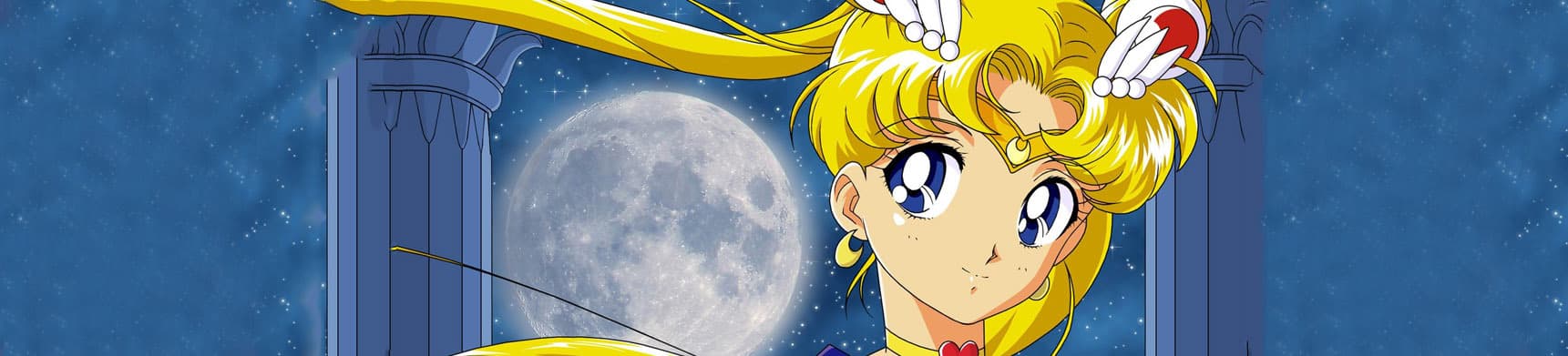
Sailor Moon
a review by Kuma187
a review by Kuma187
It all started when Usagi, 14, in 2nd year of Japanese middle school,, who's a bit of a klutz and a crybaby, as she was late to school (as usual), rescued a cat from being bullied by children and removed some bandage from that cat's forehead, unveiling a crescent moon-shaped mark. Little did she know at that moment that this simple action would change her life and she'd become a superheroine in japanese sailor uniform that fights against evil in the name of love and justice! While helping people being tormented by evil bad guys, she learns how to use her newfound powers and finds more girls who can also transform and join her in her quest to find a mysterious princess and a mysterious Silver Crystal.
As "classic" as this intro may sound, you have to understand that Bishoujo Senshi Sailor Moon marked a turning point in the Mahou Shoujo genre back in 1992. Indeed, up until now, the concept involved a solitary little girl acquiring powers which she would then use to solve people's problems, and this secret would be shared with no-one. What Sailor Moon adds to the used-up formula is a spark from the sentai genre, such as Kamen Rider, Power Rangers, etc. This is why she repeats her introduction for each villain she faces, with those exaggerated movements and poses. This is why her secret isn't just for herself but gets shared among the Sailor Guardians as they unite to defeat evil. Sailor Moon invented and popularized the concept of having multiple magical girls on the stage, a formula so potent that it became the standard for Mahou Shoujo stories from that point onwards: Ojamajo Doremi, Tokyo Mew Mew, Mahou Shoujo Lyrical Nanoha, Mahou Shoujo Madoka Magica, etc.
And honestly, it's not difficult to understand why Bishoujo Senshi Sailor Moon marked the collective consciousness: from the very first seconds, the viewer is treated to an opening sequence that is memorable from A to Z: very colorful imagery mixing romanticism and mischief with a little touch of surrealism, catchy music, this OP is then followed by the title card, showering the eye with pastel colors and flattering the ear with a charming jingle that quite simply never gets old. Sailor Moon is definitely part of those anime that make a very strong impression from the get-go. As a matter of fact, the anime itself is quite theatrical at times, with its romanticism and tragic aspects, and a lot of scenes leave a strong impression, like the lovely panning shot of Tuxedo Mask kissing Usagi in her dress under the moon, or the Christian aspect of Queen Serenity dying on collapsed pillars forming a cross behind her.
Our protagonist, Usagi, also certainly doesn't leave people indifferent. Her being a crybaby can sometimes be a turnoff, but I found her almost immediately incredibly endearing due to the fact that she's just a 14 year-old girl who now has to deal with having a secret life of fighting against terrifying demons that prey on people to steal their energy, but also because she's a girl with a lot of heart who desires a lot of genuine attention and love. Seeing her sleeping while dreaming about becoming a star loved by the public was quite touching and her innocent behavior behind her many "aspirations" certainly made my heart melt. She's a very straightforward girl who doesn't lie to herself, which is commendable.
As formulaic as the show can be, one of its strengths is that it uses a lot of settings/places that are aimed at women: the early part of the show mostly consists in the antagonist deceiving women through the sweetness of "free stuff" to take advantage of them by stealing their life force, which is honestly a very good lesson that is spelled very early on: "there is no such thing as a free meal" and women should beware of predators (people, companies or governments) that make promises that are too good to be true: strings always come attached.
As the formulaic part of the show progresses, 2 other girls join Usagi in her quest very early and they form the main trio. This is what I'd consider to be the best part of the show, which manages to find a balance between episodic content, character interactions, and progression, while also hinting at some much bigger backstory. This is also the part where Naru, Usagi's best friend, becomes an important character and starts to fall for the main antagonist of the arc, Nephrite. This is an arc about the power of love, and how the innocent pining of a young girl manages to win over a cold-hearted being that was hellbent on accomplishing his mission before anything else. This arc culminates in the most emotional moment of the entire series and... unfortunately, it's all downhill from here on out.
You see, for a show to remain consistent, sometimes evolution is needed. The problem is that after Nephrite's arc comes the Rainbow Crystals arc and their introduction is quite brutal to say the least, while also confining the show in its formulaic aspect. First of all, until that point, the goal had been to either defend people or look after the Silver Crystal. Now it turns out, all of a sudden, that the McGuffin was actually somehow divided by the lunar queen into seven smaller McGuffins, which reside into people who are actually monsters but don't know that.
As a result, there's now a rush for all the parties for whoever will manage to get the seven Dragonballs... I mean Chaos Emeralds... I mean, Rainbow Crystals. And yeah, I've said all parties because, for some reason, Tuxedo Mask, going through an identity crisis, decides that now, he should become a "third party" and compete with both the Sailor Guardians and the Dark Kingdom bunch for the McGuffins in search for his past. The problem is that he had always been an ally of the Guardians so far and there's no reason for him to antagonize his protégées, especially since he could still ask them to help him once they've gathered all the crystals.
This search ends up repeating (or rather continuing) the same pattern as the first part of the series and we're 26 episodes in. Sure there might be some level of character development, like Ami developing reciprocated feelings of love for the young Urawa, but in essence, the series is completely stagnating here and Zoisite is not nearly as interesting as Nephrite. At this point, it's pretty obvious that we're completely in filler territory. In fact, during the entire second half of the anime, only episode 34, 35, and the last 3 episodes offer interesting content. Unfortunately, after all this filler, the obvious revelations and the "shocking" events fall flat and do not affect me. Also, unfortunately, Sailor Venus was introduced to the series way too late and the 4 accompanying Guardians have been tagalongs for quite some time at that point, so there's been no proper character development and interactions haven't changed since the beginning of the series.
But do you know what is worse than bad writing? Insults. And there are some in the second part of the series that effectively soured my appreciation of the work overall. Those are mostly linked to Usagi. You know, that cute girl who triggered my paternal instincts at the start of the series? The problem is that she has basically not evolved in 30+ episodes and repeats the same actions during every episode. Worse, she effectively becomes the worst part of her own show due to her usual antics and interactions with Rei becoming obnoxious. However, after it turns out that, TADAAA, Usagi was the Moon Princess all along, she starts developing negative behaviors, like giving up the fight while in enemy territory, which results in Kunzite defeating the 4 other Sailor Guardians while she was just sitting there watching it. She even went as far as refusing to turn back Katarina into a human just because she had stolen the man Minako was in love with, and it took Minako's pleading to spur Usagi to actually heal Katarina. Like, um, Usagi? Hello? What were you planning to do then? You can't exactly let a monster running around, especially since it discovered your identity so, did you mean to kill her? What the hell?
The flashback episode also reveals that Queen Serenity never split the Silver Crystal into the Rainbow Crystals, as we clearly see that she dies while the Silver Crystal just floats away and the seven great demons are not even mentioned during the Lunar invasion, which basically corroborates the idea that the entire Rainbow Crystals arc was nothing but pure filler.
And I won't talk much about that ending that basically invalidates the entire series like Sonic 06's ending erased all the events of the game, because it's self-explanatory.
Ultimately, and while it might be presomptuous of me to say so, Bishoujo Senshi Sailor Moon is not the "anime classic" that most people seem to think. It suffers from many writing issues, too many to be forgivable, and doesn't offer much in the realm of character development until the very last few episodes, and the filler aspect can't be used as an excuses: after all, a few years later, the animated adaptation of Cardcaptor Sakura would prove everyone that filler can be nicely written. Unfortunately, Sailor Moon is not on the same level.
22 out of 37 users liked this review
