Re:CREATORS
a review by planetJane
a review by planetJane
The following assumes familiarity with the reviewed material. Spoilers below.
"I don't need magic to create. All you need is passion and practice. Fate will decide the rest."
--Meteora Österreich, Re:Creators Episode 22
Explicit metafiction is fairly rare within the anime medium (and only marginally more common in manga). For how much of anime, good and bad, relies on recalling older formulas and character archetypes and bringing them into the present, this is somewhat surprising. What then to make of Re:Creators, an unashamedly meta anime with a fairly impressive pedigree that had supporters calling it a classic in the making and detractors decrying it as pretentious schlock right from the very beginning of its run?
Let's start with the facts: Re:Creators is an action anime about fictional characters (sourced from also-fictional light novels, anime, manga, and video games) come to life. Our nominal protagonist is geeky shut-in Souta Mizushino, joined at first by Celestia, who hails from an anime that seems like a modern take on The Vision of Escaflowne, and Meteora, a mage from a JRPG who serves as an expository character both in her doubly-fictional game and within the show itself. This cast balloons significantly over the course of the show's 24-episode run, to the point that listing every character--both "Creation"--the show's term for these refugees from fictionland--and "Creator", the, well, creators thereof--is an exercise in pointless listmaking.
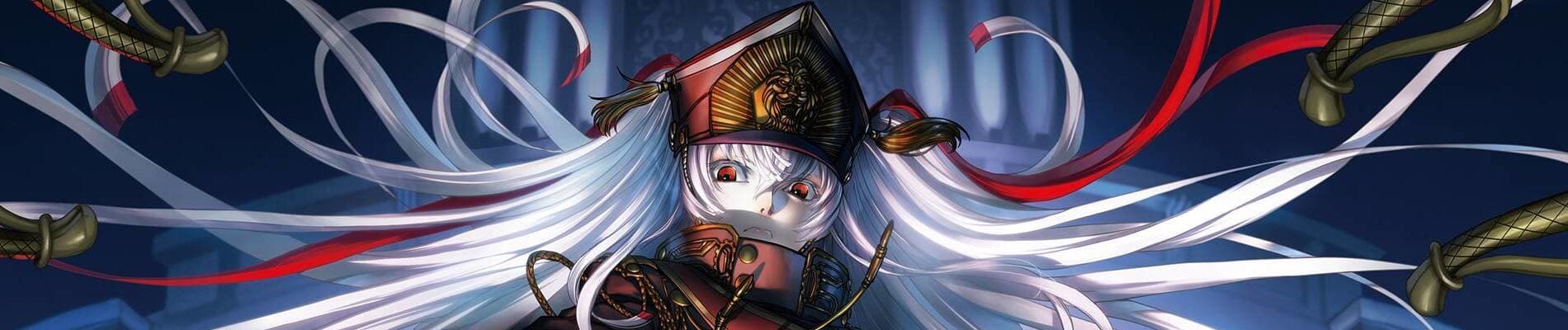
But let's back up for a moment, what about Altair, RC's main antagonist and also in a very loose sense, its actual "hero"? Altair's character arc is to put it mildly, very unusual, and her design is among the most brilliant in the past decade of the medium. Altair is a white haired girl clad in a bizarre amalgam of different 19th century military uniform styles. She has a shako cap, a Spanish cavalry coat that tapers into a wide skirt, strange high-heeled spur boots, and her eyes are double-set (a ring of red around blue), and her pupils are square. For the first half of the show's run I wasn't entirely convinced that this design being as ridiculous as it was (and it is ridiculous) was intentional or not, but over time it becomes clear that it's a definite deliberate decision.
A lot happens throughout Re:Creators, but one of several main story through-lines is about Altair herself and how she came to be. This is, by far, the show's strongest narrative thread, and is the one best carried to conclusion. But there are of course others. There is Celestia and Meteora coming to terms with being fictional, there is Magane, the gleefully wicked light novel antagonist who continually throws a wrench into the plans of both the pro- and antagonists, there's Mamika, the idealistic magical girl who gives her life for those same ideals at the end of the show's first quarter. There is the ridiculously-named Aliceteria February whose knuckleheadedness make her an antagonist for the show's entire first half, and there's the also ridiculously named Blitz Talker, a cyberpunk deuteroganist hellbent on avenging his daughter's death by killing his creator. All of these are handled better or worse. Mamika's death at Altair's hands is incredibly well-done (and, maybe unintentionally, a sneaky meta-comment on the state of the mahou shoujo genre post-Madoka), and Blitz' makes up for a slow start with a fantastic conclusion near the show's end. Celestia's is not quite resolved as well, her death at the show's end being underdeveloped and sudden, and Magane's is not really resolved at all. Other characters--like Yuya, Rui, and the second cour introductions Hikayu and Syo--don't really have character arcs in the first place, and serve more secondary roles. This is without even getting into the creators themselves who form an entire secondary cast. Nonetheless, no parts are played poorly in Re:Creators, save perhaps that of Hikayu's creator, an obnoxious bucktoothed otaku whose inclusion does ultimately pay off but remains questionable.
Altair is eventually revealed to be a doujin character, created by Souta's deceased friend Setsuna, which puts her design into a very specific--and very interesting--context. Her overdesigned-ness is the product of deliberately trying to create a character that breaks the rules of what a "good character design" should look like. She's a doujin character designed by a teenage nerd, so of course she wears a ridiculous outfit, of course she's unflappably cool but that actually hides a deep reservoir of inner rage, of course her weapon is a ring of sabers and a Russian machine gun she plays like a violin that can effectively do almost anything. These are the traits of OC's. "Mary Sues" to use an old piece of internet terminology that has largely fallen out of favor. Altair is overpowered, evil, and always in control. That her design works in references to Black Rock Shooter (her general color scheme is BRS' own inverted, white hair with red highlights in contrast to BRS' black hair with blue) and Akame ga Kill (her outfit's general fascist-evoking but nonspecific look) just seals the deal. Altair is a DeviantArt drawing come to life, and that is ultimately a really interesting character concept, and it's explored quite well in her arc.
Altair's motives aren't entirely clear until she kills Mamika, who she furiously lashes out at for presuming to be able to help her. Her lines in this scene (especially "I will destroy everything. Destroy, destroy, and destroy more until this world disappears. That is the reason I'm standing here today.") would be downright comedic if they weren't delivered with such utter disgust, and the subsequent howl of rage as she impales Mamika makes one pity her voice actor, and really sells her total burn-it-all nihilism.
Her arc takes a bit of a strange half-turn in the show's second half. As she fights the other creations (who, barring the shows-up-just-to-die Charon, have all united against her at this point) during the Chamber Festival she seems increasingly more bemused than anything else. Again, this is what an "invincible" character of her type is supposed to do. Almost nothing the protagonists throw at her offers her a genuine challenge, not even her own counterpart, Sirius, introduced late in the show as a last ditch effort. The final few episodes really are about Altair more than anyone else, and while they do often boil down to essentially shonen fight scenes with the usual form of fighting spirit-babble replaced here with technobabble about audience acceptance levels, it's a real joy to actually watch. But where things get truly strange is in episodes 20 and 21, the end of the former re-introducing Setsuna (in the form of a creation herself, albeit), and it's only here, at the show's very end, that Altair starts displaying emotions other than rage and smugness.
It's a long, long buildup to that, and understandably it's not for everyone. Episode 21 in particular, wherein Altair essentially surrenders now that she's reunited with Setsuna (and in doing so, crosses the Creation/Creator boundary, conjuring an entire world of her own making), is thick with a very deliberately sappy sort of character development. Altair arguably gets the happiest ending of any character in fact, with most of the others leaving the real world to return to their own or having died before that point. So what the finale ends up ultimately being about is, how well can you "sell" a happy ending for a character that by conventional standards, doesn't really deserve one? And the answer is that, well, it depends. If you found Altair annoying at the start of the series the ending is not likely to redeem her for you, since on a literal level she more or less gets away with everything.
On the other hand, if we take Hikayu's comment about Altair being "the real hero" into account, we're left with an interesting view of things. That Altair did not act in a moral right by any conventional standard is indisputable, but, who--both in-universe and out--ended up being the target of the most discussion (good and bad), fan art, and so on? Altair's character arc working (or not) hinges almost entirely on how believable you find the idea that, in order, the in-universe audience reflects the preferences of the out of universe audience, and that that preference--Altair as the most interesting and therefore "main" character--is valid. It's an interesting narrative trick and one I might go so far as to say is entirely unique. Certainly, it is nothing I have seen pulled off so well before. Altair's "redemption" (if it can even be called that) works because the audience wants her to be redeemed. Heroes dying to help save the world after all, is nothing unexpected. Villains voluntarily stopping themselves after a good talking to--even under extraordinary circumstances--is much rarer. For a certain kind of person it is certainly a hard pill to swallow, for another--and I fit myself into this camp--this particular piece of narrative origami is so fascinating that I can't possibly fault it for not being a simpler happy ending. Altair's arc is such a strange rollercoaster ride that it does make me wonder if the character's dark horse popularity wasn't planned for from the start.
This isn't to say of course that at the end of the day Re:Creators has no flaws. Indeed it has quite a few. For one thing there are, funnily enough, simply too many characters. The cast could be trimmed by a third, the script rewritten, and no one would notice. Several exist mostly as background fodder or only to facilitate dumb jokes. For another there are also too many episodes, around the halfway point the show enters a serious slump with a trio of episodes that focus primarily on the minutiae of setting up the Elimination Chamber Festival. This is, in a word, boring. The various creators are perhaps unsurprisingly the least interesting characters in the show, and their interactions with each other bring little to the table. Matsubara's awkward father/daughter conversations with Celestia earlier in the series, and Suruga outwitting her own creation Blitz later on, are much more compelling because they involve a creation character too. On their own, the creators don't do much of interest and this section drags the entire show down considerably (that it immediately follows an admittedly funny recap episode doesn't help).
In addition, while Altair getting a happy ending is not itself a point of contention for me at least, the fact that two other characters die in the last few episodes is a little disappointing. Late-in-show character death is of course a tried and true trope, but it is exactly the sort of thing that RC should have strove to avoid. Celestia and Aliceteria both biting it in the leadup to the finale does compromise Altair's own redemption, since the deaths are fresh in our memories by the time we get to that point. Finally there's the issue of Megane, who is herself a very interesting character, but, after she tentatively flips to the protagonists' side in the show's final quarter, she more or less up and disappears, leaving her character hang in the air unresolved. It's a strange decision especially given how much closure we're given with Altair, and while it does fit her personality to an extent, the fact that we're given not even a small hint about where she might've gone or what she might be doing after the main story is over is undeniably frustrating.
But none of these caveats even come close to ruining the show. Perhaps in another world, where it does not have them, Re:Creators might well have been the classic that youtube channel Mother's Basement famously prognosticated it might become. With them, it is more of a future cult classic, a key point of difference. Really, one gets the impression that Re:Creators' own creators are the sorts who would prefer to make a cult classic than something with unanimous critical acclaim anyway, so perhaps it's all for the best.
One last thing. The show's 22nd episode--its last--is the sort of bow-on-the-giftbox affair I wish more anime could learn to do. Most of the characters return to their own worlds, returning much of the setting to the status quo, but Meteora, notably, does not. Of course, in a show this shamelessly self-indulgent it is perhaps no surprise that she becomes a novelist, and ends up writing a book called--what else?--Re:Creators.
What you end up with at the end of the day is an anime about the creative process itself, and while Re:Creators is far from perfect, the fact that it even tries to broach this subject, with a mix of seriousness and humor, makes it an easy recommendation for anyone who won't mind the bumpy ride. You really don't see too many like this one.
52 out of 61 users liked this review
