__THIS REVIEW CONTAINS SPOILERS
__
Sound! Euphonium is a fantastic anime to begin with. The heartfelt journey of Kumiko Oumae and her bandmates was captivatingly entertaining. And what this movie does is make a great series even better.
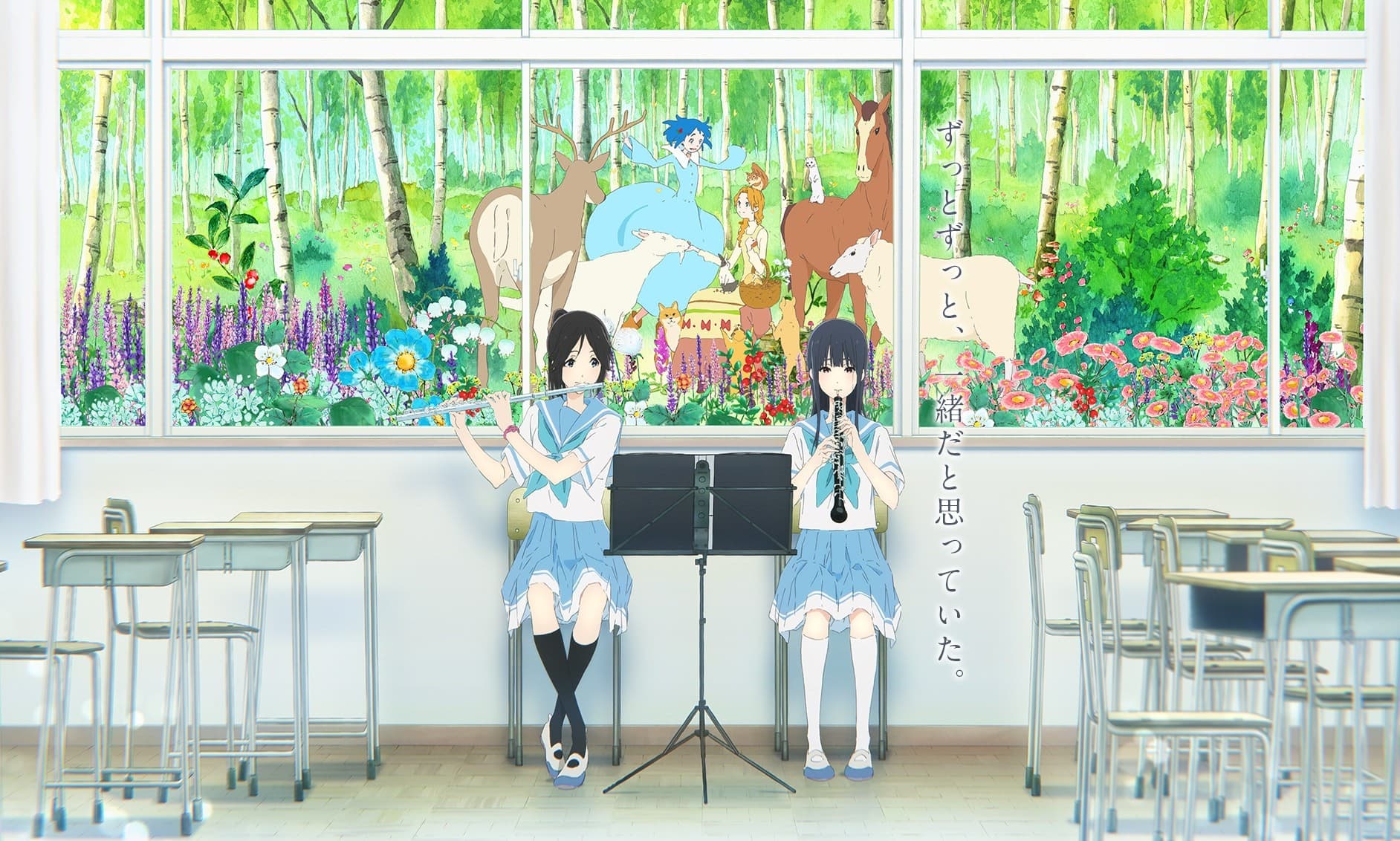
Directed by Naoko Yamada (K-on!, A Silent Voice, Heike Story, etc), Liz and the Blue Bird is a drama SOL movie that tells the story of Mizore Yoroizuka and her best friend Nozomi Kasaki. One can say that it’s the second half of their story, after the first half in Hibike season 2. The first thing you’ll notice is the gorgeous art and animation. The film’s a visual feast: each scene is drawn in intricate detail, vibrant colors and with stellar backgrounds.
Disjoint
Kitauji High School’s concert band is going to play the titular piece, Liz and the Blue Bird, which is based on an old fairy tale of the same name. The Oboe and the Flute, played by Mizore and Nozomi respectively, represent the voices of Liz and Blue Bird here. But they are unable to play well because of their inability to connect with their respective characters.
The Fairy Tale and Letting Go
The titular tale is presented in order to parallel Mizore and Nozomi, as they see themselves in their respective characters, and animated with it’s own distinct artstyle. The story is about a girl named Liz who meets an unnamed blue bird that can turn into a human. The two become best friends and start living together, but it tragically ends with them being forced to part ways.
The two girls’ relationship grows strained over time. Mizore deliberately holds back her talent because she is anxious that Nozomi could abandon her, as Nozomi quitting the band two years ago still worries her to this day. While Nozomi’s growing dissatisfaction with Mizore being the only one tutored by Niiyama sensei causes her to think that Mizore is gonna leave her behind one day.
Eventually, they realize that they are closer to being the opposite of the characters they see themselves as: With Mizore being the blue bird who would have to let go of her attachment to be able to live her life, and Nozomi being Liz who would let go of the bird so as to not weigh it down. If the viewer thinks about it more, they would realize that both Mizore and Nozomi are each others’ Liz and blue bird. That’s the duality of this metaphor, that they both need to let go of something and reach out to what they actually want to do.
The Third Movement
Yamada’s visual storytelling shines in this section of the story. Mizore, now able to understand the reasoning behind Liz’s actions, plays without holding back when they practice. Nozomi tries to keep up with her, but comes to accept that she simply cannot reach Mizore’s level and starts tearing up.
Afterwords, Nozomi confesses that she lied about going to music school with Mizore, while Mizore pours her heart out about how much Nozomi means to her. This conversation culminates with the I love you hug scene. Mizore, upset that Nozomi seemed to be ignoring her feelings, hugs her and fully conveys the extent of her love for Nozomi. To which, Nozomi replies “I love your Oboe”
All this time, Mizore’s Oboe had been a representation of her feelings, as it was the one thing that had connected her with her best friend. And with Nozomi’s reply, there is a pause. They had now mutually realized they had felt the same way about each other and didn’t have to worry after all.
"Thank you Mizore, Thank you."
Conclusion
This was probably the best way to end the film. It leaves on an optimistic note. Mizore and Nozomi had broken free of their codependency (represented by the two birds flying in the sky), chose their own respective ways of life that they can follow without issues, and their friendship had become even closer now that they have come to understand each other better. This can be seen if you contrast the beginning with the two girls walking with a visible distance between them, and at the end where they walk side by side. On top of that, the “disjoint” screen has the “dis” part crossed out and now it reads “joint”.
Mizore is one of my favorite characters ever. Everything about this girl feels so real to me. Her tendency to get anxious and overthink stuff that were made worse with her circumstances was very relatable. A lot of the thoughts and worries she had, were stuff that felt very reminiscent to my own life experiences and at times, made me reflect on those past feelings. She just feels fully realized and realistic as a person and one that I strongly felt for.
Liz and the Blue Bird is an amazing movie that brings out the best of Hibike without any of the complaints I had with the main series at times. It provides a satisfying conclusion to Mizore’s character, Nozomi’s character, and their friendship altogether. It uplifts Sound Euphonium as a whole to be a defining example of anime for me, and one that gave me a more positive outlook on a few personal things about myself.
36.5 out of 38 users liked this review