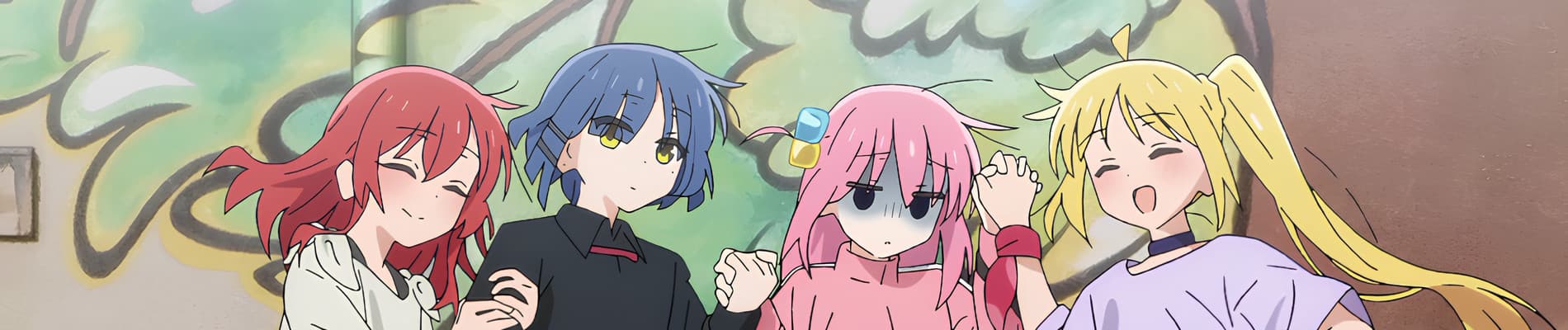
BOCCHI THE ROCK!
a review by melamuna
a review by melamuna

Slice of Life anime is a subgenre of the anime scene where you follow a character on her journey through her everyday life, and CGDCT stands for Cute Girls Doing Cute Things. Combining Slice of Life and CGDCT creates a sweet and enjoyable anime for all different ethnic groups of people and they will find something that makes them relate to the series as a whole. Azumanga Daioh's complete dedication to a pure slice of life CGDCT comedy oriented anime brings joy to the audience, and the majority of animes within this gente mostly revolve around normal lives of young girls. K-On's focus on music hooks music fans even though the majority of the show is just girls doing cute and funny mundane life of a highschooler.
And in the fall of 2022, CloverWorks' unknown anime "Bocchi the Rock!" came out. It's an anime that didn't get a lot of attention and didn't even have a proper trailer weeks before its release, but it has captivated viewers since the first episode and as I write this (currently episode 8) Bocchi the rockn this time it took the throne for one of the most highly rated anime not just for fall 2022, but managed to get on the top 50 best animes of all time with a score of 8.80 on MyAnimeList.com. (As of January 2023) This was much higher than Spy x Family and most popular anime.
Although it was a Slice of life CGDCT show, there were not many expectations in this genre, but Bocchi the Rock managed to break everyone's expectations, including anime reviews across genres . And in this essay I will try to explain how Bocchi the Rock has gained a loyal following. ***

Slice of Life anime are known for adhering to a set formula. The plot of contemporary Slice of Life animes typically revolves around one character becoming interested in something, like Do It Yourself!!, an animation that was released recently at the same time as Boochi the Rock!. Do it Yourself!! is about a character named Yua, Sefuru, who discovers the art of DIY projects. With each new episode, she gains more experience with D.I.Y.-related activities, with the help of other characters who joined in on the fun. While there is nothing wrong with this kind of structure, the more episodes you watch, the more tedious it becomes. This is a common issue with slice-of-life animes because they feature characters who constantly repeat the same actions and situations. It is not the Do It Yourself!! is a bad anime; but these formulas deter the majority of people from engaging with the slice-of-life genre, and Do it Yourself!! is a big example for it.
The initial plot of "Bocchi the Rock!" is closely identical to that of "Do It Yourself!" High school student Gotou Hitori struggles with severe social anxiety and attempts to overcome it. With this straightforward formula, you might assume that each episode would proceed as follows: Gotou, Hitori goes to school and battles her social anxiety; she fails, but one person notices her efforts; she gets up and achieves something; the episode ends; the cycle repeats; the lessons are reset in the following episode. Initially, "Bocchi the Rock!" sounds like how I described it, because it's what most slice of life animes are offered today, but "Bocchi the Rock!" managed to defy people's expectations and fully expands it's Slice-of-life tag and takes advantage of it with relatable moments to audiences and scenarios that enhance the series.
Bocchi the Rock! improves its slice-of-life element by beginning in more commonplace places. Following the standard Slice of Life high school life tactics, it's typically a school-related show featuring either a Japanese summer beach episode, a school festival episode, a Christmas episode, or anything linked to that. These kinds of concepts aren't bad, and Bocchi the Rock does have these kinds of elements, but they aren't as relatable to most people as you might have thought they should be; these shows are geared toward specific audiences who share their interests, like doing DIY projects. However, with Bocchi the Rock! it uses situations and settings that are actually relatable to as many audiences as it can grasp blended with Bocchi's personality. More screen time spent with Bocchi's home, her leisurely strolls, her bandmates' personalities, and Bocchi herself give viewers the impression that their experiences are closely similar to hers. Giving the impression that these audiences can stand and become immersed in your visuals rather than requiring it to be a literal location will allow the majority of viewers to feel connected. ***

The series' nuanced character development is another factor in its great slice-of-life anime appeal. Characters on this show have been evolving subtly, which is a way of just showing their little successes and having that strong change once the series ends without plastering it on the audience. The definition of character development on one end of the spectrum means that a character has a problem that it wants to fix, and the whole journey of this character is to find ways to fix those problems, and hopefully it gets to change once the series ends. Through the course of the series, Hitori makes every effort to get over her social anxiety. In every episode, we get to see the difficulties she faced and how she overcame them.
For example, in Episode 6, Bocchi struggles to sell the tickets for her musical performance. As she was thinking about her options, she met a drunk person who, to her surprise, had experience in the music industry, and now she's drunkenly giving attention to people around to see a musical performance. As a result, she is now forced to perform in front of an audience.
She is stiff at first since she was forced to perform in a circumstance where she will undoubtedly perform, but after receiving some guidance from the person who assisted her and encouragement from a few onlookers, she soon began to feel more at ease. It's not so obvious that you'll notice it right away; rather, it's a subtle look at Gotou's current improvement situation. At the beginning of the series, it's clear that she has trouble performing in front of an audience, and this is particularly evident in the first few episodes. While the preview episode showed that Hitori has improved to perform well with her bandmates, episode 6 changed the course of her stage fright.
However, it did not entirely remove her general fear of social interaction and the crowd. All that is left is her confidence in front of an audience, which she displayed in that episode. While her social anxiety hasn't entirely disappeared after this episode, she is now able to speak up with confidence and solve problems as they arise. This is a step in the right direction for Gotoh's improvement in terms of her ability to win others over.
The series' main focus and major highlight has been Hitori's struggle with social anxiety, and we get to see in each episode how she copes with situations like the one I mentioned earlier. However, the show doesn't shout at you to believe that she's getting better; rather, it hints at it in passing dialogue while also showing you that she is. Similar to the prior example, Hitori's development of self-confidence in expressing her emotions on stage represents a modest step along a long path of personal growth. People with social anxiety know it's never easy to get over it and face challenges when the voices in their heads tell them they're going to fail, and Hitori is clearly going through this on screen.
However, overcoming her fear in episode 6 is just one small step away from everything else she is attempting to build. Hitori's quiet resolve encourages her to go further, as demonstrated by a comparison between Episode 1 and Episode 12. She is still the shy girl you know and love, but through the course of the series, she evolved into a shy girl who is now more capable than she ever was.
Aside from Hitori, every member of her band goes through subtle growth, dealing with their own issues and seeing the outcome in the most fulfilling way. Ikuyo is the social extrovert who left the band she was asked to join, but the difficulty she faces is that she is not a good guitarist. However, after watching Hitori play the guitar in Episode 3, she developed a strong interest in learning how to play the instrument. She has been continuously studying how to play the guitar since joining the Kessoku Band, either on her own or with Hitori's assistance.
She's mainly been her outgoing self throughout the series, but we know that she's been working hard on her guitar skills and vocal range because of how much she's improved from her first appearance with the band, where she mostly pushed herself away out of fear of not being as good with the guitar as the band members she looked up to, to the finale episode, where she could carry herself and perform an impromptu solo act to give Hitori time to come up with a solution to her own obstacle. ***

Every successful band has a certain group of members who draw the audience in with their distinctive personalities. The series' central heroine and the band's guitarist, Hitori, is characterized by her social anxiety. Hitori portrayed her everyday struggles in such an extreme, exaggerated way that it came off as a cute yet deeply troubling way to follow a character, where viewers hope that she'll get a proper resolution once the series is over.
Audiences are drawn to characters who have social anxiety because it is so relatable to their own experiences, and she showcased her mundane dilemmas to an extreme, exaggerated level. Another thing that draws in the audience is Hitori's experience playing the guitar. Audiences are drawn to her by her captivating strumming as she expresses her current emotions. Hitori is a distinctly generic character that you may have encountered in other animes like Komi Can't Communicate, yet Hitori has a secret charm to her personality and the way she handles circumstances that makes her humorous, amusing, and unmistakably Bocchi.
Ryou is another band member who is carrying their bass. She is a reserved individual who is primarily passionate about his musical instruments, someone who is primarily quiet when you see her with the band and outside of the band, and she creates an unreal aura of mystery for the audience. However, she is primarily a lighthearted individual who is primarily focused on music and is capable of manipulating her friends for some food money. The drummer in the band with the yellow hair, Nikija, is a determined individual who works hard to grow her band.
She is upbeat and enthusiastic, and she frequently serves as the group's parent. Particularly for Hitori, whom she usually comforts throughout the series and gives a little bit of bravery to stand up for herself during her journey, she is primarily the one who organizes and what the band performs for their present activities and tasks while primarily being a mediator. Throughout the series, Ryou and Nikija's relationship has largely been understated, but their shared love of music unites them, even though their personalities don't necessarily suggest that they can.
And finally, Ikuyo is the band's frontman, playing guitar and singing. Her frontman skills are improved by the fact that she is a popular student with many friends across all of her classes, and by virtue of her constant social media presence, the band's existence is further supported. She is a happy person who generally engages with whomever she wants with a positive smile and without reluctance; she is an extrovert in every sense of the word.
She is, however, just as insecure about being liked or about her own attributes as Hitori is. She doubts her ability to accomplish the goals she has set for herself, particularly in light of Ryou and Hitori's musical prowess. As a result, she avoids conflict more frequently than Hitori, who sometimes deals with problems in exaggerated ways by accepting her fate and dealing with the consequences. In the series, Ikuyo and Hitori are complete opposites who look up to one another, yet they actually have a lot in common.
The Kessoku Band, which unites these three-dimensional characters and places them in a common situation while also allowing them to deal with their own problems presented in the show, helps these four distinctly different characters connect with one another. For example, Hitori's social anxiety issues give her the ability to predict future problems; Ryou's directness and tendency to not pay for the food she forcibly allowed someone to order; and Nikija's tendency to be a jerk are just a few examples. These characteristics of each band member produce these unusual situations and strange chemistry between them, which results in unique and entertaining scenes with creative jokes, line deliveries, dialogue, and character chemistry, giving audiences a sense of an original, enjoyable experience hanging out with these four characters.
Undoubtedly, Bocchi the Rock's strongest points are its characters, combined with its unremarkable but convincing slice-of-life setup. However, there is one more aspect that distinguishes Bocchi the Rock that I haven't yet mentioned. by far distinct from any other anime. ***

The presentation of Bocchi the Rock is among the main factors that attracted people's attention to it. The anime could have taken a lazy route and had an odd and uninteresting powerpoint presentation-like direction that's dependent on the voice actor's monotonous voice that comes off as pretty boring for the most part. I wouldn't blame people who think not only from slice-of-life but most animes around, especially from a lower-tier studio producing the anime. Bocchi the rock! However, it takes it a step further in its presentation by focusing too much on the specifics of the series. From the first to the last episode, the show presents an amazing presentation by focusing too much on Hitori's social anxiety as it is revealed by the situations that are given how ordinary they are without being bloated and by combining bombastic yet natural comedy with the adrenaline-rushed, chaotic, creative, and surprisingly grounded take on Hitori's descent into her chaotic mind.
For instance, in the first episode, there are these brief, cutesy animation segments that follow Hitori as she goes through middle school and describes in her head how she felt when she once asked her school to play metal music. Then, it abruptly cuts to a still shot of Hitori vigorously hitting her head on the floor to get rid of the embarrassment. The series uses this kind of presentation method frequently, and while you might think it could quickly become boring, the show makes an effort to outdo itself by either being even better at conveying the concept from the preview episode or by employing an original mode of delivery. Each episode's animation style shifts from the straightforward reactionary type that can make viewers chuckle to a more imaginative one where scenarios are roleplayed through the screen in a vivid, imaginative, and exaggerated take on a commonplace scenario of Hitori's social anxiety that pushes the boundaries of animation to the point where it becomes a stop-motion live action take.
Another mention, the opening of episode 1 included a straightforward reactionary form of animation; it was an inventive scene in which Hitori remembered moments from her past that she felt were embarrassing and that were exaggerated by the animation. Like the mid-show end credits segment, the first episode includes some fourth wall breaks that enhance the comedy and Hitori's current emotions. This hooks viewers to watch more Bocchi content, and fortunately for these Bocchi fans, they got more than they anticipated. In the adrenaline-pumping sequence from episode 4, Hitori imagines what an extrovert's life is like and then lives it.
Her imagination runs wild, and the animation captured it well as she described her crazy, extrovert existence. Another example comes from episode 4, where Hitori breaks down when someone suggests she open a social media account, rescuing her from a new world of her extremes. This is similar to episode 7, where she breaks down when she imagines the festival spirit, where her worries and extreme anxiety break through the animation medium that is unfathomable to her world, and episode 11, where a small and straightforward segment brings the same insane medium breakthrough anxiety thought.
This doesn't just apply to Hitori; Ryou's quiet nature often results in jokes that are delivered quietly; Nikija is the encouraging friend, and the majority of her scenes are those quiet ones where she pushes Hitori; and Ikuyo's nature is similar to Hitori's in that they both tend to overthink things. The anime experience for the audience is improved by the show's animation presentation, which otherwise would include bland and uninteresting events.
The music in the show or how the characters interact with music is another element of the show that appeals to viewers. Although there are subtle traces of it, Bocchi the Rock employs music as an expression of emotion rather than being the kind of program where characters start off being terrible and you get to witness them getting better as the episodes go on. Since it's a rough acoustic, Hitori's song in Episode 3 is not professionally produced, but you can still feel the emotions as you listen to Hitori describe her current situation. Similar to the well-known episode 8 where Hitori vents her annoyance during their performance at the uninterested crowd by their band by playing loud and ear-catching strums, that immediately catches audiences by her sudden burst of emotions through her strums in her guitar.
We saw this again in the climactic episode, when Hitori's strings came untied and snapped in the middle of their performance. As a result of Hitori's panic, she was unable to perform, but thanks to Ikuyo, who was able to do an impromptu solo act that picked up the whole performance and gave Hitori a boost of support and time to do her own impromptu performance, she managed to do it with the maximum amount of wow factor.
On the final episode of the series, Ryou slaps the bass with sick strings in a guitar shop, giving the people in the show and the audience a bit of a sense of "wow factor," but since we know Ryou's personality, we do know she brags about stuff like this, giving audiences a bit of a smug chuckle. These musical experiences don't always appear in character development moments; they can be used as just a lone goof. It is undeniable that the power of music draws audiences closer to the show through various musical performances, from catchy opening and ending sequences to deep cuts from the recently released album for the series. ***

Since Bocchi the Rock arrived on the scene in Fall 2022, fans of anime from all genres—from shounen to slice-of-life fans—have been delving into every nuance of this show to understand why it is so successful. After all, on paper, Bocchi the Rock appears to be quite unremarkable. Our main character, a high school student who battles social anxiety disorder with various challenges she encounters in every episode, does typical high school and teen things like going outside with friends she makes along the way, battling school culture festival activities, and for the most part, your typical generic slice-of-life situations in anime. However, it was able to draw a sizable audience that adored it, which begs the question, "What makes this show special?" What distinguishes Bocchi the Rock from other slice-of-life animes?
The answer is simply a demonstration of passion and love towards the craft. It is impossible to communicate the outrageous, bombastic, and vividly insane thoughts of Hitori into a minute-long sequence utilizing the medium it is employing with imaginative and innovative images and animation, which occasionally breaks the barrier of doing live action and stop motion. Saitou, Keiichirou, and the other staff members behind the series understood and were passionate about the source material (the manga), and they translated it to the anime medium, which not only hooks new audiences in but also impresses the manga's fanbase of the show.
You can't make a story that's simple yet captivates all audiences or make characters that have layers of depth in them without being the center focus of the series. Bocchi the Rock is a unique, straightforward, and enjoyable slice-of-life anime that has received love from the creators. This means that it stands out from the competition by not trying too hard to be something it isn't, concentrating instead on the series' central ideas while letting the audience enjoy the material to the fullest. ***
56.5 out of 62 users liked this review
