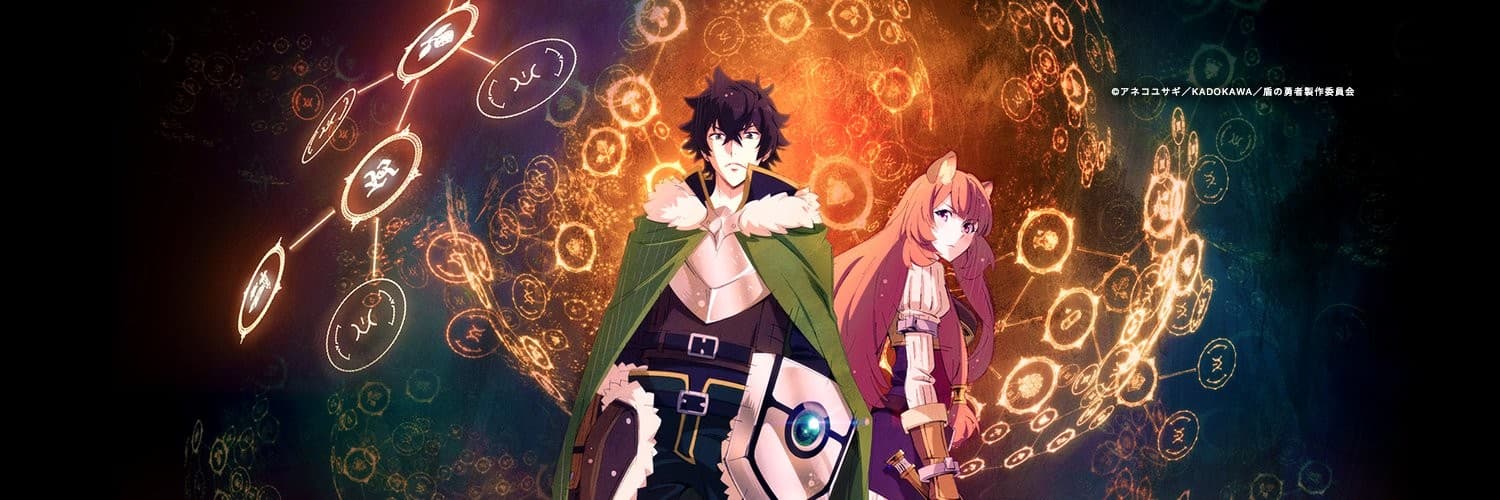
Naofumi Iwatami may have been your average Japanese otaku... Living a sedentary life consuming games and manga while generally minding his own business... But he definitely isn’t your average isekai protagonist. Rather than any kind of chosen one, he’s actually one of four young Japanese men who get transferred into a magical fantasy world, and he seems to be the least of the four. While they were transferred while playing video games they were intimately familiar with, he was transferred while opening up a book he never got to read. While the other three were granted legendary weapons of a sword, a spear and a bow, Naofumi is granted a mere shield. Finally, while the other three each picked up a band of followers, Naofumi was left out in the cold... Until he was joined by the beautiful Princess Myne, who clung to his side for a single day before pulling the dirtiest trick imaginable on him, leaving him broke, destitute, and with a reputation that would threaten to curse him for the rest of his new fantasy life. Starting his grand adventure from the bottom, with nothing and no one to his name, and a deep, deep well of emotional trauma, will Naofumi fail and wind up dead in the gutter? Or will this cruel world witness The Rising of the Shield Hero?
The Rising of the Shield Hero was primarily produced by Kinema Citrus, a production company I have somehow never mentioned before, despite the fact that I’ve reviewed Tokyo Magnitude 8.0, which they produced alongside Studio Bones. My only excuse for this is that I must have just seen Bones attached to it and assumed it was their baby. I’ve seen a couple of other anime that they’ve done, including the amazing Made In Abyss, the kinda boring Is The Order a Rabbit and the awful Code:Breaker, but I haven’t seen any of them recently enough to really remember what they looked like, although I do recall Abyss being really visually impressive. Because of this, I don’t really have anything readily on hand to compare Shield Hero to, but for what it’s worth, Shield Hero is, on its own, a pretty damn good looking anime.
Granted, at first glance, it doesn't look all that impressive. The designs are fairly generic by Isekai anime standards, both in terms of the characters themselves and the world around them. I’ll also grant you that if you were to watch any random ten second clip, the animation might not do much for you either. There are some fairly cheap looking moments throughout, including instances of obvious corner cutting in combat scenes, occasional key frames with lip flaps, and repetitive walking cycles. These things tend to happen in small doses, but on the whole, with everything taken in its proper context, this show looks fucking amazing, thanks to some whip smart budget management. Yes, cheap moments do happen, but they always happen in moments when you won’t notice or be bothered by them, either between much more visually interesting moments, during scene transitions, and during the very rare exposition dumps that never manage to feel boring.
The character designs may look generic, but that’s only by isekai standards, when you hold them up against similar anime in the genre. They all look really cool on their own, and the animators gave them all their own ways of moving and posing that almost immediately give you insight into their personalities and identities. Facial structures can be off model in some shots, with skewed features and chins pointy enough to kill a man, but again, this is few and far between, and the facial animations are otherwise exquisite. The occasional CG effect is blended seamlessly into the frame, and the cinematography is usually on point, but where this show shines the brightest(visually speaking) is with its action. The majority of the fight scenes in this anime are breathtaking, from the pacing to the choreography, every shot perfectly planned out and coherent to the viewer. I mentioned there were some corners cut during fight scenes earlier, but even these are used as effectively as possible. I don’t talk much about music in my reviews anymore, because let's face it, I'm really bad at it. But even I couldn’t help but notice how pulse-pounding the fight music in this anime can be.
The English dub was mainly a product of Bang Zoom Entertainment, and the first thing I noticed about it was that it shares a lot of the same actors as Konosuba, which I also think is an anime with a really strong dub. The late Billy Kametz, who sadly passed away in 2022, did a fantastic job in the lead role of Naofumi, transitioning very believably from a wide-eyed naive innocent in the first episode, to a jaded, traumatized anti-hero for most of the series, giving an incredibly nuanced performance as both sympathetic and oftentimes despicable. There’s a moment in the story where he reaches his true rock bottom, at a point where he truly believes the last thing he has in the world has been stripped away, and the last person he was able to trust and rely on was about to abandon him, and he almost drew some actual tears out of me, even upon my second viewing of the series.
Another weirdly perfect casting choice was Faye Mata as the despised Myne. For those who don’t know, her other major anime character was Aqua from Konosuba, and while the two are very distinctly different characters, they both serve as equally strong indications that Faye seems to enjoy hamming it up in extremely undignified roles, and I’m here for it. Myne is irredeemable, and Faye wrings every drop of sleaze out of her just as enthusiastically as she played up Aqua’s uselessness. Erica Mendez and Brianna Knickerbocker play their roles as Naofumi’s ~~slaves~~ companions with unquestionable sincerity, Jamieson Price has the perfect deep, growling noble rasp to play the duplicitous King Aultcray, and then you have Xander Mobius, who I’ve only known from his various Death Battle roles up until this point, but hot damn, he does a startlingly good Vic Mignogna impression for this show. It’s a strong dub over-all, I can’t recommend it enough.
Like a lot of the anime I’ve reviewed in recent years, Shield Hero has a bit of a complicated reputation. It’s one of those anime that, in most circles, peoples’ buttholes clench up the second you mention the name, because it’s not only incredibly controversial on its own merit, it has some very frustrating ties to recent American cultural controversies, which I’ll go into detail on later. As for me, as much as I hate to fence-sit, I can kind of see both sides. I can definitely see some very clear reasons for people to look pas all of its positive qualities to call it the worst thing ever, but I can also see why some people just ignore its many problems and just enjoy it on an island. By my own tastes as both a fan and critic, I’m kind of right there in the middle myself. I genuinely love and enjoy this anime, even though there are certain things about it that really make me want to hate it.
Just to get off on a positive foot, we’ll talk about the good, because there is a lot of it. First off, tying back to my own renaissance as a critic, I made an observation in my Smartphone Isekai review that I still hold true to this day; An isekai doesn’t necessarily need to have an interesting cast AND an interesting world to succeed, but it needs to have at least one or the other. Rising of the Shield Hero is one of very few Isekai anime I’ve seen that actually manage to kind of knock it out of the park with both. Yeah, like I said before, the character and world designs do look kind of generic, but the key is in the details below the surface. Starting with the cast, the four cardinal heroes are all distinctly different from each other, from the circumstances behind their reincarnations to their individual personalities. True, we only really get to know the Shield and Spear heroes, but there are subtle differences between the relatively supporting roles of Sword and Bow. Everyone else has their own attitudes and motivations, and the blandest character is probably Raphtalia, but even she is extremely likeable, which does make up for it.
As for the fantasy world itself, the original creator must have spent hours upon hours developing the magical system, as well as all of its social and political details, because the world feels constantly full of rich and complex lore and intriguing details. Even this world’s obvious Chocobo rip-offs wind up being way more interesting and creatively designed than actual chocobos. What probably would have just been generic villages full of nameless people for the protagonist to protect in any other isekai anime feel alive, with their own histories and residents, with their own circumstances and opinions about the ongoing political climate, and it’s hammered into our heads on more than a few occasions that the simple answers you might find to be satisfactory in a video game simply don’t solve all of their problems without sometimes creating more. I’ve seen people complain that there’s a really mean-spirited edge to this series, and yeah, there is, but in my opinion, that just adds to its unique identity. There is a gritty realism to the world that Naofumi is trying to survive in.
But the strongest aspect of this series lies in the characters of Myne and Naofumi. Their dynamic does tie into a lot of pretty serious issues, which I will address later, but putting all of that aside for a moment, this series starts off with one of the most efficient and effective hero and villain relationships I’ve ever seen in an anime. What Myne does to Naofumi in the first episode is as cruel and despicable as all hell, and it cemented her as probably the most universally hated villain since Shou Tucker, but as a side effect, she sets up Naofumi to be one of the most engaging and immediately sympathetic heroes I’ve ever seen, and for that, I absolutely love how effective a villain she is. True, she isn’t the most deeply written or complex character, and there really aren’t any redeeming qualities to her, but as I get older, the more people I’ve encountered who are just as cartoonishly evil. The overall result of all of this is that you get behind Naofumi and stay behind him, wanting... No, needing him to rise above the shit he was thrown into, just as strongly as you need to see Myne and her father pay for her crimes.
Naofumi’s circumstances make him feel so sympathetic that you’re even kind of able to forgive him for turning to the slave trade to buy a companion, which is where the first of this show’s major problems arises. Now, on the one hand, you get it. Naofumi has nothing, and the only way he can survive in this world is to buy a companion to fight for him. After all, slavery is legal in this world, and he’s already been deemed guilty of sexual assault, which is somehow considered the most serious crime in the entire world(even worse than murder?), so morals at that point are kind of out the window. Besides, he treats his slave nicely. He only uses his control over her to make her fight instead of using it to abuse her, and he doesn’t force her to keep being his slave after her loyalty is established, both of these qualities marking him as at least a better slave owner than Kagome is with Inuyasha. So it’s kind of justified, right?
On the other hand, if we take a step back and look at this whole situation from another angle, DAMN, the creator of this series sure put a lot of effort into justifying slavery in the narrative. As the creator, she didn’t HAVE to do that, there were plenty of other ways she could have written Naofumi recruiting Raphtalia without him having to buy ownership of her. And then things get even worse when later in the story, it’s revealed that Naofumi’s adventures with Raphtalia have been some damn good advertisement for the slave trade, which is doing gangbusters thanks to him. Yikes. I was hoping there would eventually be some self-awareness over this, like in future scenes where Naofumi takes the other heroes to task for the long term effects of their irresponsible adventuring, maybe one of them would bring this up as a counterattack, but nope. Even when characters DO call him out over his use of slaves, they're framed as being in the wrong. This show doesn’t necessarily love or promote slavery, but it uses it in the story, and doesn’t seem to be too critical about it.
This brings up the kind of discussions I feel should happen a lot more in otaku circles. There are two in particular I’ve mentioned in my previous reviews; One, that it’s important to be critical of the media you love, and two, it’s okay to enjoy something that society would deem problematic as long as you don’t love it for problematic reasons. For the first one, I’m well aware that Edward Bloom is the prototypical nice-guy-stalker archetype, but Big Fish is still my favorite movie. I can love it without defending its obvious flaws. For the second one, there are plenty of perfectly innocent reasons to, say, eat at Chik Fil’A, or play Hogwarts Legacy, that doesn’t make you a bad person, but if even a small part of your motivation to do so was in the interest of financially supporting the transphobic and homophobic ideologies of the people behind them, then we have a problem. When I reviewed Loveless, I couldn’t find any non-problematic reason a person would enjoy it, and while that is just my perspective, the one and only person who spoke up in its defense ultimately proved me right by claiming there’s nothing wrong with finding a romance between a 12 year old character and a 20 year old character ‘hot.’
Now, obviously, nobody’s watching Shield Hero because they support slavery, but some of them do go through the mental gymnastics I described earlier to try and justify the slavery stuff so it doesn’t bother their enjoyment of the series, which, come on, guys. Beyond this, however, there’s one particularly squicky area this show goes into that seems to weirdly resonate with a disturbingly large population of its fans in a way that I simply can’t forgive, and in order to talk about it, we’re going to have to go into not only some spoiler territory, but some potentially politically inflammatory territory as well. If this doesn’t sound like the kind of material you want to deal with right now, I will neither be offended by or disappointed in you if you choose to skip to the final paragraph of this review. For the rest of you, spoilers ahead.
There’s one particular conversation I’ve both had and observed about this show that really irks me. I’ll see somebody saying the one issue they had with this show was that Myne wasn’t executed. Either I, or somebody else, will comment “Yeah, I guess that makes sense, since she was guilty of high treason and tried to have her sister killed.” Then the first person will oh so helpfully clarify that he was referring to her rape accusation, before descending into a rant about the MeToo Movement. He’ll inevitably include specific real world examples, and while he’ll swear upon his life that a man is innocent until proven guilty, even if the accusations are coming from literally dozens of people, he also believes a woman is objectively a vindictive lying cunt if she can’t prove the abuse happened. If you point out that most forms of abuse don’t leave evidence, and most abusers aren’t dumb enough to get filmed or photographed in the act, he’ll either devolve into wild warnings about how they could come for you next, or he’ll just laugh and say “You know she’s not gonna sleep with you, right?” So, you know, really gross people, self awareness sold separately.
When you hear claims online that a woman’s accusations of abuse have been “Proven false,” this can usually be drawn back to one person making that claim specifically because of the lack of evidence, and a bunch of likeminded dudes taking his word uncritically and just spreading it around without actual proof. And look, to be clear, I’m not saying any man should have his life ruined just because of one unproven allegation, but I also don’t think any victims should be afraid to speak up just because a lack of proof is going to result in years of death threats, rape threats and other forms of harrassment. It’s a really messy situation over-all, and as much as I genuinely wish I could separate Rising of the Shield Hero from it, I can’t, because it is intrinsically tied to it.
This show is way more popular in the west than it was in Japan, and I’ve seen what I believe to be a significant amount of anecdotal evidence that this is because it supports a very uniquely American form of culture war misogyny. As much as I’d love to believe this was unintentional, when I see the unsettlingly sexually suggestive way Myne’s interrogation towards the end was presented, and the fact that she had to adopt the names Bitch and Whore to survive, and the bizarre logic behind a matriarchy considering assault a more heinous crime than murder, well, the phrase “Telling on yourself” comes to mind. Details like these ultimately kind of manage to come together in a way that reframes Naofumi’s gradual rise from the ashes as a gruff anti-hero less as the effective hero’s redemption arc that it should be, and more into the dark edgelord fantasy of some lonely middle school author living out his power fantasy, which is really bizarre when you consider the fact that this story was written by a woman.
Also, I think it was a huge missed opportunity to not include a shovel hero, because I would have loved to fill this review with Shovel Knight jokes.
The Rising of the Shield Hero is available from Funimation, and can be streamed on Crunchyroll. The original light novels by Aneko Yusagi are available from One Peace books, and also as audiobooks from Audible.
Even if you did skip ahead like I suggested, I’m sure by this point you’re aware of why I’m so torn over this series. It has some serious issues that I can’t ignore, and I’m not sure I’d be able to live with myself if I could. As I’ve said in the past, I don’t think there’s any kind of subject matter that it’s impossible to use well in a narrative, but some of them do require a level of maturity and responsibility, and I really wish Shield Hero had done a better job at this with its use of slavery. I also wish it hadn’t become such a popular culture war dog whistle, whether intentionally or not, but this is where we are. You shouldn’t throw out the baby with the bathwater, but you should at least be able to recognize when that water becomes dirty. Anyway, in spite of all that, I still fucking love this series, and I’d still recommend it to anyone who’s willing to see the nuance in a flawed work of art.
I give The Rising of the Shield Hero a 7/10.
23 out of 30 users liked this review