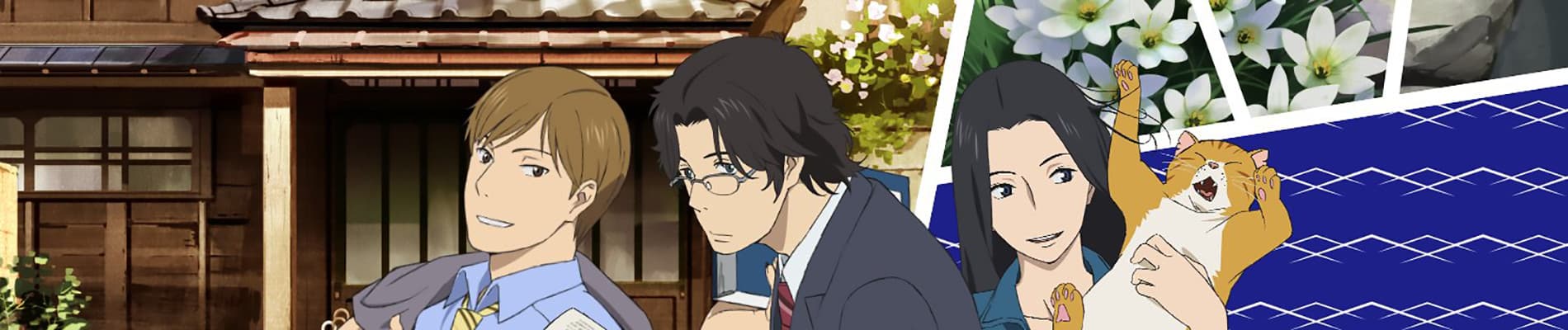
Muriel Rukeyser said that the universe is made of stories and not atoms, and as stories are made of words we can conclude that ultimately the universe is made of words. And with this in mind the anime I am going to review below gives us a beautiful love song to words and how they allow us to connect with others and the world around us.
Fune wo Amu or as it was titled in English, The Great Passage is an 11-episode anime based on the light novel written by Shion Miura, premiered during the fall 2016 season in the NoitaminA block. It was animated by Zexcs studio under the direction of Toshimasa Kuroyanagi.
The story begins when the head of the dictionary department of the Genbu Shobo publishing house, Kohei Araki, who is about to retire to devote time to his ailing wife, searches for an editor with sufficient knowledge and talent with words to replace him and finds him in the person of Mitsuya Majime, a shy man who, despite his fascination with the meaning of words, is unable to connect with other people and establish meaningful relationships with them.
Throughout its 11 episodes we follow Majime and the other members of the dictionary department in their quest to publish a dictionary very different from those that have been published before. And in addition to the human characters, words also become important protagonists in this story with their ability to build bridges of understanding between people who are very different from each other.
At the beginning Majime, a young, unsure of himself and inexperienced young man is trapped in a job as a salesman at the publishing house that he not only doesn't like but is not very good at, but a chance meeting with Masashi Nishioka, one of the editors of Genbu Shobo will put him on a collision course with his true passion: words.
A recurring theme in Fune wo Amu is the search for that which moves us, a passion to which to devote our lives and Majime, Nishioka and the rest of the dictionary department find it in devoting their time and talent to the development of the Daitokai or a dictionary that acts as a ship to sail the great ocean of words and carry its crew to the safe harbour of understanding and many of the characters refer to words in this way: the ship that carries us through the sometimes turbulent sea of words and their various definitions and uses.
Fune wo Amu is not only about how we use words, it is also a story about finding our place in the world and how difficult it is to communicate with others despite speaking the same language because the words we use not only have dictionary definitions but also carry within them intention and feeling. This is exemplified in Majime and Kagura's relationship, she a passionate foodie on her way to becoming a great chef, he introverted and not yet finding his place among his peers, and it is these differences that initially make me dislike the couple. I don't particularly like how Majime seems to fall in love with her at first sight and decide to make her his wife not only without ever having spoken to her but even worse without taking into account her feelings or her wishes.
These were my initial objections to a potential relationship between Kagura and Majime but upon further development of both characters we see that Majime is not incapable of expressing his feelings for Kagura in a way that she can understand because of the tired trope that men are from Mars and women are from Venus and that there can never be an understanding between the two or because of the fear of women that many anime protagonists suffer from but because Majime feels ill-equipped to make himself understood to his fellow man and despite his great knowledge of women. There can never be an understanding between the two, or because of that fear of women that many anime protagonists suffer from, but because Majime feels ill-equipped to make himself understood to his fellow man, and despite his great knowledge of words and their definitions when using them to make himself understood, they are not enough for him. It is this aspect of his personality and how we later see him come out of his shell a little in his relationships with the rest of the dictionary department and especially with Nishioka, that ultimately sells him as a character.
Fune wo Amu presents us with a battery of characters who in the end overcome the limitations of the medium in which they find themselves and become flesh and blood people with their ups and downs all united by their love of words and their willingness to dedicate their lives to the task of compiling them for the benefit of their fellow man, there is a recurring theme throughout the story that equates words with the thread that connects us all as a species and their importance in good relations between people. We are unable to fully relate to each other if we cannot understand each other, and it is with this mindset that everyone embarks on the creation of this dictionary for modernity.
In the end, Fune wo Amu, like its characters, is an anime that has ups and downs, especially the second half after a time skip that introduces new characters for which there is no time to develop them properly so emotionally you don't feel connected to them but what it does have is a lot of heart and a lot of passion and dedication to the story they want to tell.
Language as with all living creatures changes, evolves and transforms. New words are born and some others fall into disuse but it never ceases to have the same importance in how it serves for individuals to connect with each other and finally recognise that despite all the cultural, social or geographical barriers we are not so different at all.
I recommend that you give this anime a chance, a simple slice of life, which is easily consumed and does not disappoint.
I loved it if you give it a chance I swear you won't regret it.
25.5 out of 27 users liked this review