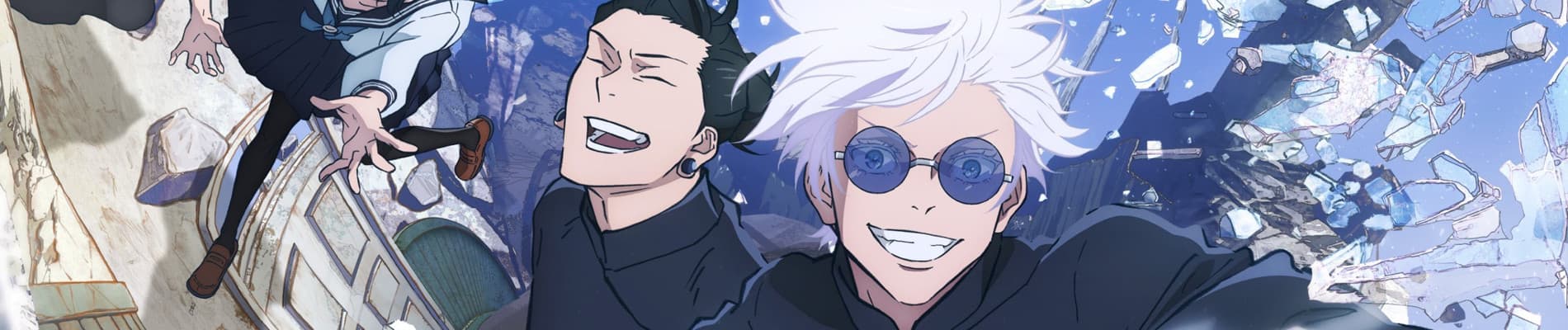
Jujutsu Kaisen Season 2 is a masterpiece and I kind of hate it.
It's a weird position to be in, I admit. My opinions of the first season of JJK weren't very intense: I liked it a lot, despite my many criticisms, and that was that. Just another mega-popular shonen elevated by a top-tier smorgasboard of action scenes and some truly excellent ass-kicking action girls. It certainly didn't feel like a show that would ever be worth expending as much thought as I've been doing the past couple months over the course of the Shibuya Incident. But somewhere between the first season's release and Jujutsu Kaisen becoming the third-biggest anime on the planet behind Attack on Titan and Demon Slayer, my feelings started curdling, so subtly that I barely even noticed until the second season came out and dragged them up to the surface. I love Jujutsu Kaisen Season 2, I hate Jujutsu Kaisen Season 2, it's one of the most triumphant and one of the most existentially depressing anime I've ever watched. It is, for better and worse, the most important anime of the 2023. And it's gonna take a very long time for me to fully parse out why.
From the outside, you might be thinking, "Gee, what did this show do to shake your opinions up so violently? It must've really gone in a different direction that completely upended what it's even about." But no. Quite the opposite, in fact; the Shibuya Incident arc that dominates season 2 after a brief flashback story is about as straightforward an arc as you can imagine. It's a single, massive, sprawling brawl across the streets of Shibuya, sorcerers and curses duking it out all over the map with the fate of golden boy Satoru Gojo on the line. It's nothing but fight after fight after fight after fight with increasingly broken superpowers and collateral damage, escalating to absurd degrees and never letting off the gas. Yes, there's a lot of consequential stuff that happens in this arc, but on a moment to moment basis it's as pure an action experience as anime has ever accomplished. No complex political factions, no deep symbolism or themes, just the sheer chaos of watching a city come undone under the collective onslaught of this superhuman war.
And it fucking rules.
The first season of Jujutsu Kaisen was already a marvel in the action department, don't get me wrong. But under the new direction of Shouta Goshozono, who's been responsible for some of the absolute best-directed anime episodes in recent years, that experience has gone absolutely nuclear. Every episode is astonishing in a different way, every fight pulls out some new animation technique that completely changes the timbre of the action, every scene is directed so uniquely and specifically that it's impossible to forget. As good as season 1's action was, it favored consistency over creativity and didn't really get to flex the true insanity that these curses and cursed powers are capable of. But season 2 fully embraces every animator's individual quirks and lets them run absolutely buckwild with it. Yuji's bathroom brawl with Choso is a searing cyberpunk-tinged smackdown. Sukuna's long-awaited return is a kaleidoscopic nightmare that feels pulled straight from a particularly nihilistic episode of Mob Psycho 100. Megumi's big spoileriffic fight paint the streets in surreal chaos reminiscent of early Masaaki Yuasa. And almost every single episode has this level of hyper-specific visual panache put into it. It is, without hyperbole, one of the most jaw-dropping achievements in anime spectacle of all time
And that's just the action scenes! That's not even counting how goddamn amazing this show looks outside of combat now! If you go back and watch season 1, it tended to play things really safe visually when it wasn't kicking up a fight. Conversation scenes and down moments are mostly functional-but-boring collections of shots that get the job done without leaving much of an impression. But with Goshozono at the helm, every single moment, from the most explosive showdowns to the simplest character-building conversations, is infused with life. Off-kilter camera angles imbue every line of dialogue with infinitely more meaning. The editing constantly catches you off guard in the best ways with how it draws your focus through a scene. There's some of the loveliest loosey-goosey comedic chibi animation I've seen in a long time. Every scene is distinct, every scene pops, every scene feels like its own unique entity in this mesmerising arthouse collage of styles and talents crashing together in somehow perfect harmony. I can think of very few shows in recent years that have looked this incredible and this experimental on such a consistent basis.
Which is wild enough on its own, but there's an additional level to this: Jujutsu Kaisen is pulling out all these experimental, ecclectic techniques in a mainstream shonen anime. And that just never happens. Mainstream shonen shooting for broad appeal never play things this risky and outside-the-box with their visual presentation. Sure, most of them look good with all the money pouring into them, but they also look, well, like Jujutsu Kaisen season 1. They're polished and pretty with all the edges sanded off and nary a risk taken, content that being flashy and detailed can make up for a standard visual palette. But JJK season 2 has taken the kind of aesthetic you'd normally see in underground cult classics from offbeat animators too rebellious to fit into the industry machine and translated it to the widest audience imaginable. It's introduced genuine artistry to this playing field, marrying the mainstream and the hipster and making it look like child's play. It's pushed the visual boundaries of mainstream shonen far beyond what they used to be, expanding what the most popular genre of anime can look like on a level I don't think we're fully prepared for. Imagine how many future adaptations will take cues from the course this season has charted. Imagine how creative, how experimental, the future of shonen anime might be thanks to JJK. That's a cause for celebration no matter how you look at it.
And yet.
And yet, there's a question I've been unable to stop thinking about ever since the Shibuya Incident really got underway: if it weren't for the masterpiece production... would I even like this arc?
And unfortunately, I think I know the answer.
Let's be brutally honest for a moment: Jujutsu Kaisen's biggest problem is, has been, and always will be that this show does not know how to goddamn focus. It's constantly introducing and throwing out plot points at seemingly random intervals, changing tracks and abandoning story threads before they're fully realized, even outright contradicting itself on a whim on multiple occasions. Hey, remember those two normal friends Yuji had back in the very first episode who he seemed to have a good relationship with and liked hanging out with? Well, JJK hopes you don't, because they completely vanished after the first episode and Yuji never so much as mentions them again, as if they never existed in the first place. Then it feels like it's setting up a classic shonen power trio with Megumi and Nobara, except then Yuji dies and has to hide his resurrection for another eight episodes so they never really develop as a group dynamic. Plus there was building up Junpei as a new friend-turned-antagonist only for him to get axed right off the bat, though at least that one tried to make some kind of thematic sense so it's not as egregious. But when you take a bird's-eye view of the whole unfolding story, it really becomes apparent how many times Jujutsu Kaisen will stop dead in its tracks, say "actually nevermind," and completely change direction, leaving whatever it was in the middle of developing to wither and die.
And if that was a problem in season 1, then good fucking god does season 2 push it into absurdity. There's a genuinely excellent five-episode prequel arc that finally gives a sense of stakes and thematic weight to one of the show's most central relationships... only to reveal mere episodes later that one of those people is already dead, and all the potential story threads that could've sprung from the seeds planted by Hidden Inventory are stamped out before they've even got a chance to bloom. One of the dead characters from that flashback arc is brought back in absurdly convoluted way and set on a collision course with the character from the present they have the most connection to, setting up a confrontation with real emotional weight for both participants... except then he just dies again without it ever mattering. There's an out-of-nowhere romantic subplot that only starts mattering when one participant is already on the verge of death and only matters to the other when she's mourning his loss despite them never having shared a scene before. Not to mention a_ major fucking character death_ that comes so out of nowhere it's genuinely hard to emotionally wrap your head around it and is possibly undone literally minutes later because???
Look, being chaotic and messy doesn't have to be a death knell, especially for shonen. So much of what made Hunter x Hunter work so well is leaning into the sheer messiness of its world and characters, letting them push each other in bizarre, risky directions that a more traditional story structure might not have the guts to pull off. But this doesn't feel like intentional chaos, it feels like Gege Akutani just doesn't know what kind of story they're trying to tell, changing their mind every other episode and undoing whatever plot threads they were starting to set up because they realized they weren't interested in continuing them. And it absolutely murders the emotional throughline of this show. Every potentially interesting, meaningful idea it brings up has a 50/50 chance of being hastily written out of the plot the second the author gets bored, leaving all that investment feeling wasted and pointless. At some point, it becomes hard to emotionally engage with anything the show tries to pull; why bother taking the risk when there's no guarantee it's even going to be paid off, let alone paid off well?
And the longer I sit with that feeling, the more it pricks at a far more frustrating question: why Jujutsu Kaisen? Why was this story, out of all the potential options, the one chosen for a once-in-a-decade animator's wet dream? Why were mostly flat antagonists like Mahito and Sukuna given spectacular enough fight scenes to sell their menace in a way the writing itself barely accomplishes? Why was Miwa and Mechamaru's half-finished sketch of a romantic subplot deserving of enough evocative, wrenching filmmaking to almost manage an emotional response in spite of its utter lack of development? Why spend all this time, effort, and crushing human misery polishing a deeply flawed story to a mirror shine instead of giving an already good story the royal treatment it actually deserves? Why is this worth dragging Mappa's animators through the fires of hell for? I mean, not that any show would be worth the apocalyptically bad working conditions Mappa's corporate masters force on their employees to fatten their own bank accounts- seriously, can we figure out how to unionize the anime industry already?- but with all the horror stories coming out of this mismanaged production, it's hard not to look at the end result and wonder: Really? This is what we've decided to bleed so many people dry for?
Of course, that question's also fairly rhetorical. I know the reason Jujutsu Kaisen gets this kind of treatment when plenty of far more deserving shows have to settle for scraps: because it's a shonen. And shonen will always be favored by the moneymaking powers that be as long as the people making those decisions are traditionalist old men who don't see women and girls as a viable demographic. We're finally coming out of years-long drought for shoujo and josei anime, a stretch of time when almost no works targeted at women and girls were given anything above a shoestring budget and C-tier production schedule, and yet shonen has never once failed to be given all the tools it needs to devour the competition. Trite, treacly mush like Demon Slayer is given enough polish to become an era-defining blockbuster while the possibility of a Yona of the Dawn season 2 becomes an increasingly painful impossibility. And Mappa itself, a studio that first made a name for itself by winning the hearts and wallets of women and queer audiences with Yuri on Ice, has put the sequel film to that cultural phenomenon on indefinite hiatus as it grinds its animators into dust churning out shonen adaptation after shonen adaptation. Because even the biggest smash hit imaginable, the show that made this studio a household name in the first place, doesn't matter if it doesn't cater to the only audience that the industry really seems to care about.
It's all of this I can't help but think about as I watch Jujutsu Kaisen top itself over and over again. In every mind-blowing fight scene, in every stunning display of cinematic brilliance, in every skill and talent the animators pour on screen, I see the countless other, more deserving shows that could've been something special with just a fraction of this support. Just this season alone, we had I'm in Love With the Villainness and Shy, two female-forward anime with far more compelling ideas and stories that could've been genuine hits if they hadn't been flopped out with the most cardboard productions imaginable from studios that just didn't have the time or energy to do them justice. Imagine if just a few of the people pouring their souls into prettying up Supernatural Boys Punch Demons Version 347 were able to offer their talents to those shows instead. Imagine if a beloved shoujo, yuri, or BL manga getting slapped with a bargain-bin production inspired as much outrage as a shonen adaptation having only a small handful of animation cuts below spectacular (Yes, I still remember how stupid the Chainsaw Man anime discourse got). Imagine if this industry favored stories for women even half as much as it valued stories for men. Hell, I'd even be partly satisfied if blockbuster shonen anime just stopped treating their female casts so abysmally. And JJK used to be one of the few to manage that! What the hell happened between that first season and now, Gege? Nobara deserved better, god dammit!
This is the contradiction of Jujutsu Kaisen Season 2. It's a masterclass of artistry that raises the bar for animated action everywhere, given to a story that doesn't deserve the honor of bearing it. It's a showcase of the most talented people working in this industry today, all putting their best efforts in to the least interesting project they could be providing their talents to. It's a mediocre franchise elevated to spectacular heights at the cost of potentially reaching even higher with a more worthy source material. It's all this industry's imagination and all its laziness, all its ambition and all its cowardice, rolled into a single shining exemplar of anime's infinite possibility that doubles as a condemnation of its priorities. And I've spent this entire season laughing with glee at at the heights it's reached while I feel my enthusiasm for the overall show slowly bleed away. Never before have I been left so in awe of what this medium is able to accomplish, yet simultaneously so exhausted by its unwillingness to spread that effort evenly.
In the end, Jujutsu Kaisen is both the greatest success and the greatest failure imaginable. As a showcase of animated spectacle from the industry's most talented up-and-comers, it's a landmark achievement that will rightly go down in history. As a continuation of Jujutsu Kaisen, it's a death knell for this story ever being worth more than the sum of its parts. And as a representation of where this industry currently stands, it just leaves me sad, tired, and hollow. It will be a long time before we get a show as singular and staggering as this again. I just hope next time, all this talent and effort goes toward a story that can actually do something meaningful with it.
59.5 out of 74 users liked this review