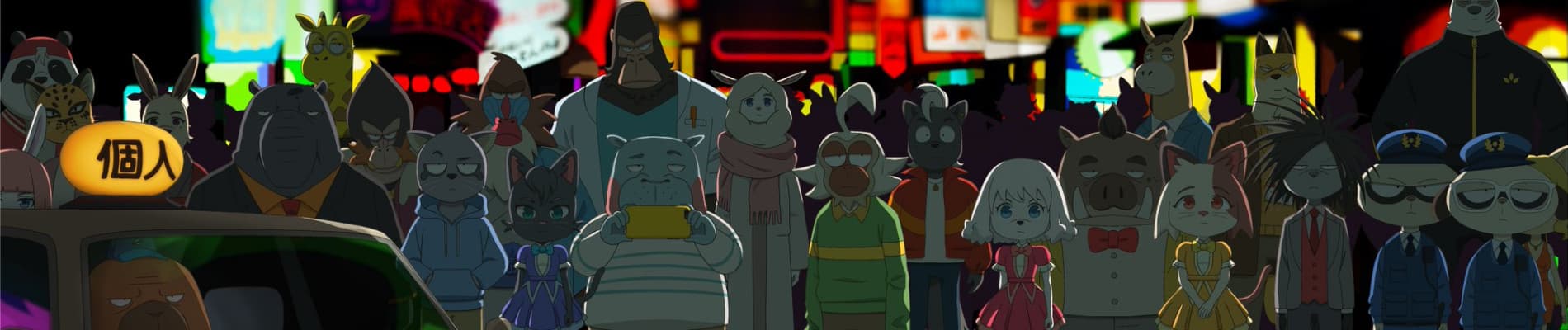
This review will offer my detailed thoughts and feelings about ODDTAXI. It also includes a table of contents for structural purposes and explains my rating criteria and categories, detailing which aspects I evaluated.
---
#Rating Scale
---
>[10] - Best of the Best
>[9] - Phenomenal
>[8] - Great
>[7] - Good
>[6] - Decent
>[5] - Average
>[4] - Boring
>[3] - Bad
>[2] - Really Bad
>[1] - The Worst
---
#Rating Categories
---
All of the rating categories are judged based on my pure enjoyment and the positive experiences I had with them. ''Objective'' qualities will not be judged because I'm not an expert on these fields, just a guy who watches anime.
>- Story/Plot (40%)
- World Building (5%)
- Characters (25%)
- Animation/Art (10%)
- Cinematography (10%)
- Sound/Music (10%)
=
My overall enjoyment from the anime. (100%)
---
#Table of Contents
---
>- Introduction
- My Expectations
- Story/Plot
- World Building
- Characters
- Cinematography
- Animation/Art
- Sound/Music
- Overall Thoughts & Final Rating
---
#Introduction
---
First of all, welcome to my first-ever written review. My name is Galios, and I am just an overly invested fan of anime and manga who loves to talk and argue about them in a very worrying and unhealthy way. These attributes make me surely a perfect candidate to write a review about. Right? But who cares about me? Let's get going and let's dive into my thoughts on ODDTAXI!
When approaching new media, everyone tends to have expectations. Personally, I like to keep mine low to avoid potential disappointment, a strategy that's worked well for me in the past and often led to a greater appreciation for unfamiliar content.
However, with ODDTAXI!, keeping those expectations low was a bit challenging for me. The anime had gained significant popularity and success, falling into genres I particularly enjoy like Psychological and Thriller.
I didn't know much about the parties involved, such as the animation studio, staff, or source material. Still, it grabbed my attention with initial impressions describing it as a ''breath of fresh air'' and a ''super simple yet unique experience'', descriptions that definitely piqued my interest.
Despite my curiosity, finding time to watch it initially slipped my mind. But here we are now, and I finally have the opportunity to see what all the acclaim is about
In a nutshell, the story is about ‘'animal people dealing with human problems.'’ I'm not planning to do a detailed story analysis or recap because, honestly, the best way to grasp it is to watch the show. However, if you're looking for my detailed thoughts and want to dive into specific episode storylines and beats that I found particularly captivating and can't wait to discuss, you're in the right place.
Let's start with discussing things in chronological order. While looking back, I see the first episodes (1-3) as a solid build-up for the story. However, purely in terms of enjoyment, these episodes were decent for me. Nothing exceptionally interesting happened; characters were introduced, and their personalities, as well as their everyday lives, were showcased. It provided a solid foundation but wasn't necessarily 'important' in the sense that you need to catch every word or scene to understand the story. This is acceptable because the conversations between characters and the portrayal of their lives felt genuine, capturing the essence of big city life quite well. However, to fully enjoy these interactions, I craved more interesting events or subjects that had a greater integration into the overall story.
After all the introductions, general story buildups, and becoming familiar with the characters, we move on to the fourth episode, which I'm eager to discuss as it stands out as one of the significant highlights of this series.
Where do I begin? What immediately caught my attention was the sudden introduction of a new character who had only appeared in one scene during the initial three episodes. This unexpected entry marks a significant departure from the previous narrative, almost serving as a palate cleanser for viewers immersed in a straightforward story build-up.
The introduction of Tanaka's character left me initially perplexed without context. In the first scene, he was running on a sidewalk, clad in dirty clothes, and sporting deranged eyes. I pondered the reason for his sprint, was he running away from someone, or was it something else? What also caught my attention were his eyes, reflecting the obsession of an individual fixated on something. They didn't convey fear but rather an ''obsessive'' demeanor, a correct assumption as Tanaka later becomes a perfect example of how life can ‘’fuck you up’’ due to shortsighted decisions. This episode skillfully unveils his tragic backstory.
His backstory unfolds as follows: In a bid to gain popularity among his schoolmates, Tanaka followed the trend of collecting unique erasers. Even after the trend faded, his fixation on making friends persisted. Taking drastic measures, he stole his father's credit card, used his brother's PC without permission, and splurged on an exorbitant mandrill monkey eraser, only to fall victim to a scam. The resulting trauma left him a soulless young man, devoid of passion or drive. His plunge into addiction to a pay-to-win mobile game severely undermined his skills as a video game developer and overall coherence. Discovering that the person who scammed him was also the top player in the same game fueled his determination to surpass him at any cost. To cap off his backstory, he finally defeated ''Ditch-11'' by obtaining a rare creature in an alley, only to have it invalidated when Odokawa almost collided with him in his taxi. Dodging the accident, Tanaka dropped his phone in a water-filled ditch, shattering it and rendering the rare creature useless. This mentally shattered him, transforming him into an obsessed man hell-bent on revenge.
In my view, this stands as the most coherent and comprehensible character backstory for a ‘'villain,’' perfectly told within a 24-minute timeframe. Tanaka, initially introduced as a very naive but still innocent character, evolved into a shattered individual fixated on revenge against those he perceives to have wronged him. His distorted perspective on life refuses to acknowledge his own shortsighted decisions that landed him in this position in the first place, making him an overall great villain with a lot of depth and believability behind his actions.
After this episode, there were numerous standout moments. The highly anticipated reveal of Yano was not only hilariously entertaining, as he started spitting some bars at Odokawa, but it also left Odokawa utterly perplexed by this guy. Witnessing Odokawa and Dobu come to the rescue of poor, old, love-seeking Kakihana from Yano and his yakuza goons was both heartwarming and intense. It was also satisfying to see Kabasawa, the attention-seeking character, finally getting what he deserved.
The revelation of the identity of the corpse from the first episode, along with insights into Nikaidou’s real personality and her initial guilt about the disposal of the corpse, added layers to the story.
The capoeira animation featuring Shirakawa was a comedic gem that made Shirakawa even more adorable.
However, my main interest lies in discussing the last two episodes; episode 12 for its concluding storylines and intriguing main narrative, and episode 13 for reasons that are quite obvious.
This episode wraps up the side character storylines involving the police Daimon brothers, Ani and Otouto, the Homo sapiens comedy duo Shibagaki and Baba, and the street thug Dobu and the absolute bat shit crazy Tanaka. While most of these particular storylines weren't the most captivating for me, they were decently presented, and I found myself not entirely indifferent to all of them.
Delving into the Daimon brothers' storyline, their minor role in the main plot took an unexpected and dramatic turn in this episode. The revelation sheds light on Ani's corruption and Otouto's unwavering sense of justice. Ani's motivations lead back to the yakuza boss, resembling a tapir named Kuroda, who supported him during his orphanhood. Ani's allegiance to Dobu also served Kuroda, a fact sympathetically understood by Otouto but impossible to ignore due to his righteous personality. Despite its brevity, this side storyline had a highly fitting conclusion, making both characters remarkably sympathetic despite their initially surface-level appearance in the show.
Next is the Homo sapiens storyline. This felt quite insignificant to the major storyline, or more like it had no real involvement in it. While Baba had a romantic relationship with Nikaidou, there was no real connection between them and the main storyline with Odokawa, despite their brief meeting in the taxi. What I can relate to is that the comedy duo had one goal of trying to be successful comedians. However, due to changed circumstances, the inexperienced and rather naive Baba gets opportunity after opportunity for his career alone, while Shibasaki's career suffers from stagnation. Shibasaki's frustration was authentically presented, in my opinion, as he tried his best to focus on the duo's goal and improve as a comedian himself. Still, Baba’s naive and egotistical thought process that his career is more important set Shibasaki off in the last round of their comedian competition as the final conclusion to their storyline. Ultimately, I find their storyline pretty insignificant in the grand scheme of things, but their career struggles and problems as a duo were authentically shown, and it felt way too real for just a mediocre side storyline.
And lastly, Tanaka and Dobu. It's so ironic that Dobu, of all people, was the one who scammed Tanaka in the first place, essentially creating this 'mental dumpster fire of a man.' The revelation of this conundrum was incredibly cathartic and hilarious to watch. Tanaka notices the mandrill eraser on Dobu and then slowly realizes that Dobu was the one who had been scamming him all along. Then, Dobu confidently lies through his teeth, denying all involvement while thinking Tanaka had no bullets left. Tanaka completely realizes that Dobu is indeed Ditch-11 and then mercilessly blasts him in the abdomen with Dobu's gun (also very ironic). This leaves Dobu in absolute shock, pondering how this scenario was possible, lying bleeding on the ground, while Tanaka frantically runs away. The story conclusions for Tanaka and Dobu were just perfect.
This episode serves as the perfect ending to the show, and I can't emphasize enough how phenomenal it was. Odokawa's backstory was emotionally heartbreaking, and the revelation explaining why we see animal people in the first place was a genius moment for me, adding layers to Odokawa as a uniquely complex main character. The montage of every significant character in the show cinematically experiencing their cathartic ending scenes, with Odokawa's taxi plummeting into the river, is nothing short of art. It's undeniable that this is straight-up art, just phenomenal.
But that's not all. The plot twist on who actually killed the cat idol was the most unpredictable and shocking revelation from my perspective, and my jaw dropped when it dawned on me. Seeing this psycho of a person step into Odokawa's taxi while smiling at the camera gave me literal chills.
This single episode makes enduring 12 episodes of mundane story buildup completely worthwhile. That's how phenomenal this episode is. It delivered the most shocking yet incredibly rewarding revelation in a story that I've experienced in such a long time.
Overall, the story had a slow start, primarily due to the necessary buildup. However, the peaks of the narrative, such as Episode 4 and the concluding episodes 12 and 13, are absolutely phenomenal and elevate this show to a whole new level storywise. While my thoughts may still seem somewhat recapped, there wasn't really something to ''interpret'' or ''a core message'' to derive because this piece of art speaks for itself. The story speaks for itself. The characters speak for themselves. It is just a phenomenally authentic story about animal humans grappling with human problems presented in a very unique way.
In this series, worldbuilding generally takes a somewhat secondary role compared to the development of storylines and characters. Despite this simplistic approach, it proves sufficient to authentically and coherently portray big city life in Tokyo. Throughout the narrative, we encounter recurring settings like Odokawa's home, the doctor's office, and the sauna, among others. While these locations are easily recognizable, they lack substantial details or aspects that might inspire deeper thoughts or a profound appreciation for the set pieces. Essentially, they're quite ordinary and unremarkable. Tokyo, in general, seems to serve as a surface-level backdrop, with worldbuilding appearing to be an afterthought.
Which is totally fine, by the way. It's just that, when compared to the other aspects, I've found more enjoyment in the narratives and the characters than in the portrayal of Tokyo or any of the shown set pieces.
I adore Odokawa as the main character; he's eccentric, unabashedly straightforward, socially awkward, and his grumpy walrus face is both amusing and endearing. He's my secret spirit animal, and what I appreciate most is his knack for calling out the fake social behavior and irrelevant small talk ingrained in most of us in modern-day society. He couldn't care less about conforming to social norms when conversing with others, resulting in incredibly amusing and intriguing exchanges throughout the series.
Thanks to his non-judgmental demeanor, many people feel comfortable opening up and confessing their genuine thoughts and beliefs to Odokawa. Essentially, he functions as a therapist on wheels, a concept that, while somewhat familiar in other media I've encountered, feels remarkably fresh within the anime realm. From my perspective, it's a genuinely invigorating departure to witness the portrayal of individuals sharing their emotional baggage with a stranger in the anime landscape.
And not to forget his undoubtedly phenomenal backstory, detailing his character's personality and his perception of the world and people around him, serves as an exceptionally cathartic exploration of his trauma, social awkwardness, and the reasons behind his choice to become a taxi driver. This entire narrative package is as remarkable as Tanaka’s backstory, even more so given that he is the main character. It's exceedingly rare to encounter a main character written and portrayed with such fantastic simplicity yet uniqueness.
I delved into his episode in great detail, characterizing him as an absolute nut job. This is why I consider him the best antagonist, surpassing Dobu, Yano, or any other contender. Tanaka represents a deeply unsettling yet realistic outcome of unfortunate life circumstances that can morph an individual into a scary and dangerous person. His vengeful obsession, unpredictable behavior, and delusional worldview embody the consequences of bad life choices. This makes him relatable in a pitbullish way but also alarming, showcasing how life can deal a giant middle finger if you're too shortsighted to seek help. Actions have consequences, and his shortsighted and naive decisions led him into a dopamine spiral with no apparent escape route.
Ironically, when he was on the brink of ending his life, Odokawa’s supposed death "saved" him, fulfilling the very desire he had from the beginning. This twist brings his story full circle. His delusional hatred against Odokawa ceased when he believed Odokawa had met his demise.
The big baddy Dobu, cunning, strong, and very full of himself. He's an authentic portrayal of a ‘'bad guy who’s cool.’' He serves as a great story tool to move the plot further and is nonchalantly a very badass guy. His power struggle against Yano is also cool and interesting to watch, but this is where my positive thoughts end, or the general thoughts I have about him. As a character, he's not really delved into. His backstory and motivation for why he’s doing things are kind of vague and imply just his absolute loyalty to his yakuza boss. However, other actions, like the revelations of his Ditch-11 persona, show he’s had a bad side always in him, but we really get no clear conclusion on it, which is kinda disappointing. But he still functions well within the story and is generally a cool character.
Supa Hot Fire aka Yano is an emo kid who raps all the time. As dumb as this sounds, this guy is just a joy to watch. He is the only character who kinda feels like a cartoon villain. You can’t really take him seriously at all, and I enjoyed every bit of him. The final scene where he stops rapping because of his shock at being bamboozled by Dobu was so funny. I like Yano; he’s such a dumb character compared to all the other ones which focus much on authenticity.
Honorable mentions: Shirakawa, Kakihana, Nikaidou, Yamamoto and that absolute pyscho Wadagaki. (this cat watched to much perfect blue.)
Overall, all characters have different stories, and I feel differently about each of them, but one thing in common with everybody except Yano: all of them are authentic portrayals of human beings surviving the oppression of big city life.
I'm definitely not an expert, nor do I claim to be, but if you're someone who enjoys watching media and experiences more of it, you kind of develop an eye for what works for you, and if something looks noticeably different than others.
Odd Taxi's cinematography is very influenced by Japanese TV drama. There are a lot of static shots with people interacting with each other, but they still perfectly encapsulate conversations most of the time and are very good at showing details that help to understand the context of the story within the scene. However, the absolute highlight is definitely the Flying Taxi scene.

Throughout most of the series, the animation doesn't stand out. The blurry art style for backgrounds is okay, and the CGI cars are borderline acceptable, not too bad. However, there are unique exceptions like the opening and the ending, which are absolutely fantastic in every way.
Especially the Opening, there is like so much information and foreshadowing in it presented in such a unique visual way. Hats off to the director Daiki Kamoshita.
Also, due to the clear focus on the narrative and the characters, the animation and art style take a back seat, much like the world-building, which is completely secondary compared to those aspects. So, it's kinda forgivable for a rather unimpressive art style and okay animations.
Obviously, the OP/ED are bangers. No questions asked. I dig the OP the most because of the rather soothing nostalgic vocals, along with the added woo-woo vocals and the lofi/jazz beat. It has this vibe of driving through a busy city, which perfectly suits this show in my opinion.
The ED is also great, with the idol group Mystery Kiss performing it and sounding authentically like an idol group in the Pop genre.
And I can’t forget the OST. Most of the tracks don’t stand out individually, but they suit their characters insanely well. Yano's theme is a great example of this. Also, Fairy Tale, the track used for the flying taxi scene, is also phenomenal.


Expressing my concluding thoughts becomes challenging after delving deep into the intricate details. Yet, I can confidently declare that this show deserves the hype. It stands out from the typical anime fare, with characters and their stories feeling remarkably authentic and coherent. The overall narrative payoff is truly fantastic. However, as I mentioned in the beginning, I'm just an overly invested anime/manga fan who sometimes writes a lot of gibberish. If you've gone through this entire manifesto, good job on wasting your time, because instead of reading this high quality gibberish, you should have been watching anime or reading manga.
5 out of 5 users liked this review
