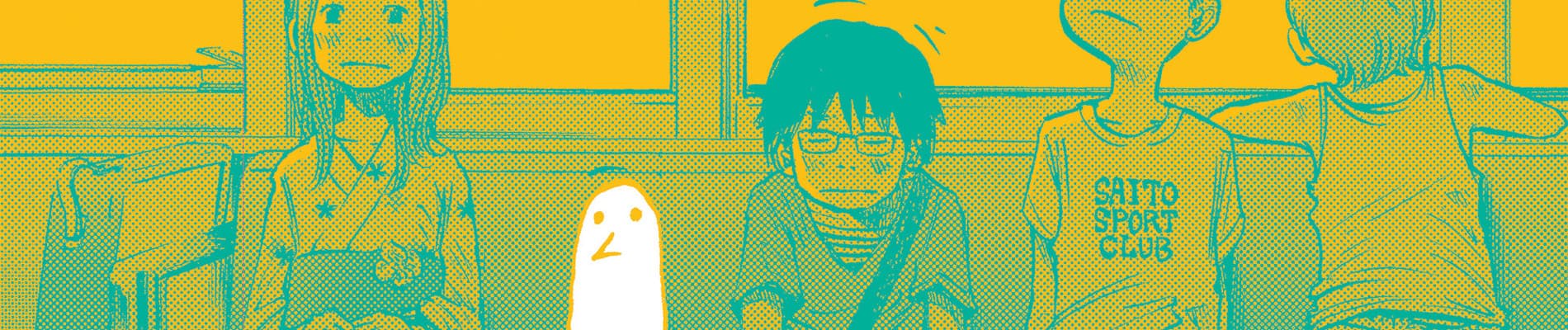
An unexpected playdate, a window seat in your classroom with a beautiful view of falling snow, a formative video game, a promise. Nostalgia is imbued in the human experience, no matter how mundane your life. Goodnight Punpun begins with Punpun, a young, shy boy, and his falling for the new girl in school. At the same time, his home life is falling apart, and he's growing to see the intricacies and pain of the world around him. Throughout the early parts of the series, Punpun bonds with Aiko, the new girl, and he visualizes her as an escape from the ever-increasingly plain and phony world; however, when push came to shove and she asked him to run away with her, his meekness forbade him. The series continues, charting his life from middle school into post-high school. Given that it is tens of chapters worth of story, it's no use to summarize and it is only worth noting that it is some of the most bizarre yet realistic writing I have ever come across; there are simply too many side stories and analyses' to even begin to get into. Finally, however, the story comes to a head when -- after giving up all his philosophies, Punpun models himself off his "everyday Chad" neighbor -- he reunites with Aiko. Without spoiling, what follows is some of the most emotionally brutal, gut-wrenching, writing and drawing I have ever consumed. Though there are multitudes of theories and philosophies one can divine from the story, one of the simpler and broadest is that Aiko is a representation of nostalgia and the childish belief that there is a world outside ours, one we can run away to. Many times, I have found myself painfully reminiscing and even taking action to try and replicate the conditions in the original event; a recent example was purchasing a used 3DS for the purpose of playing old Pokemon games. It is a subconscious feeling that drives me; I want to get a high-paying job and have a free lifestyle purely so that I can recreate those old feelings before their design is lost forever. In Goodnight Punpun, Punpun actually receives that chance, finally running away with Aiko. However, the impossibility of those feelings reveals itself; they're not kids anymore. In the most heart-wrenching Bonnie and Clyde situation I've ever read, Punpun and Aiko fight against their family, society, their lust, and themselves. A whole essay can be written on the story's ideas on desecration as reverence, and maybe I will someday. Eventually, it all comes to an unsparing end; Punpun watches all of his childhood desires, everything he has lived for up until now, get slaughtered in front of him. There is so, so, so, so much more that can be written about this manga, and it truly has earned its reputation. I haven't felt this visceral of an emotional hole since finishing Evangelion.
>I’m afraid it will be cloudy on tanabata forever