This review contains spoilers, however it's still safe to read for those unfamiliar with the series. I try to keep things as abstract as possible, but there are some concrete examples and specific plot details within. I’ll include a warning before they come up and spoiler tag anything beyond light spoilers, so feel free to read even if you haven’t read the series.
Love. A profoundly human emotion, a magical four-letter word known by all but only truly understood by those wrapped in its warm embrace. Love encapsulates the extremes of all emotion: the unimaginable bliss of being with the one you care about most in the world, and the knowledge that they feel the same way; the unbearable pain of heartbreak, the grief for a love that has since died; the anticipation, the excitement surrounding the formation and development of a loving relationship; and many, many more. Love can cover the entire spectrum of emotions, reaching the peaks of joy or the depths of despair. And there is no series that depicts love, with its infinite number of forms and associated emotions, better than Bloom Into You.
Words cannot begin to describe the profound emotional impact Bloom Into You had on me, both when I read it for the first time and when I recently reread it. Similar to other SoL dramas like Hibike! or Shirobako, Bloom Into You pulls you into its world and refuses to let go. The more you read, the more attached to both the story and characters you become, making the climactic moments all the more powerful. And believe me, these moments deliver an inconceivable payoff surpassing all expectations.
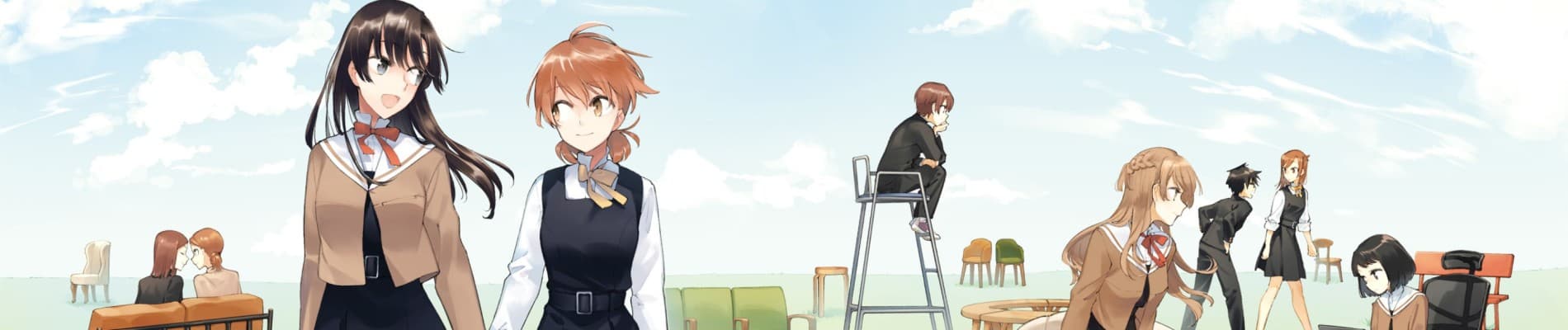
Following Yuu Koito, a girl who doesn’t understand love, and her senpai, student council president Nanami Touko, the series uses these characters (and the rest of its well-written, lovable cast) to examine love from a variety of different angles and perspectives. Whether it’s a fanciful crush, an unrequited love, or the blossoming of a brand new relationship, Bloom Into You manages to weave so many different heartfelt examples of love into its story.
But Bloom Into You is not just a simple romance manga. The series moves far beyond romance, lust, and affection; sure, these are omnipresent in the story, but only as a part of a much greater, more powerful whole. Bloom Into You is about the human desire for intimate connection and the emotional whirlwind that comes with it. Not to sound cliche, but Bloom Into You is about love in its purest, truest, and most intimate form.
Reaching this wonderful state, this pinnacle of love, requires effort from both sides. Love is not a given, it is a journey undertaken and explored by those in love. To truly attain love at its purest, you must be willing to open up to others and become emotionally vulnerable. Because our vulnerabilities—our scars, weaknesses, and insecurities—are a part of who we are, and it’s only by having them accepted, and accepting them in turn, that we can truly reach this enchanting, one-of-a-kind state.
Bloom Into You doesn’t shy away from this vulnerability, fully exposing the more “private” side of love. The series is not afraid to show us Yuu & Touko’s relationship in full, establishing an intimate connection between the reader and the main characters. This open-book nature allows us to truly “fall in love” with the characters, demonstrating each small step of their relationship and creating a more intimate, heartfelt, and genuine experience than most other romances.
This genuineness, thanks to the vulnerability at display, makes the characters feel so alive. I can confidently say that Bloom Into You has one of the best and most well-written casts of characters I've seen: every character is so nuanced, lifelike, and endearing, and their chemistry—especially Yuu & Touko’s—is clearly palpable. Not to mention Sayaka, who is on par with Yuu and Touko in both complexity and likability, having her own incredible narrative arc that ties in perfectly with the main story (as well as an awesome spin-off LN series!). Even the other side characters like Maki, Dojima, and Yuu’s friends feel fleshed-out and realistic, which makes the entire manga feel so down-to-earth and real.
Bloom Into You displays countless examples of love and its accompanying emotions. I briefly touched on some of them before, but I want to dedicate this paragraph to listing out some (but not all) of the feelings and concepts that the series perfectly captures involving love. Whether it’s the immense loneliness of being separated from your partner, the difficulty in both confessing and responding to others’ feelings, the cowardice that can develop in the face of love, the antsiness and nervousness just from talking to your lover, or how painful it can be to lose everything, the series superbly weaves all of these ideas and more into its spectacular narrative. Reading Bloom really makes me feel like I myself am in a loving relationship, experiencing all these tumultuous and exciting feelings firsthand. And its depictions are so distinctly human, reaching a level of genuineness I’ve rarely seen before.
Warning, the next paragraph contains very light spoilers. It’s kept as abstract as possible, but uses a concrete idea as an example.
One of my favorite portrayals of love in the series stems from one character’s belief that love is akin to shackles: if someone says they love you, isn’t that the same as them saying they love the current you, that they never want you never to change? But another character beautifully posits that change is okay, and even perfectly natural. Even if the person you love changes, it’s alright as long as they stay true to the reason(s) you fell in love with them in the first place. In that sense, love is an expression of trust: it’s faith placed in your lover that they will uphold the qualities, but maybe not the specific attributes, that made you originally fall in love with them. This means that love and change aren’t mutually exclusive; a person can lose what made you originally fall in love with them, but still maintain qualities that you love. This is by far the best definition of love I've ever heard and one of my all-time favorite quotes. And this is just one of the many ways Bloom Into You examines and portrays love.
Bloom Into You is a story about identity as much as it is love. The series primarily explores its themes of love through Yuu & Touko’s relationship (as well as the relationships of the rest of the cast), but their individual coming-of-age stories are equally important. Both through Yuu’s journey to discover her sexuality and Touko’s to find her own individuality is the series able to deeply explore complex themes of self-discovery and identity.
Yuu, simply put, is romantically and sexually confused. All her life, she’s consumed romance media and seen depictions of people whisked away by love. Her subsequent encounters, both with the boy who confessed to her and her first kiss with Touko, did nothing for her. They didn’t make her heart flutter or leap out of her chest like she had read about: she felt nothing. She so greatly desired a love that would sweep her off her feet, one that matched her expectations created by the media she consumed and persisted by society as a whole.
Warning, the next two paragraphs in particular contain spoilers.
Spoiler, click to viewclick to hideYuu is also known to primarily go with the flow, doing what is expected of her but never getting too involved. And this is equally the case for love: she expects to get whisked away, without putting in any effort herself. But her relationship with Touko teaches her that a loving relationship takes work to create and maintain. And as she falls in love with Touko (her narrative opposite, who is constantly pushing for the things she wants), she learns to take action for the things she believes in and people she cares about.
Spoiler, click to viewclick to hideAnd it’s Touko’s journey of self-discovery that propels Yuu’s forward to reach this state. Touko, in trying to imitate (a facet of) someone she’s not, struggles alone under an immense burden until she meets Yuu. Finding an (arguably unhealthy) outlet for her pent-up emotions, she furthers Yuu’s journey of self-discovery while working towards her ultimate goal of the play. And through a clever use of the play as a means to inspire Touko (and as a brilliant plot device), Touko is finally able to take that step forward towards being herself, realizing that she can choose her own path. With Yuu’s help, she realizes that the people around her care about her, not her sister, and that everything she’s worked for, the facade she’s created, came about thanks to her own effort and ability. Her life is her own, and she can be proud of it and love herself as others do in turn. She can drop the mask, express weakness, and act like a normal girl. And this journey is fantastic: watching Touko take these steps forward, truly finding herself and shining resplendently, is simply sublime to read.
Yuu and Touko push each other forward through their own journeys of self-discovery, and it’s by helping each other through them that they are able to expose their vulnerabilities and enter a genuine loving relationship. It's in this way that the series beautifully entwines its themes of love and identity, signifying that those in a loving relationship should help and inspire each other through their own introspective journeys.
Tying in with the series’ theme of love mentioned earlier, Yuu’s journey is a perfect example of how each person’s experience with love can be unique. Her experience far differed from the ones propagated by romance media and society, requiring significant time and effort to properly develop. By depicting this stark contrast, Bloom Into You demonstrates how you shouldn’t feel pressured to fit into society’s mold; instead, you should move at your own pace, forging your own path through love. Because there's no wrong path or answer, nor is there an instruction manual to guide you through this journey. It's up to you to experiment, discover, and learn about yourself, to find what works for you.
Somehow I’ve gotten this far without even mentioning the obvious: Bloom Into You is a girls’ love, or a yuri. But it’s not just a simple yuri manga: the series uses yuri as a lens in which to examine love, specifically emphasizing that, similar to what Yuu’s journey represents, each loving relationship is different. This may (hopefully) be stating the obvious, but love doesn’t have to be between a boy and a girl. Love does not conform to society’s standards, nor does it bend to the will of others. Love is far more complex than that, and in Bloom’s case, a loving relationship can even be irrespective of sexuality. By building this idea into the very foundation of the series, Bloom Into You already implicitly emphasizes one of its core themes: that each loving relationship is distinct and special.
The next paragraph contains spoilers pertaining to the ending of the series.
Spoiler, click to viewclick to hideThe epilogue of the series is also phenomenal. It’s so good I just had to mention it, and it’s quite possibly my favorite ending to any series ever. There was more than enough (nonsexual) fanservice to leave me satisfied, like Yuu & Touko’s date and the continued progression of their relationship, and the final chapter was an exemplary conclusion to the series. The use of the play again as a way to nostalgically look back at all their past events, their third visit to the iconic river with the stepping stones, and their firm resolve to support each other as they move forward in life legitimately made me cry with how perfectly beautiful it was. It’s not the end of their journey, it’s the start of their new one through life together. I could not have asked for a better ending.
As I’ve talked a lot about how incredible this manga is, I’d like to spend this paragraph and the next responding to the most common complaint about Bloom Into You, specifically regarding the first kiss. Many people read (or watch) the first few chapters/episodes, see that scene, and are immediately turned off because of the sexual assault. And while sexual assault is like a perennial thorn in the side of yuri/yaoi series—acting as an ever-present nuisance in Japanese LGBT media—I disagree that this instance is in poor taste.
Unfortunately, to explain this, I have to discuss the series as a whole, so this next paragraph contains major spoilers.
Spoiler, click to viewclick to hideWhile I can’t disagree with the fact that a sexual assaulter “wins” in the end, I think that viewing it in this light ignores all of Touko’s meaningful character development. At the beginning of the series, she’s a deeply traumatized and damaged person suffering under a burden of immense pressure, originating from her desire to become someone she’s not. She’s a very lonely person who practically leaps at the first chance to express these emotions, relying heavily on Yuu as an unhealthy outlet for her pent-up emotions (while Yuu simultaneously uses her to try and understand love). But, as I explained above, Touko becomes a vastly different person after the play, and her relationship with Yuu (who has now grown to love Touko) is completely different as well. So concentrating on the sexual assault at the start of the series, which she not only felt guilty about but also did in an unhealthy state of mind, feels wrong to me. Not to mention the scene serves an important narrative purpose for Yuu’s character, demonstrating how indifferent to love she is. Hell, she got assaulted and had her first kiss stolen, and she does not care. The series only “downplays” the sexual assault because it doesn’t matter to Yuu; it’s not meant to romanticize it.
But if you find the scene reprehensible and it ruins the series for you, I’m sorry to hear that. Media is an art form interpreted and appreciated by the consumer, so each person's experience will be different. And I’m not trying to justify the action she took: I’m just offering insight into her character, which won’t excuse her actions but will allow you to understand them. To those who are on the fence of reading (or dropping) for this reason, I urge you to read for yourself and come to your own conclusions. I assure you, it's worth a shot.
Nio Nakatani truly created a masterpiece, not only serving as an emotional coming-of-age SoL, but also splendidly displaying so many different types of love. Yuu & Touko’s relationship is also my favorite romance ever, and I’m so grateful to have had the chance to read this one-of-a-kind story. I can’t thank Nakatani enough for creating this phenomenal series, one that I’ll surely never forget.
P.S. please give the anime a second season, I’m begging you