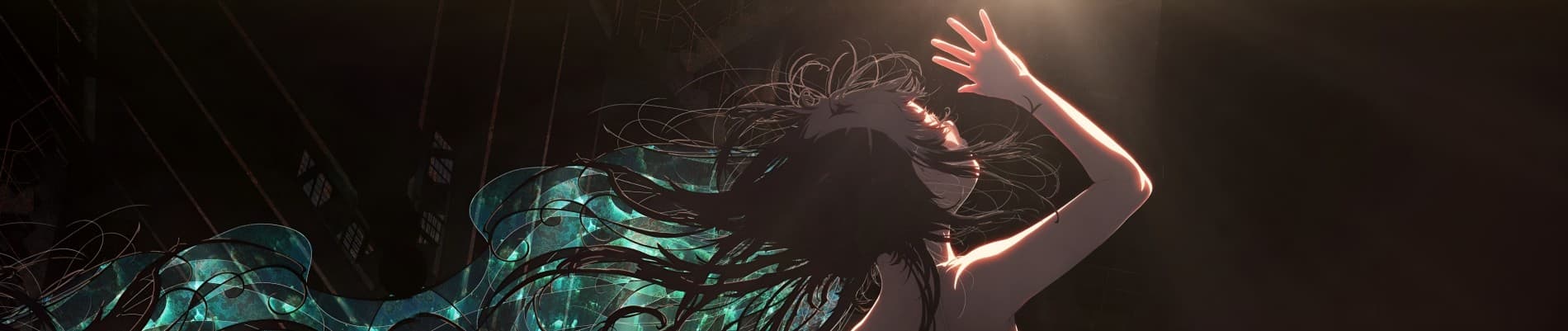
Oh, Mari Okada, I wish I knew how I felt about you as a creator. After her theatrical debut with Maquia: When The Promised Flower Blooms, she's back in the director's seat with a brand new movie, Maboroshi, or if you wanna use its Japanese title, Alice and Therese's Illusion Factory. No, I don't know why the Japanese title is so strange. I read something about how the names Alice and Therese, when said in Japanese together, also pronounce the name Aristotle in their language, which makes you wonder why they didn't just call it Aristotle's Illusion Factory, especially since there are no characters named Alice and Therese in the film, but I digress. Anyway, Mari Okada is pretty prominent in the anime circle, and people tend to be divided on what she works on or creates. Some like her stuff, others hate it, and some are mixed. There are anime she's worked on that I really love, such as AnoHana, Maquia, and Anthem of the Heart, but also titles that I'm really not a fan of, such as A Whisker Away, A Lull In The Sea, and Hanasaku Iroha. If you get the chance, I highly recommend you read her autobiography, as it's really enlightening and fascinating. Now that Maboroshi is out (I'm going to refer to it by the official English title that Netflix gave it for the sake of brevity)...unfortunately, I don't feel this movie is as good as Maquia. Someone on a blog I follow described it best, that Maboroshi is the most Mari Okada movie ever made, with all of her indulgences and writing tropes concentrated into one movie. Not gonna lie, they're absolutely right, and unfortunately, this isn't one of her better movies, which is a shame because there is a lot to like about it!
14-year-old Masamune Kikuiri is your average middle school kid who likes hanging with his friends and practicing drawing in his rural Japanese town. One day, an explosion at the local steelworks factory literally shatters the sky as if by magic, cutting the town off from the rest of Japan. Time is literally frozen. Nobody ages or grows old, the seasons never change, there's no new forms of entertainment, the world has truly become static. Everyone trudges on, hoping the world will right itself, but nothing changes. One day, Masamune has an unpleasant encounter with his mysterious classmate Mutsumi Sagami, who sneaks him into the abandoned factory to show him something...or rather, someone: A feral girl she's been taking care of in secret, whom Masamune names Itsumi. Upon getting to know her and the circumstances surrounding her imprisonment, Masamune discovers that Itsumi's existence might just be the key to figuring out why the town is in the state that its in. But some people fear what could happen if things change, doing all they can to keep the kids from helping Itsumi.
Gentle reader, I ask you, did you ever read that Ursula K. Le Guin book The Ones Who Walk Away From Omelas and wonder why nobody in the book bothers to just rescue the abused child from their imprisonment? Mari Okada decided to actually do just that, taking that one question and building the whole house around it, which forms the backbone of Maboroshi. The story is actually the most interesting part about this movie, really going deep into examining just what being stuck in a truly static world and never physically changing does to a person and a whole community. Imagine being an elderly person who struggles with daily tasks who can't even die, or a pregnant woman whose child will never be born. It also explores what happens when people look to those who seem like they have the answers, even if the person in question is a crazy old coot whose explanations have no real basis in logic. Gee, that totally doesn't remind me of a cult leader or anything. The implications behind the world these people live in are really terrifying and depressing if you think about them, which is obviously intentional on the movie's part. Using all this to craft a story about the fear of change and the difference between making the best out of a bad situation and simply resigning yourself to it is done really well here.
The stellar animation and deliberately 90s music also really helps bring this dilapidated, static town to life, making it into a character of its own. Yes, Maboroshi is firmly set in the nineties on purpose, and kudos to the movie for really putting a lot of care into recreating that time period down to the last detail. Oh, and I bet you're wondering why the singer they brought on to sing the ending song has such an...interesting voice. Remember how in Maquia, Mari Okada really wanted to have Bravely Default veteran Akihiko Yoshida to do the character designs for the movie because she really liked his work? For Maboroshi, according to this article, Okada personally asked popular singer Miyuki Nakajima to create an original song just for the movie because she really loved her songs, and the reason her voice sounds so distinct and unlike most of what you hear in anime movies is because Nakajima is 71 years old. I admit I'm not familiar with Nakajima's work besides Shin-On, but the fact that she's still singing well into her seventies is pretty amazing.
God, you have no idea how much I wish I could have liked this movie more than I do. The basic set-up is interesting, and I actually cared about Itsumi's plight. Unfortunately, the characters and how Okada uses them are the movie's biggest weakness. I thought the male lead, Masamune, was fine as a character. Not the most three-dimensional, sure, but he has his reasons for doing what he does and his insecurities and frustrations are relatable. However, other than him and Itsumi, none of the other characters are in any way interesting or compelling whatsoever, and there are several that feel really out of place in this movie. I really could have done without that pervy fat kid and his antics. This also leads into one of Okada's biggest weaknesses as a writer: For some reason she has this bad tendency to shove pointless love triangles/polygons in the stuff she works on, even when having them would feel really out of place and on characters that she really doesn't bother to develop or flesh out. There's a girl in the movie whose only reason for existing is to tell Masamune she has a crush on him, and for a really dumb reason at that, and to be fridged just to get the main conflict going, and I really couldn't give a shit about her because the movie never bothered to flesh her out beyond the fact that she has a crush on Masamune. Plus, I really didn't like Mutsumi as a character, and the fact that the movie introduces her by having her show her panties to Masamune just to give them a reason to interact is just...gross. You literally could have done anything else just to get them to talk to one another. Hell, Mutsumi spends a lot of her time being mean to Masamune and dragging him into her problems, with Masamune rightfully calling her out on her behavior a lot of the time...and then later in the movie they're suddenly in love and falling all over themselves for each other. And I'm sorry, but I could not buy their romance at all. Not only did they hardly ever spend time with one another for there to be any romantic or even friendly chemistry between them whatsoever, Mutsumi spends so much of the movie being a bitch that I really couldn't see why Masamune would even fall in love with her in the first place. Every attempt at romance in this movie seems thrown in there just for the sake of shoving in some contrived drama when they could easily be cut out to make for time to actually develop the characters. You could literally cut most of the side characters out of the movie and it'd probably be better off.
And for as much as I like the overall story for this movie, a lot of the conflict stems from people acting like arrogant pricks who can't use their heads for one second or even refusing to do really basic things that could have been resolved things right then and there. There's so many plot threads left hanging and basic questions the movie just flat-out doesn't answer because it's more concerned about having every character fall in love than actually doing something. Such as the following:
Man, it sucks that I couldn't enjoy this movie more, because it does have some genuinely great stuff in it, and I think its great that Mari Okada is being allowed to do more of what she wants as a creator. I certainly hope she gets to do more things after this. But I and other people find that her works tend to be better when she has someone to reign her in sometimes or if she just cuts the needless romantic drama bullshit. So yeah, I prefer Maquia over Maboroshi, as the latter is a little too preoccupied with pointless drama to care much about character development or really making full use of its potential. But that's not to say Maboroshi doesn't have anything to offer, like I mentioned above. If you like the movie, more power to you. Maboroshi isn't the best or worst thing Okada made, and I hope the next movie she makes is successful. Oh, and I recommend you watch the English dub, both because it is genuinely very good, and because they cast an actual child actress to play Itsumi, which makes her sound far more authentic and bearable to listen to compared to putting up with the literal auditory nightmare that is Misaki Kuno's squeak toy voice.
73.5 out of 81 users liked this review
