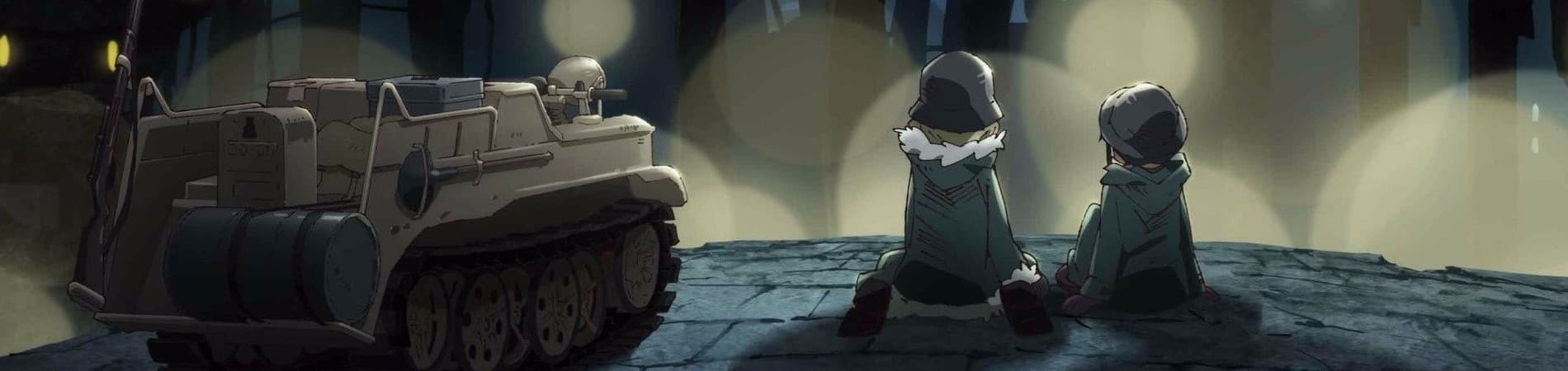
Spoilers Below.
Anime that deal with the decline of humanity are rather rare, and when they exist, the human race usually goes out in spectacular fashion. A go-down-swinging approach, if you will. Girls' Last Tour though, is an iyashikei, which puts it in rare company indeed, alongside just a handful of other properties, most of which never made it outside of the manga format. Were it interesting only on the basis of its genre rarity GLT would be merely vaguely interesting, but it combines its subject matter with its genre in some thought-provoking and at times genuinely surprising ways.
While the older Record of Yokohama Shopping Trip--one of GLT's few peers in its peculiar genre/subject matter intersection--often emphasized a world of technology being slowly reclaimed by nature Girls' Last Tour takes the opposite tack, a technological megalopolis that seems to have subsumed all nature entirely (in the third episode when the girls encounter a dead fish, Yuu has no idea what it is, and Chi is only passingly familiar), yet fallen into ruin regardless. Another example of this is the fourth episode. The temple the two stumble upon that lights up the city is filled with artificial plants, namely lilypads, which rest on a glass floor filled with metal fish sculptures, all meant to resemble a giant koi pond, but actual organic life is nowhere to be found. When the girls finally do come across a living organic being (another fish) much later in the series, there is only one, quite possibly the literal last fish on earth, and it is attended to by a squarish robot, and a strange mammalian creature they encounter later turns out to be biomechanical. There's a fair bit of BLAME! (a much more violent post-apoc anime) in its set design. Yawning chasms, broken and sometimes colossal machines, and weird architecture give GLT's world a touch of disconnectedness from our own reality, and really they're just damn impressive to look at.
Around episode 6 is when the show genuinely comes into its own. Iyashikei as a genre has always been hard to define but the episode (called "Takeoff") is a masterclass on what sets the genre apart from similar but more conventionally narrative types of media. Chi and Yuu become lost in a sort of desert-like area where metal poles protrude from the ground, and the Kettenkrad breaks down, leaving Chi unable to repair it. Here, they meet Ishii, a woman who lives in an abandoned airbase and seeks to build a plane to leave their massive city. They help her and in turn she fixes the Kettenkrad. Much of the episode is spent on the interaction between Yuu and Chi, and when the time finally comes for the plane to take off, a long, genuinely goosebump-inducing flight sequence (with a beautiful soundtrack that almost reminds one of Enya's "Orinoco Flow") is dashed when the plane begins to crumble in mid-air, not a minute after taking off. Ishii survives--our protagonists watch her parachute safely to the first level of the city below--but crucially all of this, the Kettenkrad being fixed and Ishii being removed from the narrative altogether, resets the status quo to zero. This is certainly deliberate (Yuu's sing-songing the word "hopeless" only nails the point home) and is part of the point of this sort of art. Something failing to succeed does not mean there was no point in trying, simply doing, GLT tells us, is an end in of itself.
Really this is a central theme of the show on the whole, and many other examples--big and small--crop up throughout the series. The "Spiral" segment of Episode 8 is another case in point, our protagonists make their way up a massive spiral ramp (not unlike the inside of a multilayer parking garage, scaled up a thousandfold), and are at one point forced to detour over a rickety bridge that collapses as they cross it. Really, the two brush with death surprisingly often and it's here that GLT takes an interesting, and slightly different, approach from most other iyashikei. The concept of the "endless everyday" comes up a lot when discussing this genre (and the broader slice of life umbrella in general), but GLT actually tackles the subject head on both with the girls' encounters with near-demise, and repeated in-series acknowledgement that the lackadaisical lifestyle they lead is unsustainable. During the aforementioned "Spiral" segment, Chi compares their lives to the spiral ramp, an endless corkscrew that will eventually terminate somehow and somewhere, but it's hard to know where and when, and until then, each iteration of the loop is remarkably similar. Not only is this a nod to the series' opening (which features the kettenkrad driving around a spiral pattern), it's an acknowledgement that every day of the girls' lives is essentially the same while also presenting that spiral's eventual end as a sort of guillotine that looms over the whole series. At the same time, this combined with the earlier themes of episode 6, as well as Yuu--now long established as the wise fool of the duo--proclaiming that you can't live if you're afraid to die, a notion Chi initially rejects as "stupid" but rather quickly comes around to, seems to advocate pushing forward and living in the moment even in the face of certain eventual demise. It's a theme that's actually pretty powerful and (perhaps unintentionally) surprisingly relevant to the 21st century.
It's legitimately hard to not lapse into episode-by-episode breakdown, because these themes are iterated on and reemphasized so many times that it's compelling to just list example after example, but the main thesis of the series is unchanging. Girls' Last Tour, then, is a story about the twilight years of Earth itself. This comes to a head in the final episode. The girls, having stumbled upon a grounded ship somehow still rigged with functioning electricity (a nuclear reactor is implied to be responsible), accidentally find a way to open the contents of their camera on a multimedia player (a thing they are of course not familiar with). We see pictures first--of the man who gave the girls their camera, as well as an unnamed woman he was traveling with, departed, through some fashion, by the time he showed up in the series. Then something extraordinary happens, Yuu plays every video file on the device at once, and a hypercondensed flurry of human history via media flashes by. First, we see the meeting of a girls' robotics club, its three uniformed members and their lazy conversation being a loving riff on more conventional, contemporarily-set slice of life anime. Then, there are home recordings of a newborn baby, a classical concert, declarations of war, nature documentaries, school festivals, panicked news reports, we see none of these in full but the swelling frission they create really is something. Media is as a rule of thumb rather bad at talking about itself, but this scene is a tribute to the astonishing power of shared experience in general, and a sort of premature eulogy for all mankind, something that the series itself in a way, also is. I will not spoil the series' final (and really, very strange) twist, but it ties in with that idea as well as anything in the series.
Chito and Yuuri, the last girls on earth, go on living for the sake of each other and themselves even in the face of certain eventual demise. There is something really quite admirable about that, and something quite admirable about Girls' Last Tour, the idea that we are all we have, that life as we know it on this strange blue marble has come and will one day go, but that we must push on for ourselves and each other is a strangely compelling one. For exploring it in such detail, GLT deserves commendation.
99.5 out of 104 users liked this review