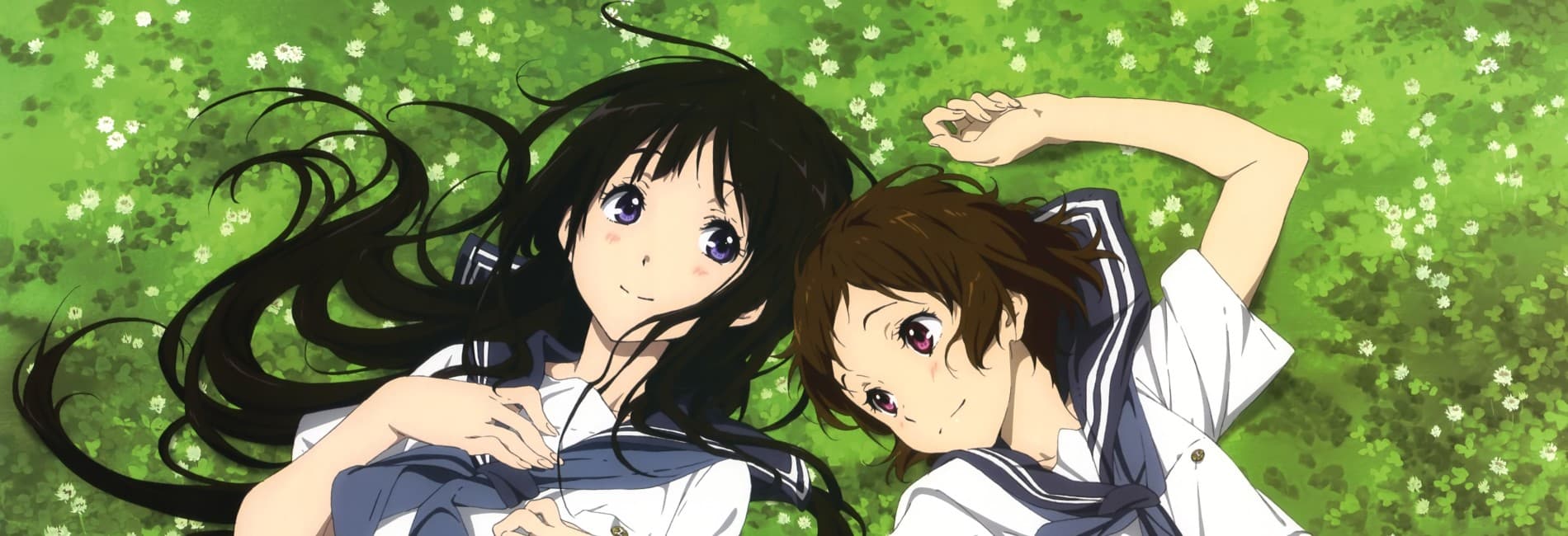
Hyouka
a review by scorcheddar
a review by scorcheddar
This review contains minor spoilers.
At a glance, Hyouka seems like the height of anime comfort food; warm, low-stakes high school mystery-solving with just enough mystery to keep you guessing. It's fun, charming, and for the first six episodes, it is precisely the anime equivalent of a hot cup of tea. But then, almost imperceptibly, it becomes something entirely different; one of the most subtle, poignant, and devastatingly accurate portrayals of what it's like to grow up in a world that only values you for what you can produce.
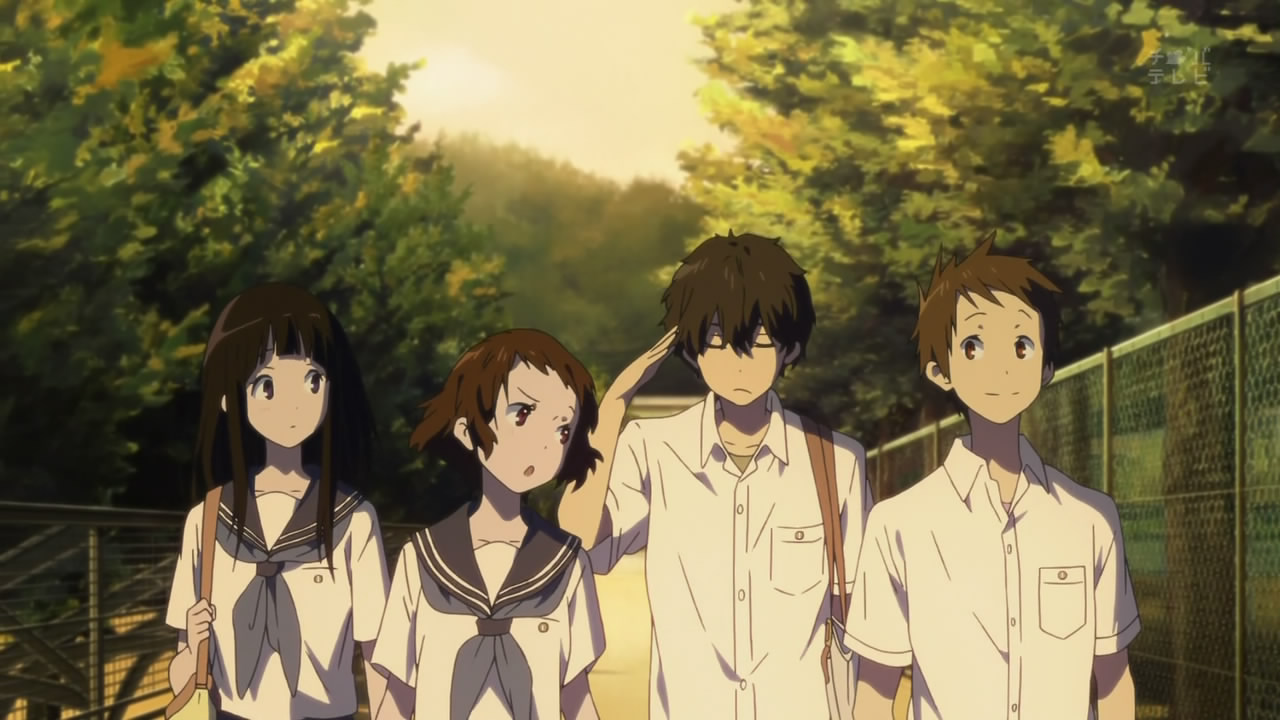
It’s almost funny; Hyouka is sort of radical. It sports the costume to perfection; a high school mystery with a hint of romance, which is perhaps why it often flies under people's radars. Not because it’s underrated, nothing ever is, but because of the way it's hungry to rip that perfectly threadbare costume to shreds. Borne deep beneath its picturesque backdrop and romanticized character exchanges is something much more compact. An open wound of a failed revolution and a trauma passed down like a family heirloom. The student socialist activism of 60s Japan, crushed and silenced, lingers over Hyouka's world like an avenging shadow. Not overtly, not even loudly, but in a way that defines precisely what Chitanda is and isn't, without her even knowing. Her curiosity isn’t just a character quirk; it’s an unconscious yearning to understand a past that was deliberately hidden from her.
She and Oreki aren't just compelling foils; they are symbols of a societal shift. She's the return of an era that was forcefully extinguished, and he's the by-product of a world that has long since given up on change. Their love is not about attraction or personality conflicts. It's a gradual and profound intellectual awakening. And in these neat little mysteries, Hyouka meticulously pieces together the fears, anxieties, and survival mechanisms that a competitive, ego-driven world instills in young people from the moment they learn how to use their brains.
The thing is, Hyouka doesn't just talk about these strains in loose conversation; it renders them with almost perfect accuracy. Self-denial, guilt, the irrepressible fear of burdening others, and the inbuilt shame of wanting something for yourself when you've been taught your whole life that everything is a transaction. How we unwittingly turn others into rivals, roadblocks, and stepping stones to be trampled over. How we rationalize to ourselves that this is just the way things are: anything but treating others like fellow human beings.
Its brilliance is that it doesn't treat these pressures as an abstract dystopia. It simply presents them as a backdrop to daily life. The system is omnipresent, but not the entirety of the story; a minor detail in the present. It’s always going to be there. But what Hyouka wants you to take from it is a moment. A moment where someone looks at you, not as a tool, not as an opponent, but with genuine curiosity. When someone sees you, really sees you, and forces you to see yourself. To break out of the role, the costume that you’ve spent your whole life internalizing. You see it in the very first episode when Chitanda gets that gleam in her eye.
Hyouka serves as a reminder that breaking out of this mindset doesn’t require some grand awakening. It can be as simple as one question, one person, or one moment of curiosity that makes you realize that you can be curious about just anything. Suddenly, the things you believed to be definite, fear, guilt, shame, and isolation, aren’t as solid as you thought. It starts to crack, and for the first time, you see yourself from the outside.
Kimi no mystery, bro. Kimi no mystery.
48 out of 52 users liked this review
