
NOTE: Contains minor spoilers
But for an anime depicting the sometimes awkward, yet all the more heartwarming relationship between high school boys, are all of the above qualities fitting and effective? Absolutely.
Too often, anime lose sight of their self-awareness—characters are forced to take unrealistically melodramatic leaps of faith, or overly complex storytelling muddles relationship building and overarching themes. At the opposite end of the spectrum, anime lacking exposition or coherent narratives often fall victim to dulled tension and stilted character development. Given, on the other hand (wink), strikes a rare balance of light and shade, encompassing both the insecurity and innocence of teenage life; the characters’ motives are not only multifaceted, but also grounded in the reality of high-school life and never dwelled upon to the point of melodrama, making for a plotline that, above all, feels real.
Take Ritsuka Uenoyama and Mafuyu Sato, the co-protagonists of the story. At surface level, their journey is straightforward and sweet: through their interactions as bandmates, Mafuyu learns to come into his own, sifting through unresolved grief along the way, and Ritsuka rediscovers his passion for music while challenging his preconceived notions of sexuality and communication. Put more simply, they each work through their own brand of well-intentioned teenage angst, making for an easily comprehensible and relatively low-stakes watch.

That said, it’s precisely this narrative simplicity that brought me to connect so viscerally with Given where it truly shines: its characterization. Its grounded and character-driven plotline allows for a nuanced exploration of Mafuyu and Ritsuka’s personalities, who very much act like sixteen year old boys: both are moody, at times egotistical, and often lack the maturity and self-awareness essential for deeper communication. At the same time, they both contend with their insecurities while feeling obligated to put on a front for others—Mafuyu fears self-expression out of fear of being ridiculed, despite his natural talent, and Ritsuka grapples with his feelings for Mafuyu while balancing the obligations of their band. In other words, armed with not only their strengths, but also their unsanitized vulnerabilities (a topic that scarcely receives the necessary attention, much less in men), the characters in Given feel just like ordinary teenagers—a deceptively difficult feat—and I couldn’t help but root for them while relating to their struggles of finding their voice and identity.
Mafuyu, for instance, is initially characterized as a soft-spoken introvert, filled with ideas yet unsure how to go about expressing them: a personality I very much shared at that age. What I found most remarkable, however, is how his character captures the nuances of introversion beyond merely “shy” and “quiet,” the typical typecast. His interactions with his childhood friends, Hiiragi and Shizusumi, are markedly more blunt and tinged with humor compared to those with the band, representing how us introverts can thrive in familiar, comfortable environments, rather than simply shy away from all possible interaction (as some seem to think). By the same token, his relationship with Yuki, his former lover, while caring, hardly allowed for the same interpersonal growth he experienced with Ritsuka. One quote in particular stood out to me in Hiiragi’s conversations with Mafuyu: “Yuki wanted to write a song for you. But you wanted him to say ‘Let’s do this together,’ didn’t you?” It’s a subtle, yet nonetheless important distinction that resonated with me; though I may be an introvert, that doesn’t necessarily mean I wouldn’t relish the chance to push myself out of complacency and beyond my comfort zone. Evidently, Mafuyu feels the same, and his relationship with Ritsuka provides an avenue to do exactly that.
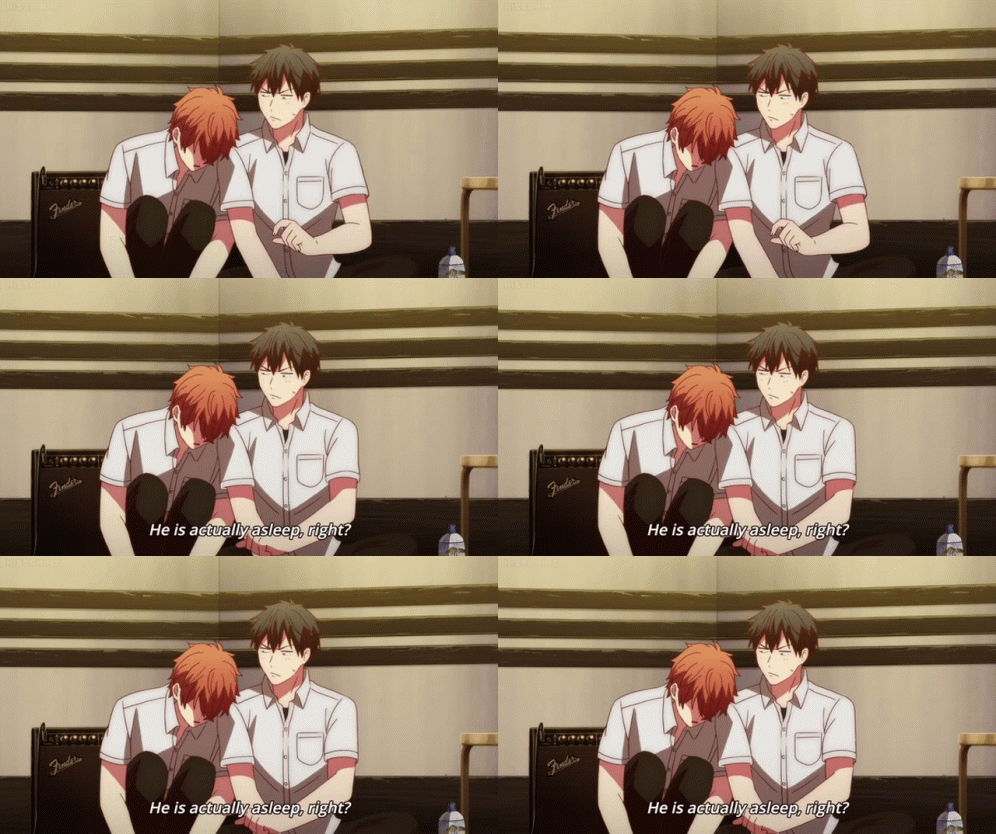
Though it’s easy to predict the outcome of their relationship, its development is anything but smooth, heightening the authenticity of the characters. Rather than rely on “love at first sight” or “enemies to lovers” tropes, Mafuyu and Ritsuka’s relationship falls somewhere in between; their relationship is very much a slow burn, and to some, it may not even be apparent that Given is a boys’ love anime until episode 7. That said, the anime does an excellent job of reminding us that they’re only sixteen years old, as their awkwardness and insecurities are palpable at every step. From blurting out undeveloped thoughts to clumsy miscommunications and impulsive decisions that almost gave me second-hand embarrassment (episode 2, anyone?), Ritsuka and Mafuyu are endearingly awkward with one another, and their authenticity makes them easy to root for. Even the smaller details of their relationship, such as them being uncomfortable with excessive touch and overly affectionate displays, feel refreshingly realistic—I know I’d certainly be a bit awkward in the aftermath of episode 9 at sixteen years old (clearly, so was Ritsuka). Nonetheless, their relationship is uplifting and well-realized, with the anime providing concrete grounds for their feelings: Mafuyu feels grateful to Ritsuka for taking a chance on him and pushing him beyond what he thought possible, while Ritsuka admires Mafuyu for endlessly responding to his prompts and finds new purpose in making music with him.
Where words fail in their relationship, music prevails. For two characters who aren’t necessarily the strongest communicators, sometimes it’s most effective to surrender themselves to the healing power of music; indeed, the track in episode 9 provides Mafuyu cathartic closure regarding his lingering feelings for Yuki. Out-of-universe, however, the track is an absolute showstopper. You’d hardly expect episode 1 Mafuyu to pull that out the bag, and the emotion is palpable in both the singing and the production, even in the absence of the Japanese lyrics—an admirable achievement in my book. In the context of the show, the song only hits all the more harder; paired with the flashback montage on the screen, it moved me on a level few anime have. Add that to the opening and ending tracks and you get my favorite OST of all time, responsible for earworms I still listen to today.

Though Given is not without its melancholic moments, its message is ultimately optimistic, illustrating the hope and renewal genuine connections can bring. It’s certainly a BL at heart, but its grounded characters and their vulnerabilities make it an equally thought-provoking exploration of masculinity and coming-of-age. In doing so, it wears its heart on its sleeve in a manner I’ve yet to see in another anime, and I couldn’t help but relate to the characters while falling in love with their sincerity and endearing awkwardness. Given may not be technically or narratively perfect, but neither is real life, and its faults only add to the rawness and realism that give the anime its charm.
11.5 out of 13 users liked this review
