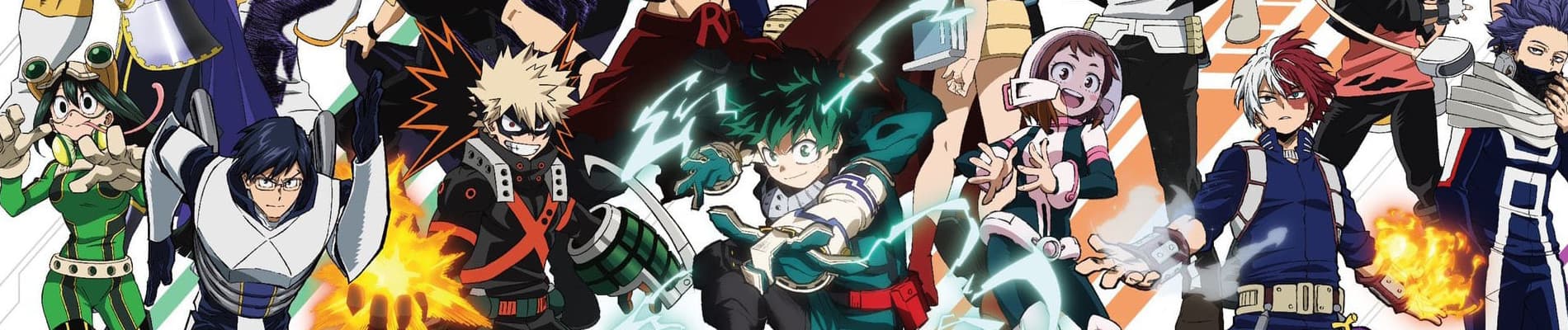
So, let's finally talk a bit about the fifth season of My Hero Academia. Leading up to it, I had heard quite frequently that this particular season suffered from pacing issues, exacerbated by the simultaneous production of the movie, which negatively impacted the series due to the dual workload. Personally, I can definitely see some minor problems, such as the lack of an overarching structure to tie together the individual segments of the season, resulting in somewhat clumsy transitions, and the anime relying more on recaps to stretch out a few minutes. However, overall, it's still within acceptable limits, only occasionally and to a limited extent really standing out as negative. The individual segments were still strong, although unlike for many others, for me, the quality somewhat diminished as the anime's narrative progressed.
To start of, I really enjoyed the first segment (the tournament between Class A and Class B) because there rarely was a segment of the show that so carefully portrayed all of its characters, their personalities, and their abilities like this one did. Particularly with the sports festival, I had criticized that many fights felt like mere footnotes, which was different this time. Considering many of the Class B students were still entirely unknown until then, sufficient time was taken to introduce them into the story and establish them as characters. I was particularly impressed by how most fights managed not to portray any team or member poorly: everyone had their shining moments, whether through a clever tactical maneuver or by applying a new technique they had honed in training sessions at school. The only exception here was Bakugo's team, which quickly swept the other away. However, that also worked quite well narratively because it stood indicative for Bakugo's development: the opposing team had relied on his usual behavior to refuse any form of cooperation. But since he explicitly does not do that this time around, he shows his training progress not in the form of a new technique or a clever tactic, but in the further development of his character. Although he takes away from the other characters in this way, the moment is so strong for him as a character that the fight still creates a coherent overall picture.
In line with this were the new revelations regarding One for All, where Deku unleashed a technique he had never been able to control before. It definitely arouses curiosity about why it was specifically Deku who learned the different specialties and I like the idea that now that he can control One for All's power better and better, he also has to work on mastering other techniques. However, after the conflict was established, he mastered at least the initial one too quickly for my liking. Essentially, in the arc that followed, he only had to think for a moment and suddenly could control the whips perfectly. That seems somewhat disappointing considering his previous struggles, as Deku and his progress have always been very plausible and credible, which is lacking this time. There were also strong character moments outside of the fights: the Christmas party with Eri, the family dinner at Endeavor's, and especially the moment when Present Mic and Aizawa confront Kurogiri and their backstory is illuminated. It suddenly becomes clear why both characters are constantly together and seeing how they completely fall out of their roles – the always cheerful and joking Present Mic, who falls into a state of pure rage, and the stoic Aizawa, who starts crying. But Endeavor was also excellently characterized: his obsession with surpassing All Might, him achieving that without actually overtaking him and, in the process, learning to take responsibility, abandoning his tunnel vision and realizing how much he has harmed his family and thus, trying to make amends, is a tragic story that doesn't absolve Endeavor of his guilt, but is all too human, which makes his intentions honest and credible. He represents a kind of corrupted version of Deku's hero ideal, which leads him to lose all empathy in his pursuit of his goal and to blindly pursue this ideal monocausally, without understanding its essence. That's why Endeavor, with all his conflicts, is also the perfect character to represent this second phase of My Hero Academia, where after the glorious, dominant hero era under All Might, a much grayer and morally more ambiguous phase arises.
Accordingly, the last arc was conceptually and thematically extremely interesting. I had already said in Season 3 that Tomura was paralleled with Deku as All for One's student. Now that the League of Villains as a whole is undergoing a parallel journey to the Yuei students, facing two major tests – controlling Gigantomachia and defeating the Liberation Army – to finally catch up with them, is thematically fitting. It also shows a development within the entire group, as they previously immediately rejected anyone who wanted to work with them, but now that they are willing to compromise, they were able to mobilize a huge army, which could also be dangerous for the heroes. Thematically, this section worked, but the simultaneous opportunity to humanize the villains and make their characters more understandable was only achieved to a limited extent, mainly due to somewhat uninspired direction. Scenes like, for example, between Twice and Himiko, had the potential to be extremely emotional, but unfortunately were relatively bland in terms of audiovisual presentation, something that also affected Tomura's backstory. I don't know if more time necessarily would have achieved more, but compared to the rest of the series, I felt that there was still a lot more potential here, which is unfortunate.
Overall, I still found the season to be good, and I also believe that the individual segments were mostly well-directed, but they could have used a bit more composition to turn them into a coherent whole.
15 out of 20 users liked this review