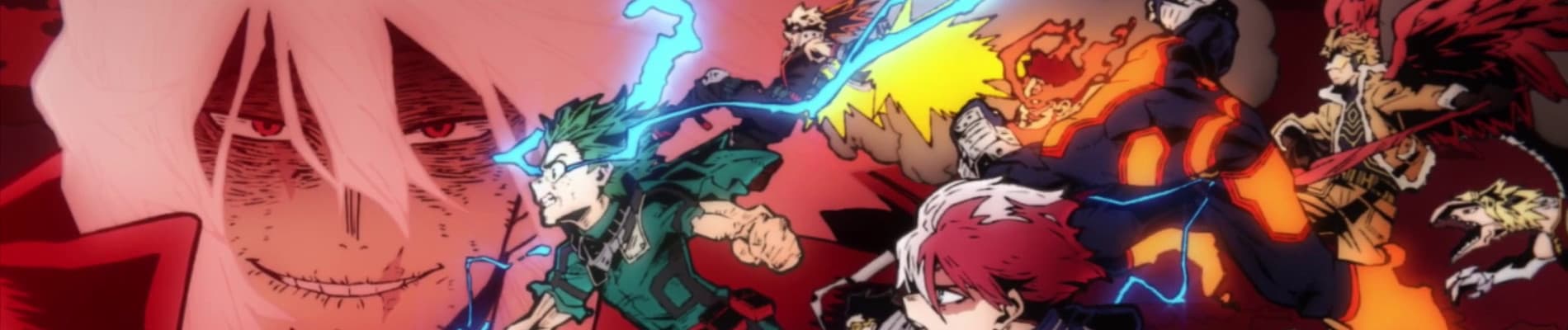
Alright, I've brought my journey to an end by wrapping up the sixth season of My Hero Academia, and let me tell you... it was a spectacle from start to finish, likely the best arc I've ever witnessed in a shonen series. What really sets this season apart, besides its attention to detail, is that it feels like countless plot threads that have been building up finally pay off here. The storyline serves as the culmination of the second act while also representing a pinnacle for the characters and the world they inhabit, giving them one last shining moment before the inevitable change in the status quo. The two halves of the season were markedly different but showcased independent strengths that blended seamlessly despite their disparities.
In the first half, the focus was on the heroes' assault on the Liberation Front headquarters. For one last time, the "civilized" superhero world came together through cooperation between intelligence agencies, police, government, and hero institutions before being overthrown due to the events that ensued. Unlike the first attack in the third season, the balance of power this time was much more evenly distributed, thanks to the factors of Tomura and Gigantomachia. However, the heroes were by no means portrayed as incompetent, as they considered all these factors, except for the anomalies that accompanied Tomura unexpectedly waking up. And that's precisely the great strength of this part: it's a truly epic conflict in every sense of the word where heroes and villains constantly outdo each other, react swiftly to their opponent's plans, and maximize their tactical and physical abilities. However, the conflict doesn't just stop at the external spectacle but unfolds immense depth by serving as a culmination point for a vast number of characters, always driven by their emotions. Hawks must abandon his hero ideal to defend it by killing Twice; Twice finds his perfect ending by finally being able to protect his friends; Fumikage must deal with the conflict of saving his master, even though he killed a person; Mirko manages to smash the reactor with Tomura through sheer willpower; Aizawa has to witness people dying to protect him, and even his students come to his aid while he goes beyond his limits to protect everyone; the Yuei students must administer a sedative to Gigantomachia completely out of their league, with Mina becoming relevant for the first time; Endeavor must take on the entire burden of the fight as the number one hero and later confront his past with Shoto in the form of Dabi; Eri finally manages to control her power so Mirio can return with his powers; Tomura finally gains his power and then has to defend his freedom and independence, which are so important to him, even against his master, who means so much to him; Bakugo, who jumps into the line of fire to save Deku and quotes his line from the second episode, saying "his legs just started moving"; Deku, who loses his rationality for the first time and then surrenders to his pure hatred, only to later speak with the manifestations of One for All.
The journey of so many characters during this conflict comes to a grand climax, experiences a decisive turning point, or serves as an emotional starting point. But not only the characters change during this conflict, but also the world. While initially it was just a special operation conducted by the heroes, more and more heroes fall and die; more and more cities are destroyed; and trust in the heroes fades more and more, partly due to the desperate state of the heroes, partly due to the destruction, and thirdly due to Dabi's speech, which questioned the moral integrity of the heroes. This increasing wear and tear are also visually fantastic, with more and more heroes and villains leaving the battlefield, while those who remain are increasingly battered externally, and the area is increasingly destroyed in the form of the furious Gigantomachia. The progression of the battle can be clearly seen in the environments and the condition of the heroes, and in the end, the enormous effort and damage caused by the conflict on both sides are very clearly noticeable and palpable.
The end of the first conflict marks the second turning point of the series, which wonderfully poetically rhymes with the first one at the end of Season 3: the first turning point saw the end of All Might and the uncertainty that came with it, the second the figurative fall of Endeavor and an even greater uncertainty that followed, leading to the same public discussion about how the world should move on after this event. In the same way, they end with a battle to exhaustion between the protagonist and the antagonist. All for One was defeated just like Tomura, severely wounded but survived for the next conflict, while All Might ended as a hero figure, and Deku also gave up his hero dream and became a vigilante. However, there is also a difference: the end of the second act represents the absolute low point for Deku and the hero world he believes in. The visual representation and content are organically integrated: while the sky was blue and sunny in the first half, it is now dark and covered with rain. Deku, as he roams as a vigilante, sheds more and more of All Might: first by hiding his face behind a helmet, then by his gloves turning into claws, and then his helmet taking the form of a bloodthirsty lizard. His connection is finally severed when Deku turns his back on All Might and tells him he no longer needs his help. This alienation is expressed by Bakugo, as he sarcastically asks Deku where his smile is – what always characterized All Might, being able to confidently smile in every situation. In the end, it's his friends who bring Deku back from the isolation he has catapulted himself into by reminding him of how much Deku has shaped them and what they have accomplished together as a team in the past. Especially the dialogue between Bakugo and Deku, in which Bakugo explains to him that he always rejected Deku because he saw his strength, finally apologizes wholeheartedly, and calls him Izuku for the first time, was the most beautiful moment of the entire series and felt like the emotional finale of a journey that began in the very first episode. Visually, this is underlined by Deku taking off his helmet, revealing his face again, and for the first time since his self-imposed rejection, being able to cry.
While the first part was accompanied by a thrilling action and tremendous character moments, the second part is characterized by even stronger character moments, while the plot is explained very strongly visually and aurally. Through Ochaco's speech, the internal conflict that Deku fought was universalized to the entire society and their handling of heroes, making the micro-level simultaneously a representative of the macro-world. But also, the other character interactions, especially Hawks' past, which gave his character more depth, and Endeavor's low point, which is parallelized with Deku by his family being the ones who pull him out of this hole and make him look forward again, are among my absolute highlights of this series. I could probably keep talking forever, but MHA Season 6 has been a fundamentally deep artistic experience that touched my human soul as tenderly as few other artworks. This season is on par with my absolute favorites of all time. I love this series and am so excited to see which direction it will develop further.
25.5 out of 33 users liked this review