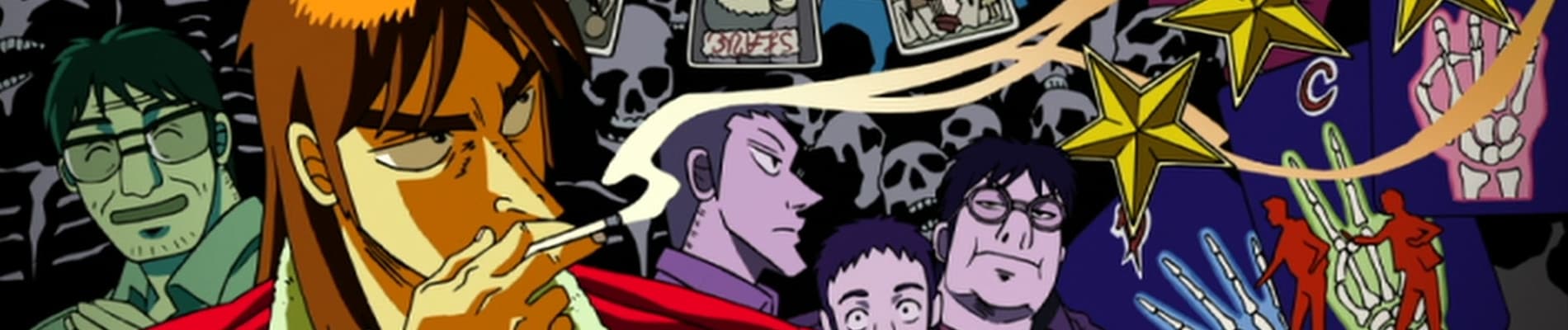
Kaiji is a series both about corruption and humanism, fuelled by outlandish setpieces and larger-than-life personalities while still remaining ultimately grounded, shying away from abstraction and towards powerfully blunt imagery and emotional beats.
Restricted Rock Paper Scissors is an important way to introduce the situation Kaiji is in, and where he differentiates himself from the others in that situation. It seems obvious that he would change his attitude of trust, after being tricked by Funai into giving up two stars. Kaiji immediately trusting Furuhata and Andou as allies feels like a mistake in the wake of this last betrayal, and they predictably both turn their backs on him out of greed. This is the first instance of the show’s grounded representations of its societal observations, using diegetic imagery in place of abstraction. The losers of this game, separated from the rest due to poor strategies, or via a stab in the back, are placed behind a two way mirror, naked and in darkness. The ones behind the mirror can see the ones competing, hoping that someone might allow them back into the main floor, but those competing cannot see behind the wall, and are able to safely ignore everyone back there. Kaiji is insulted by Okabayashi behind the wall, claiming that he has guaranteed his safety with a threat, and smugly believes that Kaiji was mistaken in trusting anyone else. Kaiji learns a lesson about trust through Andou, and his betrayal by coworkers soon after, but his trick to buy himself out of the back room proves that these threats are not an assured path to victory. The ones on the next floor up can just as easily ignore someone failing on the game floor as they could turn a blind eye to the ones behind the glass. Instead of falling into despair at the injustice of his situation, Kaiji finds a way out, and bluntly rejects this despair, by punching his betrayer in the face.
The following challenge, to cross the beams, proves Kaiji’s mindset even further. While it is clear that anyone behind Kaiji could and would easily pull him down, Kaiji chooses not to tear someone down to win, maintaining his belief that everyone here is fundamentally the same, and piling up bodies of the ones at the bottom to reach top is ignoring the broader picture, the ones that designed this situation. When the beams are electrified, Kaiji pictures this as a microcosm of humanity as a whole, a series of people walking their own narrow path, unable to reach out to each other. This poignant and hopeless image is immediately torn down, as Kaiji promises to win for the sake of Ishida, taking his ticket from him to save his family. Ishida tells us that Kaiji is truly someone exceptional, someone capable of prevailing under this pressure where someone like Ishida cannot. Kaiji again wins, mourning the loss of those he called comrades, but never falling into the trap of hopelessness against the corporation’s tricks.
Kaiji proves himself as truly exceptional in his battle against Tonegawa. No longer allowing himself to be swayed by despair, or simply hope for victory, he uses the memory of Ishida and Sahara as fuel, taking every step necessary to outperform the game designed for him to lose. Another powerful image comes from this game, as the losers recognise Kaiji's ability to prevail, crawling into a crowd at his feet as some kind of messiah for the downtrodden. In Kaiji sacrificing his ear for the sake of Sahara and Ishida, and outsmarting him, Tonegawa is brought down low. He is punished at the hands of the chairman, but there is no satisfaction in this. At this point, it has been proven time and time again that those under the feet of the ones in power, no matter how grandiose they appear, will fall just as hard to a mistake as Kaiji does. When Tonegawa is forced to kneel, it proves that he came from the same place as Kaiji, or Andou, or Sahara, acting out of fear of the systems that govern him, and he is just as much of a victim of these systems as anyone we’ve seen suffering until now.
Kaiji finally challenges the chairman directly, a nameless force presiding over all the misery in the show so far. The stakes will plunge Kaiji back into ruin if he loses, but Kaiji recognises the hollowness of his victory so far, wanting revenge whatever oversaw the whole affair. Kaiji’s plan is full of holes, but appears to miraculously succeed until the final, easiest step. Kaiji lets his guard down, and discovers that the plan failed, at first thinking a random chance ruined it. He then realises he had made a fatal mistake, failing to notice the winning slip had been folded, and the spirit that carried him through everything else is alive and well. Kaiji discovers the chairman’s name, Hyodo, and swears revenge. He has put a name to the force of evil at the top, realising that Hyodo is just as human as he is, and Kaiji’s victory was achievable through his own power as a human, not governed by random chance, fate, or some incomprehensible greater force.
It’s easy to assume at the start of the series that Kaiji himself is the quintessential everyman, a fundamentally unspecial human on a lifelong streak of bad luck, easily manipulated into a cruel game designed for him to lose what little he has left in dignity and flesh. While never explicitly stated, the purpose of the events portrayed in this show are an effort to prove that this is a false conclusion, both about the nature of Kaiji, and the nature of his tormentors. Every progressive level of Kaiji’s journey raises the stakes against him, and sends him deeper into despair. He experiences more and more cruelty and betrayal from the ones above him, and yet Kaiji himself prevails at every step, never fully giving in to that despair. Kaiji is seemingly taught a lesson through Andou’s betrayal, to abandon his implicit trust in the people at rock bottom around him. Despite it all, he never chooses a path of cynicism, always making the decision to reach out and try to lift up the ones around him. Kaiji’s eyes are permanently set at the ones above, those orchestrating the misery, instead of choosing to ignore them and tear down the ones around him. He never fails to see the human element in the world, never reducing his peers to pawns or his bosses to unknowable puppet masters.They are all fallible as humans, but all equally worthy as humans alongside him.
25 out of 25 users liked this review