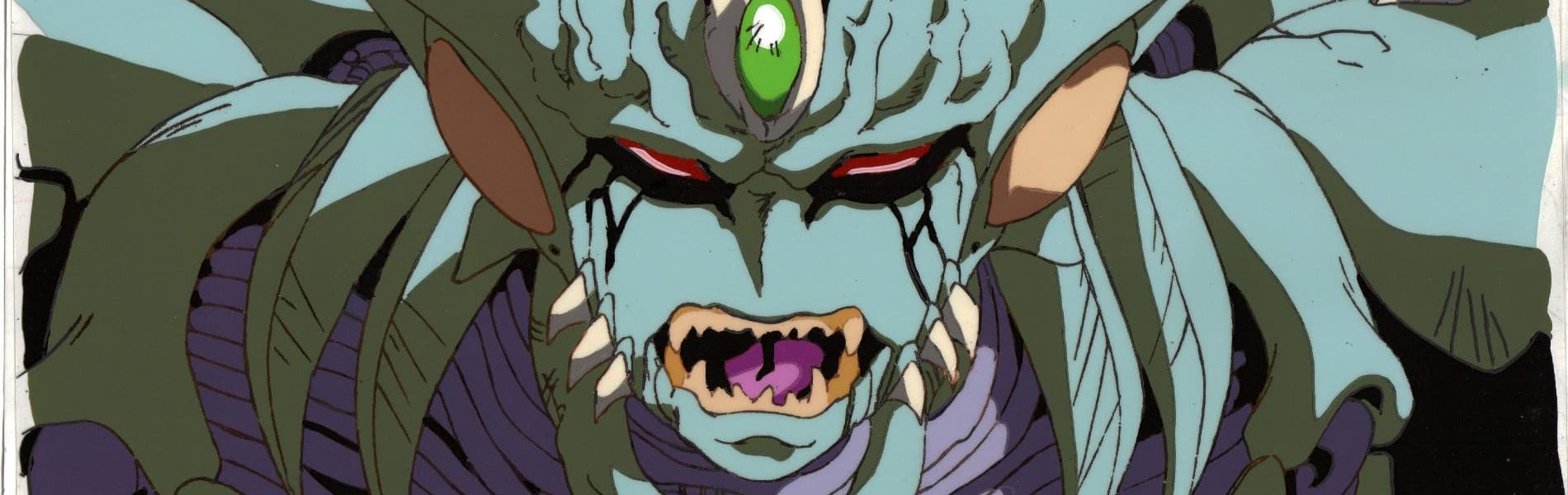
Neither their silver nor their gold shall be able to deliver them on the day of the wrath of the Lord. In the fire of his jealousy, all the earth shall be consumed; for a full and sudden end he will make of all the inhabitants of the earth.
Zephaniah 1:18
Note: I have decided to exclude graphic content from this review's visuals
If you ask your average young anime watcher about gore animated works, that person will probably come up with what came to be known as the representatives of the concept: Higurashi no Naku Koro Ni, Devilman Crybaby, Hellsing Ultimate... Should you be unlucky and ask a person with questionable tastes, this one could even recommend you Elfen Lied, Blood C, or Tokyo Ghoul. However, a more seasoned anime veteran will probably take you a bit further back, to the land of the 90s or even 80s, the territories of old, « cult classics » that most people nowadays tend to shun. Within this particular timeframe, one ultraviolent anime in particular stands out among the rest: that is Genocyber.
▶ VideoGenocyber takes place in a grimdark, cyberpunkish version of our world where wars led by conglomerates tear the world apart and lead to the suffering of the people. There, we follow Elaine, a feral, powerful esper girl, and her interactions with a merciless world of death, suffering, and despair. Throughout the story, and after merging with her sister, Diana Reed, she takes on the form of the Genocyber, an incredibly powerful cybernetic monster wielding psychic and psychokinetic abilities who destroys anything it encounters. The story is told in 3 distinct arcs: the first episode is the beginnings, the origin of the monster. Episode 2 and 3 show Elaine's growth and how the final conflict started for humanity, while episode 4 and 5 are centered around a young couple arriving in a city with an oppressive government that constitutes some of the remnants of the human world long after said war ended.
Let's just put this one out of the way: like I've said before, Genocyber is incredibly violent and gore. In fact, episode 1 and 2 are usually used by fans of older anime as an example of how old school body horror used to be done: taking into consideration the fact that the artstyle is not only quite realistic and very well shaded, the images of bodies being ripped apart, guts spilling everywhere, beheadings, flesh torn asunder by gunfire and highly cybernetically augmented bodies look certainly more gruesome, or at least convincing, than anything Blood-C could come up with. Such are the visuals that have marked the minds of a certain number of those people who watched low image quality, imported anime OVAs back in the 90s.
▶ VideoThe problem is that this ultraviolence is beyond gratuitous, and it becomes clear within the first few minutes of the carnage happening in the hospital that this is (mostly) being shown this way to please a certain crowd, and all the time and effort spent drawing and animating this first episode should have probably been spent on actually creating a coherent, less technobabble-filled story. Indeed, episode 1, serving as the origin story of a monster created through inhumane levels of scientific and cybernetic manipulation, is filled with exposition, pseudo-scientific droning and mindless violence, to the point where most people looking for an intriguing story will just start “switching their brains off”, if not lose interest altogether, which is a shame since the last arc of the anime effectively toned down the gore violence to the bare minimum and actually decided to focus on offering some proper storytelling with a lovely couple as protagonists.
However, this may have been an intended effect by the makers, as Genocyber's story is more of a metaphorical one than something you have to take at face value: in a very Lovecraftian and Shelleyian sense, the story represents science as an invading force, something that can be used for monstrous purposes, be it the dehumanization of people who augment themselves to the point where you can't even call them “people” anymore, but also the simple use of a helicopter to gun down innocents. And that's also not taking into account the second arc's boat crew who got instrumentalized and the female doctor who lost all sanity after going through the hell that resulted from such a horrible experiment.
The show's criticism also takes on corporatocracy, as it shows clearly that big corporations are exploitative in essence and evil in nature, as their dominance on the planetary level is the very reason the story happens altogether. That is why, when the Genocyber reaches the Kuryu Group's satellite at the end, it finds the place a deserted, empty ruin from which a broadcast kept running for many years: the Kuryu Group was long gone, but the threatening shadow of this once almighty force still remained. And it's only with the destruction of this last vestige of exploitation and terror that Elaina and Diana are finally free from the past and will be reborn.
Speaking of rebirth, Genocyber also runs counter to a very frequent trope in modern media: where contemporary nihilistic, science-obsessed writers tend to use religion as a symbol of fanaticism, zealotry and ignorance to give more value to rational thinking and explanation, this anime does just the opposite and shows religious communautarism in a positive manner, where people can be themselves, connect with others on a deeper level, and be free from worldly desires, which are represented as sinful and the root of evil. Greed is the source of violence, and violence is the source of cybernetic augmentation, and all of that led to the events of the show. It's an unusual take on religion, martyrdom and “primal-ness” in media that deserves to be outlined, but I think it does so in a very one-sided way: science isn't nearly as bad as the anime tries to portray it, and religions aren't exactly exempt from flaws altogether.
And I can't say even some of those themes hold well at all: after all, Elaina might become the Genocyber to enact vengeance for the innocents who die at the hands of evil scientists, soldiers and corporations but she isn't exactly a paragon of virtue either, especially considering she's responsible for turning Hong Kong into an inferno before vaporizing what was left of it in her grief-filled rage, killing millions because her friend died and gave her one last farewell. Or triggering the last war against humanity after the boat incident. Which is my main criticism: Genocyber is childish. That may be ironic, given the amount of adult content, but while there are certainly some ideas, the tone is definitely reactionary, full of hatred, like the outburst of a kid trying to get back at the world for feeling that something is wrong and preaching for a return to a more “primal form of society”. The show later portrays the Genocyber as a godlike entity by the religious cult because it delivered humanity from what it had become, but I'm pretty certain a lot more innocents died in the global war when compared to the amount of “evildoers”.
▶ VideoI can't exactly praise the narrative story itself either. I've already touched upon the first episode earlier but the second arc is, ultimately, very vacuous and merely pitting two entities against each other because one hates the other simply for existing, which in turns triggers the ultimate war. Out of 5 episodes, 3 of them are simply incredibly messy because the framing of the events/explanations is very bad, to the point where it's often hard to understand exactly what's going on on screen the first time around, and it takes episode 4 to introduce some proper worldbuilding and actually likeable leads. I'd lie if I said I actually enjoyed myself watching Genocyber early on and in fact, it actually took me several years to complete this, because no episode other than episode 4 made me want to watch the next one. Also on a side note, I found it a bit hypocritical that Diana, who initially killed Elaina out of jealousy and anger, somehow decided to become the voice of reason to Elaina's remnants of primal anger in the last arc of redemption, but I guess so much time had passed that the past no longer actually matters.
All in all, Genocyber is a mess of anger and hatred that buries its metaphorical journey under a thick layer of obfuscation. The thematics might be interesting enough for me to try to decode them through the essay you've (hopefully) just read above, but the tone and the language used just aren't tasteful for most of the runtime to justify watching this unless you need your fix of bloody violence.
10 out of 14 users liked this review
