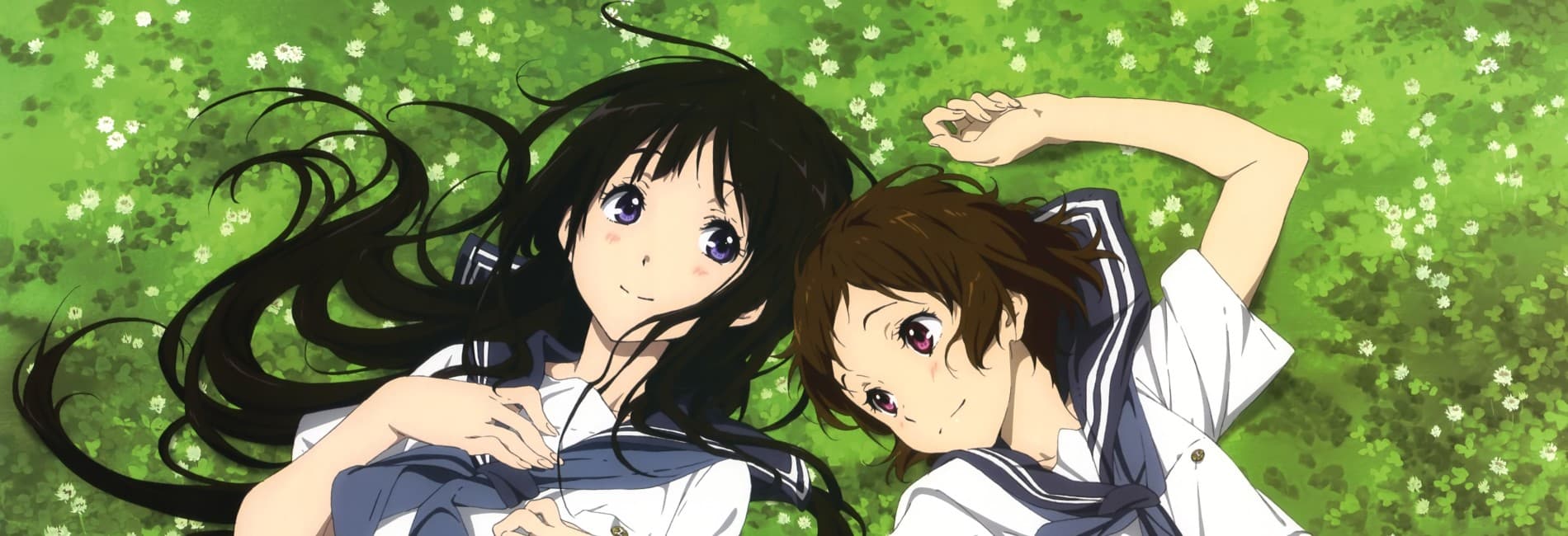
Hyouka
a review by BriForABri
a review by BriForABri
In the highly regarded (and one of my personal favorites) movie "Pirates of the Caribbean: Dead Man's Chest," there is a very memorable scene between the stars of the film, Captain Jack Sparrow and Elizabeth Swan, in which the two are discussing their respective moral compass and personal desires. The suave pirate attempts to woo Elizabeth by enticing her with the allure of the freedom and exploration that comes with pirating - an attempt that is emphasized by the quote, "One word, love: curiosity." Elizabeth then does the exact same thing to Jack in a clever bout of teasing and mind games, all the while using the same pretext of curiosity to get a rise out of the pirate. The relationship between the two main characters of the hit anime Hyouka often reminded me of this classic scene - curiosity drives Chitanda's explorative nature while burdening poor Oreki.
Comparisons between two completely different forms of media aside, I, too, am guilty of falling under the sway of curiosity when I officially decided to start watching Hyouka many weeks ago. However, unlike the proverbial cat whom curiosity was said to have killed, I not only gained a great deal from watching this anime, I felt as though another area of respect for those who make the industry so special was born within me.
I first remember being drawn to Hyouka back when I saw clips of it and being amazed by how beautiful the artwork and animations were. So, naturally, my curiosity led me to further research it and, eventually, take the plunge and watch it - just like how Chitanda's curiosity inspired her throughout the show, while also causing a great deal of stress for the carefree Oreki. One of the first aspects that immediately piqued my interest (aside from the aforementioned artwork) was how the show called itself a mystery/romance combination. I'll be the first to admit that my knowledge of the anime industry and its various genres is, simply put, lackluster, so I'm sure there are numerous anime with this genre distinction, but the concept seemed very unique to me. Needless to say, Hyouka was very unique - especially in how it centered much of its story around the concept of solving mysteries and uncovering the truths for anomalies that I'm sure many of us, myself included, don't give a second thought when they occur.
What comes off as a very plain setting and background with a typical high school group of friends hides a very pure and heartwarming connection between two characters who, based on their interactions, could not be any different. Chitanda is a very outgoing girl with a passionate love for her community and those who make it unique. She has an insatiable desire to learn about anything she stumbles across, whether it's a new hobby or activity, or something strange and out of the ordinary within said community. Oreki, meanwhile, is a very quiet and reserved individual with no interest in probing things that don't directly affect him. He is a very lazy individual, but that very aspect is something on which he prides himself - so much so, that he makes it his moral code. Yet, despite these seemingly negative traits, he is clearly very observant and intelligent - something that draws Chitanda even closer to him (maybe too close for his liking, perhaps). Indeed, they are as different as winter and spring, with Oreki being the former and Chitanda being the latter, but I will return to this point later.
Alongside their friends Fukube and Ibara, the two friends lead a Classic Literature club in hopes of not only discovering the truth about Chitanda's uncle, but also uncovering the many mysteries of their high school's history, staff, and even its student body. The main group of characters consists primarily of these four individuals, which is something that I have often praised when it occurs. By creating a small, yet strong and unique, group of main characters with a larger group of side characters who "revolve" around said nucleus, you create a cast that is clear in whom the main object of intrique is, while including smaller objects who serve to further support and build upon the established nucleus. This can be seen for each of the four main characters in Hyouka: beit __Oreki's older sister, Ibara's fellow manga club members, Fukube's overbearing guy friends, and Chitanda's fellow club leaders seen during _Kan'yasai_. We learn about each of the main character's past, personality, hobbies, etc,. through these interactions and they only serve to further enhance the viewers' intrigue__.
I'm sure that there are many different interpretations of how this anime ought to be perceived, in terms of a potential message or outlook on life, but in my mind, I thought that this anime did quite a good job at painting a picture of how important it can be to explore the world outside our comfort zones. Everyone has heard of the phrase, "Stop and smell the roses," and while that was a prevalent theme, I believe that Hyouka expanded upon that idea even further. There are countless people in our world with boundless knowledge and insight on how to perceive society and potentially improve upon it, but lack the desire or motivation to act upon their gifts. Oreki is one such person whose intelligence helped those around him, though it took serious persuasion from his friends to do so. And I believe that once Oreki experienced everything he did throughout the show, he started to become more open to the world from which he gladly withdrew. I'd like to bring up the previously mentioned metaphor on how Oreki was like winter while Chitanda was spring to further explain this [SPOILERS AHEAD].
The final scene in the final episode in which Oreki mentions the slight nip in the cold air, only to have Chitanda reply with, "No, it's spring," has, in my opinion, laid the groundwork for a metaphor that can summarize the entire relationship between the two friends. As previously mentioned, the two characters' personality traits embody the season with which I have associated them: Oreki's cold, withdrawn, and lazy nature embodies the desire to withdraw from the cold, depressing weather of winter, while Chitanda's bright, happy, and explorative nature captures the feeling of joy and bloom we feel during the springtime weather ~~(unless you have hayfever, like me)~~. Despite Oreki's clear disdain with Chitanda's overbearing personality and curiosity, he begrudgingly starts to emerge from his "hibernative" state of laziness and withdrawn lifestyle, only to gradually take a liking to Chitanda's way of thinking. And, in the end, just as winter gives way to spring, Oreki sees the blooming cherry tree shining behind Chitanda and realizes that joy and beauty can found from exploring the countless mysteries and curiosities that our world has to offer. This can even be seen in the 2nd opening animation when Chitanda seems to "pull" Oreki out of his lonely reflection of the world in which he lives. That's how I chose to perceive it, anyway.
1. Music: 90/100 - The music of Hyouka is nearly as beautiful and bright as the animations, in my opinion. I felt that the opening and ending of the "first" half of the anime (優しさの理由 [Yasashisa no Riyuu] and まどろみの約束 [Madoromi no Yakusoku]) were the best, but I can safely say that each of the openings and endings were so good, that the animations that accompanied each of them were reason enough for me to watch every episode until the very end.
2. Plot: 83/100 - This area of Hyouka is perhaps my least favorite among these four categories. While I can appreciate everything that Hyouka does right, such as the mystery aspect and touching messages, there were times when I felt like the plot was moving too slow. I can safely say that some of the episodes were more boring than others, and that the overall pace left something to be desired. This may be a reflection of my own ability to solve mysteries, but I also found that some of the mysteries solved throughout the show were almost too complex. They were definitely interesting when they revealed the A-ha! moment, but I just wished that they were a bit easier to understand.
3. Characters: 89/100 - Many of the characters in Hyouka left a lasting impression on me; even as I write this review, I think back on the interactions between the members of the Classic Literature club with great fondness. Oreki, Chitanda, Fukube, and Ibara were all different in so many ways, but their differences only served to make their interactions with each other all the more interesting and amusing. Indeed, I enjoyed not just the main cast, but also the numerous side characters who helped make the main cast and their stories that much more special.
4. Art & Animations: 99/100 - God bless you, KyoAni. __I cannot overstate how much I love the animations and artwork for _Hyouka_. It is, without a doubt, the best looking anime that I have ever had the pleasure to witness (sorry, Shikimori-san). I have stated countless times that I am, and will likely continue to be, partial towards the animation style of shows from the 80's and 90's, but I cannot deny that modern anime have some truly incredible works of art. _Hyouka_ is the cream of the crop, in my opinion. It reminds me how hard people work to create the media that we, as fans, constantly desire from companies like KyoAni. For people whose names most fans will only see in the credits, they deserve far more praise than they get__.
Hyouka is an anime that removes some of the more negative aspects that are common within this industry, such as overbearing fan-service, and embodies numerous aspects that others ought to strive to achieve. I can safely say that the artwork and music alone make it worthy of wielding the mantle of one of this industry's most beautiful works, and if you add the unique story and charming characters, you get a show that can proudly represent what anime can achieve outside the realm of entertainment. Needless to say, my curiosity was well-rewarded, and I highly recommend that you follow Chitanda's example and nuture your own sense of curiosity - you never know where it will lead you.
33.5 out of 37 users liked this review
