__MUSHI MASTER
(INTRO)__
We live in times where everything can be easily accessible, our waters are cleaner, our food is easily produced and transported, and there is far greater entertainment we consume today than there could have been hundreds of years ago. But one thing that stands out from the rest is that information is far more abundant right now than it was in the past. If you find something in the streets that you can't easily identify, you can easily open up Google to confirm it. Feeling sick but couldn't decipher what caused it? A trip to the doctor is just half an hour away, or google your symptoms and do some home remedies.
However, that wasn't always the case as it was a few decades ago and could be argued even a little while ago. People back in the day didn't have the privilege of having a shelf load of information in the comfort of their palms, nor could it be carried anywhere they please, and some weren't even literate. People back in the day lived simple lives; the sky was at its most blue, and a lone or a couple of wooden houses under the forest were in its most luscious green, with air devoid of industrial smell. It was a simple life lived by people in the past, yet one thing that has never disappeared from before to now is the ability of people to tell stories.
Today, we would be watching various art films, reality shows, news shows, or an hour-long TV series right in the comfort of our own homes, but back in the day, people didn't have that kind of privilege. Stories are spread by meeting and talking with people. Stories that came from a faraway village about a supernatural phenomenon that is unexplained by its nature. These stories people tell are mostly filled by the curiosities of people, but more than that, it testifies that the desire to clash and find more stories, no matter how absurd they can sometimes be, is innate to us.
They seem strange and alien, primitive and peculiar; they are unlike any flora or fauna known to us; they are feared by men and women who encounter these beings, which came to be known as "mushi." Not a lot of people know what certain abilities a mushi has unless you'll talk to a professional about them. A mushi master comes along and helps people who are unfortunate to encounter and interact with a mushi. Ginko, the Mushi Master, has a lot of stories to tell about his adventures. ***
__CHAPTER 1
A MUSHI AMONGST THE GREEN__
Mushi-shi isn't your typical fantasy. It blurs the lines between reality and the fantastical, creating a world saturated with ancient mystery. Imagine curling up on the sofa, enveloped in the warmth of a childhood memory, listening to your grandparents whisper tales passed down through generations. Every whisper hints at a time beyond reckoning, where even your grandparents' ancestors were shrouded in mist. Mushi-shi captures that boundless wonder, leaving you both captivated and questioning just what lies beyond the veil.
That vibrant green, once a siren song of calmness, now cloaked the jungle in an eerie pallor. Each step deeper felt like a silent descent into mystery; the melody that once soothed is now a haunting counterpoint to the unsettling quiet. A prickling feeling on the back of your ears as a sense of something neither here nor there, neither living nor dead, is in your surroundings. A mushi is what Ginko calls it, and the people in this world weave themselves into the very fabric of the world alongside with the mushi.
Mushi are enigmatic creatures that walk a tightrope between life and something else entirely. Some seamlessly blend with the living, while others warp reality in unsettling ways. From a bridge appearing only once a few decades, or a fire leaving behind deadly frostbite. Even death takes on a strange twist with Mushi, as corpses thrown into the ocean might find an unnatural rebirth. Even seemingly beautiful things, like a dazzling river, can harbour hidden dangers, luring the unwitting to their doom. Each subclass of Mushi comes with its own bizarre quirks, further blurring the lines between natural and supernatural. Their presence irrevocably changes human experiences, leaving a lasting mark on anyone who encounters them.
Unseen and enigmatic, mushi weaves through the fabric of human life. Although independent, they subtly tap into the essence of what it means to be human, like a pervasive fungus absorbing life's vital spark l. Their myriad forms and vibrant abundance, a spectacle almost beyond human comprehension, can overwhelm and unnerve some. Not everyone can embrace the unsettling reality of the mushi's influence on our lives. We have no control over these infectious, supernatural beings; we can only adapt and coexist. ***
__CHAPTER 2
A TALE OF THE LIVING__
Mushi is supernatural and unknown in nature and has his own sets of goals on how to survive while being attached to its host in their own unique way. In most cases, they manipulate the feelings of those they attach to in the most psychologically traumatic way possible, from bringing the vaguely dead to luring something that isn't alive. The mental toll it takes for a mushi to torment the grieving is great, yet what it leaves behind is greater.
Mushi exploit a person's grief, particularly the longing for deceased loved ones, to maintain their parasitic hold. But discovering these relapses are mere illusions, facades for the parasite's infestation, shatters this illusion with devastating consequences. Facing not only the parasite's insidious manipulation but also the ostracization and scorn of their community as "oddballs," the victim endures immense mental anguish. Yet, even amidst this crushing isolation and despair, their desire to live further endures.
Even amid the crushing weight of guilt and the emotional turmoil inflicted by the Mushi, those touched by their influence cling to reasons to live. Though these motives may seem ordinary, the fire of determination within their hearts burns fiercely. Though their loved ones may be forever lost, they strive to keep their memories vibrant, a beacon of purpose even when that promised reunion feels impossibly distant. With unwavering acceptance, they carry on, their resilience a testament to the human spirit's enduring flame.
Mushishi compels us to confront our definition of a meaningful life. In its quietude, it exposes the limitations of material comfort and technological advancement as pathways to inner peace. It reveals the profound solace found in embracing personal grief, even within the desolate confines of a memory-haunted home. This profound longing for a lost loved one, though seemingly bleak from an outsider's perspective, holds immeasurable value far exceeding any worldly possession. While the outward appearance may suggest misery, it pales in comparison to the emptiness of a life devoid of such cherished memories. ***
__CHAPTER 3
RURAL SUPERSTITIONS__
If you've ever lived in a rural environment, you would start to notice these nostalgic feelings that Mushishi emanates. Rural beliefs between solitude and awareness of surroundings—these uneasy feelings you have over the luscious green emanating around the forest. A glance at it might not be able to see, but if you squint a little more, you might start to see the invisible life that's surrounded the living. Whether they have intentions of ruining a living person’s wellbeing may be instinctual, but as humans remain the recipients of these harmful misdemeanors, an exaggeration of superstitions arises, and as the mystery becomes more unknown, the greater the fear it eminates.
The impact of Mushi in rural areas is greater at higher levels, whether directly or indirectly. Unlike the privileges of the modern world, where anything can be explained with logic, if things can't be explained, there will be preventive measures that ensure the safety of society without the discrimination of one person or a group of people. That, however, doesn't work in rural areas. In rural areas bound by rules of the mouth, it ties people together by their intuition and would go their own way in order not to be harmed by the effects of mushi, even abandoning the people they know in order to get a hierarchical leverage, whether for their safety or selfishly.
Even though a terrifying creature called a "mushi" is no longer present in this village, its legacy of fear lingers. Stories and rituals passed down through families keep the memory of the unforsaken event alive, even though it might not be relevant in modern times. The trauma experienced by victims and the fear witnessed by others have become deeply ingrained in the community's collective memory. Even though the mushi is gone, the fear it instilled persists, casting a long shadow over generations.
Even though a mushi is just a fictional aspect of the show, it perfectly encapsulates the folktales of real-life rural towns shared from people to people and the beliefs they still hold even when the original purpose is lost in translation, or it could be a mere miscommunication, a form of prejudice over a single person, or a significant event that shaken the people who lived during the time of down. In today's modern society, we can just brush off these kinds of stories as a mere blip of the unknown, exaggerated as time goes along. It still doesn't stop us from listening to a nonfiction story that may or may not have happened in the past. ***
__CHAPTER 4
BETWEEN DEATH AND THE LIVING__
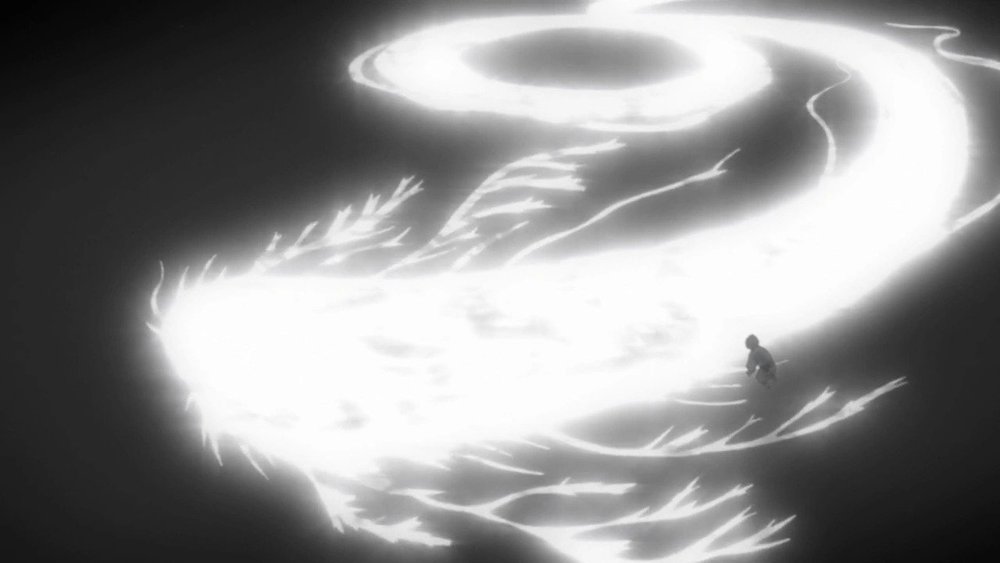
In episode one of the second part of Mushishi: Next passage showed how young Ginko encountered the border between death and the living for the first time of his life. That was later known as the River of light. As the show describes, it is the channel where mushi transcends between the living and the nonliving, keep an eye on it and you will be sucked into with little hope of returning to your real self. It's the backbone of the mushi lore and the most times it returned in multiple episodes. With this presence, you always get to wonder what it truly means to be between the living and the nonliving?
Ginko is one of many exceptions to being able to live with humans while also seeing a mushi; therefore, he can technically be in between the threads of the living and the non-living. With Ginko having a long enough experience with Mushi, he has grown accustomed to their nature to the point where he is one with the Mushi while at the same time interacting with people from the living. The balancing of two worlds can take a huge mental toll, but Ginko, through years of experience, managed to balance himself; however, it's not the same with other characters.
There are characters in the series who either have the desire to disappear with the mushi because the living world betrayed them or have no choice but to live with the nonliving, and we see snippets of these characters traversing between the living and the nonliving with huge conflicts of awe and confusion. However, between the living and the nonliving is surprising a world that is emptier than the nonliving, in between worlds where neither recognizes you as one of them despite being one with them. You lost the identity you possess and had to force yourself to traverse the undesired unknown.
Mushishi delivers loneliness in a way that is calming and haunting. The majestic spectacle of the Mushi that's eye-catching with offerings of lust in between the living and the nonliving with promises of a better life than the sufferings of the living world, however, traversing the unknwon can be anxiety-driven, as the mushi tricks you from the offerings, actually luring you down into a downward abyss of eternal misery, and then here's Ginko, living in both worlds, walking from the world of known and unknown with all of the heavy weight behind his back, travelling with no destination, a wanderlust caused by the curse. ***
__CHAPTER 5
WANDERLUST__
Life is a weeping journey of the known and unknown. Ginko, our main character, traverses through the unknowns of the jungle. He has this condition because, because of him being a mushi master, he couldn't stay in one place for too long because it caused the mushi to come closer to that specific place, and that's not good for the people who are living in that area. Therefore, Ginko, the mushi master, has to be on constant travel, an aimless adventure into the unknown, yet it's never a sad journey but rather a lust for something new to see on the horizon. No matter how dangerous everything may seem, you still want to keep stepping forward to see a brand new adventure through the aimless journey.
Ginko, a travelling mushi master, encounters various individuals on his journey. He possesses a unique ability to perceive and comprehend these beings, which he employs, often unknowingly, to assist others impacted by Mushi-related problems. Although he maintains a seemingly detached demeanour, his deep compassion shines through in his actions. While respected by many, he also faces opposition from those seeking to exploit Mushi for their own gain. Undeterred, Ginko continues his mission to protect both people and Mushi, using his own unconventional methods.
While Ginko's personal growth takes a backseat to exploring the world of Mushishi, his character embodies the universal yearning for adventure. He taps into our desire to break free, grab a backpack, and wander into the unknown, immersing ourselves in nature's embrace. That's part of what makes Mushishi so captivating - it resonates with our inner desire to explore the mysterious woods and supernatural realms. Ginko becomes our guide, an unconventional hero who aids those he encounters on his journey. He represents the spark within us, the urge to explore and help others along the way, our inner wanderlust. ***
__THE NEXT PASSAGE
(OUTRO)__
Not everyone finds solace in the serene embrace of Mushi-shi. Its meandering pace and self-contained episodes, lacking a grand overarching narrative, might leave some viewers yearning for more action or a deeper connection. Unlike shows fueled by cliffhangers and plot twists, Mushishi invites you to simply wander its world, savouring each encounter like a whispered folktale from times gone by. It's not about reaching a specific destination, but about appreciating the journey itself, a journey that might not resonate with everyone, but only for the people who appreciate these kinds of storytelling.
Like a cozy fire on a winter night, Mushishi draws you in with its gentle warmth. Initially, the silence might lull you, but soon, you're captivated by whispers of forgotten tales inherited through generations. These stories, bordering on the fantastical, might elicit an eye roll with their fantastical creatures defying reality. Yet, you find yourself enthralled, eager to unravel the lives touched by these otherworldly beings. The narrative unfolds like a quiet conversation with your grandparents, sharing tales passed down from their time. Despite the seemingly chaotic encounters, an underlying curiosity compels you to see how it all unfolds, how lives intertwine with destiny, and how even the extraordinary holds a touch of humanity.
Mushi-shi is not just an anime; it's an experience. Each episode unfolds like a hushed folktale, weaving fantastical creatures, quiet lives, and the whispers of generations past into a captivating tapestry. Stunning visuals and animation elevate the sense of emptiness and wonder, painting landscapes that vibrate with life even under a cloak of gloomy subtext, mixed in with the soundscape perfectly complements the visuals, adding depth and emotion with subtle yet evocative touches, it's a masterpiece worth experiencing at least once. To savour its essence, approach the series gently, consume one episode per day or two. Let the slow pace and aimless wanderings pull you in, and soon you'll find yourself captivated by the show's unique brand of adventure – one that's both devoid of a set destination, and meaningful. ***
33.5 out of 34 users liked this review