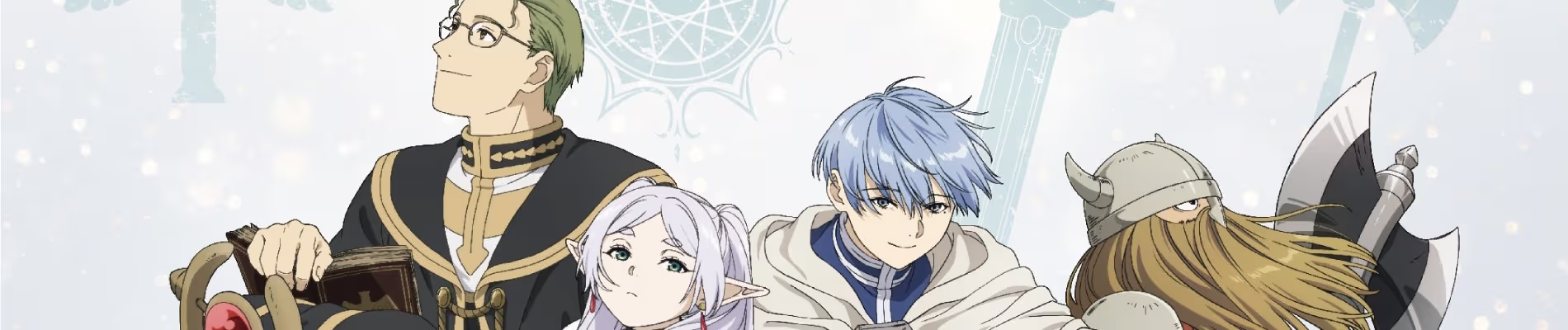

This review is spoiler-free.
(Note: If "Frieren" is italicised, I'm talking about the series. Otherwise, I'm referring to the main character.)
〈 𝘈 𝘫𝘰𝘶𝘳𝘯𝘦𝘺 𝘪𝘴 𝘯𝘰𝘵 𝘢𝘣𝘰𝘶𝘵 𝘵𝘩𝘦 𝘥𝘦𝘴𝘵𝘪𝘯𝘢𝘵𝘪𝘰𝘯... 〉
Have you ever felt you're way too cautious when it comes to interacting with art, which, in turn, may have caused you to hesitate or even avoid starting books, movies, or shows that piqued your interest? Have you ever set your expectations rock-bottom low because you were worried the latest popular product wouldn't be worthy of its acclaim, thus leaving you sorely disappointed? Have you ever given said trendy new thing a shot, only to view it with a ton of bias, which utterly doomed your first impression beyond repair? I've been there and done that, and one of the best examples of this bizarre predicament is Frieren. But fret not, my dear reader, because my wild and turbulent experience with this anime ends on a surprisingly positive note. This review won't be yet another cynical rant where I passionately trash-talk a show for a couple of paragraphs. Well, not this time, that is.
I won't beat around the bush or pretend to be holier than thou... I was initially super sceptical about Frieren, with heaps of negativity flowing through my caffeinated veins. I kept doubting if it could live up to the hype, and, worse yet, I tried to avoid the show like one of the plagues of Egypt. After watching the first episode, though my opinion became more favourable, I wasn't entirely sold on any of its ideas and struggled to see the appeal. But as I dove deeper into its episodes, the show, slowly but surely, started growing on me. Now, having watched all of its twenty-eight episodes, I can confidently say it's one of the greatest anime I've ever encountered, and I feel silly for not taking it seriously from the get-go.

First things first, we have to give credit where credit is due: the team behind this project's truly outdone themselves in terms of visuals and sound, and they deserve all the praise they can get. Hell, I'm more than happy to continue complimenting their work till I can no longer breathe or the sun no longer emits light. Keiichirou Saitou and his crew poured their hearts into this, and their passion for the craft and the medium itself shines through in every single frame, still image, second of animation, and note of the soundtrack; like a kid who was given a flashy new toy, I can't stop gawking at their work in complete and unadulterated amazement and awe. But all of these compliments and commendations are very ambiguous and general, so we need to get down to the nitty-gritty.
The colour palette was one of the first components I criticised when the show aired its first episode because I wasn't particularly impressed by it. Yet, as time went on, I finally came to my senses and concluded that my critique was unsubstantiated and narrow-sighted, as these seemingly commonplace colours consistently and relentlessly demonstrate how vibrant they are. Every scene, scenery and scenario is bright and full of life, yet the hues that inhabit them aren't excessively saturated or unnaturally radiant to the point of causing eye strain or discomfort. In some weird fashion, despite the setting being anything but grounded in reality, everything on display teems with energy in an incredibly lifelike sense; thanks to these no-frills colours, the show's able to immerse the viewer in its vast, glamorous world and its countless distinct lands effectively and thoroughly. While you may see them as just another generic collection of tints already seen a thousand times before in other shows with similar art styles, when combined with other elements that constitute the visuals, they infuse Frieren with intense vigour and immediately make it stand out from the massive crowd.
Speaking of the art style, it's undeniably straightforward, yet that very simplicity is its most prominent strength. Owing to the usage of brisk, crisp and quirky lines, designs and hues, the art style emerges as delightful to look at and spellbinding all the way through. By dint of its inherent beauty, the background art can easily blossom and become an exceptional sight to behold. You can almost smell and taste the world the characters exist in. You feel like you're a part of it, and, by extension, you get this tingling sensation of wanting to embark on a grand journey filled with numerous adventures, random encounters and memorable happenings. The cities the characters visit along the way look grand in scope, yet the manner in which they're drawn makes them feel cosy and lived-in. Unlike other fantasy tales that merely aim for a fantasy-like look without much substance, the anime actually populates its villages with town life and makes the buildings, roads and architecture look like they were developed and used by actual human beings. Rural areas are gorgeously serene and peaceful, while forests, mountains, plains and whatnot evoke both a sense of medieval realism and enchanting fantasy. In the same vein, the character designs are memorable and full of personality, considering they bring out the unique traits of each person donning them with simple ornaments, lovely outfits and distinctive body features. Altogether, the art style and everything surrounding it brim with this indescribable sense of wonder and magic, which perfectly captures the unique and delicate personality of the series. Nonetheless, as beautiful and majestic as these images can be, their charm will hastily fade away once the animation fails to match their quality and struggles to bring them to life. An anime without proper animation isn't going to cut it. After all, a contemporary show's neither a slideshow nor a trip to a museum.
Luckily, there's no need to worry about that because Frieren's animation does what's expected of it with flying colours. It doesn't settle for mediocrity or reeks of half-assery but instead executes everything flawlessly and constantly produces awe-inspiring, jaw-dropping scenes. Simply put, it's fluid and stellar, and it never runs out of gas despite the exhaustive number of high-quality and constantly impressive episodes. Whether it be a sombre moment where the characters converse with each other and contemplate their lives or a moment of high-octane, intense magical battle, which involves countless blinding spells and objects flying left, right, and centre, the animation never stutters and always manages to deliver a mesmerising spectacle you can feast your eyes on. It's further complemented by the camerawork that makes sure the action's smooth, zappy and easy to follow, the lightning that enhances the ambience of every situation, and the editing that's not only sharp but also lets the scenes linger just enough for the emotions to settle in and take effect.
But a sincerely impactful moment isn't just about what you can see; it's also about what you can hear. For a scene to deeply resonate with the viewer, their ears need to be treated to beautiful melodies that'll strike them to their core. Yet again, we don't have to worry about that because the music the series boasts is absolutely wonderful at every step. Both the opening theme by YOASOBI and the one composed by Yorushika fit amazingly into the atmosphere the show erects; they have a lingering feeling of melancholy within, yet are full of energy and positivity. The ending theme by milet embraces the other side of Frieren's narrative as its saddening, silky tone elicits a sense of sadness related to departure or loss, which is an ideal fit as the closure to every episode. In conjunction, these songs will make you feel the urge to click on another episode, as you don't want these feelings to fade away. You want to cherish every moment you have with the show by your side for as long as possible. Tying it all together is the soundtrack by Evan Call. Through tracks like "Journey of a Lifetime," "One Last Adventure," "Where the Blue-Moon Weed Grows," and many, many more, the composer truly cements Frieren's score as one of the most impressive and gorgeous ones in recent memory. Tender, heartfelt, sorrowful, heartwarming and overflowing with a satisfying fantasy vibe all at once; these tracks feel grand yet so personal, majestic yet grounded, and sad yet hopeful, and I feel my heart crumbling to dust just by listening to them.

With an extensive description like that, you could easily get the idea that pretty looks and catchy songs are all there's to Frieren. Frankly, I wouldn't blame you for thinking this way one bit. Whether we like it or not, the medium is populated by a constantly increasing number of anime that value a single moment of visual brilliance over having a coherent, well-put-together, well-crafted and ingenious story and authentic, multi-dimensional characters worth rooting for. But let me assure you that Frieren isn't one of those shows that present the audience with plenty of eye candy but nothing to chew on narrative-wise; it's much, much more than meets the eye. However, before I really dig into the narrative, I need to mention something that may not be so obvious but is definitely worth bringing attention to. Though many, after witnessing the first few episodes, deem the story to be an emotional tale that'll pull your heartstrings at every opportunity, I believe that approaching Frieren with such expectations can and most likely will be extremely detrimental to not only your enjoyment but also your opinion about the show as a whole since you'll expect such scenes to play first fiddle all the time. While, at the start, the emotionality of the content is painfully apparent, these emotionally charged moments aren't so chokingly defining and dominant that everything revolves around them. They're a part of the narrative and not the narrative itself. The anime's sights aren't set on merely being an evocative and meditative tearjerker that'll force you to bawl your eyes out at every turn. Yes, the series is more than capable of doing that, which I experienced firsthand on too many occasions. Still, Frieren is, first and foremost, about the adventures, making memories, random encounters, and various detours the characters encounter along their trek; the emotions are a sweet and much-needed bonus.
Now with that out of the way, we can finally get down to business and see what the narrative is about. As I said earlier, the production values are made with so much passion and love that it's nigh impossible to resist their allure. However, as top-notch as they are, it's the combination of story, characters and themes that sets the show apart, puts it on the map and ultimately wins you over. These three components are the driving force behind its success and the reason why so many folks, myself included, have utterly fallen head over heels in love with it.
In the beginning, we're introduced to the hero's party, as they gear up to and eventually succeed in taking down the Demon King. Sounds quite familiar, doesn't it? Of course, it does since we've seen stories with such a premise so many times before that it's become something of a cliche. As we quickly learn, in the case of this anime, this is nothing more than a setup or a prologue to what's to come. The quest's instantly taken care of off-screen, and time begins to blur as, in the wake of the constant utilisation of time skips, the years fly by in rapid succession. Before we know it, the group ceases to exist, and its leader passes away. What follows his death are tears, not only shed by those whom they helped throughout their numerous adventures but also by the titular protagonist, as she realises that what seemed like insignificant, trivial moments to her meant the world to others due to them being a huge chunk of their life. With the realisation that she'll long outlive everyone around her, and her apathy and indifference towards the world won't make her existence whole, she begins travelling in search of answers, yearning to understand humans and how to treasure the memories she's made and will make. Along the way, she revisits the lands she's stopped by in the past, meets and befriends other people and enjoys the presence of her newfound companions.
This is such a simplistic yet phenomenal setup that I'm genuinely shocked I didn't notice and appreciate it earlier. Taking the tired cliche of a party of warriors, mages and priests that aims to defeat the generic demonic overlord and completely flipping it on its head is such a refreshing and satisfying sight, and the way the whole quest's depicted is nothing short of ingenious. You see, Frieren is an elf, which means she's basically immortal. Even though the quest spanned about ten years, to her (and, consequently, the viewers) it was merely a fleeting moment, like a gust of wind that comes and goes without leaving any signs of its presence. However, this skewed perception of time isn't a one-time gimmick; it constantly evolves and changes throughout the show's and the protagonist's development, and it originates from one of the main motifs of the series: the preciousness of time.
Time's a finite resource that we must use wisely. If you wander aimlessly through life, you'll soon find yourself running short of it. Before you know it, you've used it all up, and it's only a matter of, well, time, before you have to bid goodbye to everything you own and everyone you know. The immortality of an elf stands in stark contrast to the frailty of human life, seeing that elves can live for thousands upon thousands of years, and still look like they are in their twenties/thirties. Yet, their careless management of time can very easily be applied to humans or human-related activities such as memory-making. Whether you have ten, twenty, fifty, or one thousand years, there's always the possibility that you're not focusing on the present and instead being completely oblivious to how fast and unrelenting the passage of time can be. Frieren perfectly encapsulates the importance of learning to appreciate each little thing, moment, and uneventful day, and understanding the fleeting nature of it all. It turns this incredibly straightforward idea/theme into one of the many important lessons it teaches not only its characters but also the viewers.
The same applies to the concept of memories; they, much like the passage of time discussed above, constitute the heart and soul of Frieren. These snippets of the past kick off the protagonist's tale, drive most, if not all, of the characters' actions and are responsible for some of the most emotional, poignant and powerful moments in the whole series. Just as they're essential to the narrative, memories are intrinsic to all of us. While they don't entirely define our existence, as we can still carry on even if we were to lose them all, they are extremely instrumental in shaping who we are. With them lingering in the recesses of our minds, we find solace in previous experiences, reflect on the present with the insight the past provides, and discover what makes us who we are. However, what is head-scratchingly problematic about memories is the fact that what seems to be nothing more than an ordinary and everyday moment may become a vital, cherished recollection down the road. This notion is reflected throughout the series, as remembrances influence every character in one way or another. Although these simple moments might characterise these individuals, they don't restrain or torment them like shackles. Instead, as time goes on, the cast learns to use them as stepping stones toward personal growth and self-realisation. And therein is the reason why this show's so touching and relatable. The theme is universal and easily applicable to anyone, yet it's the process of witnessing the characters uncover how to deal with their past and try to use it as a learning experience that makes it all extremely personal, heartwarming, and therapeutic.
Naturally, these two motifs aren't the only ones that Frieren wears on its sleeves. Grief, loss, regret, the importance of human relationships and connections, morality, death and its ramifications, the search for meaning, mentorship, friendship, familial bonds, heroism, good vs. evil, embracing life, accepting oneself and many, many more themes are vividly portrayed within the anime, and are given just the right amount of attention and care to pack a really hefty punch. As mentioned numerous times throughout the review, Frieren is all about the journey the characters set off on, which can be equated to a collection of sidequests with plenty of goofing around, fighting, talking, and exploring, connected with surprising cohesion and creativity. On account of that, the series could've easily stuck to these adventures for the entirety of its run, never going beyond its excellent worldbuilding, captivating magic system, believable setting, exciting battle scenes, charming character interactions or quirky personages. But it decided to embrace and embody both sides of the idea of travelling, combining literally moving from one place to another with attempts to find your true self and become a better person, and the themes above are why it all successfully comes together to create this nearly perfect package. The adventures are at the forefront of the plot as they entertain your eyes, ears and mind, while the intriguing ideas that reside deep within the show's body touch your heart and make Frieren an unforgettable experience.
Nonetheless, every potent and contemplation-arousing subject needs to be conveyed and presented in an easy-to-digest manner. This is where the characters come in, as they're the ideal vehicles for these ideas. But don't mistake them for mere carriers of the various concepts; they're fully fleshed-out people with their own interesting stories to tell. Whether you look at the protagonists or the supporting characters, everyone brings something to the table and fulfils a concrete and important role in the story, no matter how much screen time they get. Surely, some of them may be seen as generic and one-dimensional, but that's merely a surface-level observation that hardly applies to any of these folks; even the most seemingly insignificant supporting characters are exciting, authentic, full of depth and flesh and blood. Yet, as is the case with every single story to have ever been written, it's the main group who are in the constant limelight. Frieren and her companions, both old and new, are a diverse, sympathetic and charismatic bunch of goofballs. They all possess distinct personalities, easily understandable and relatable motivations, and dreams that strike a chord with the audience. It's very hard not to root for them, appreciate their wonderful chemistry, enjoy their quirky interactions/banters/conversations, feel happy when they achieve their goals, and feel down when they encounter any sort of hardship. The way they develop and mature as individuals as the show progresses is extremely impressive on account of the subtle, small yet noticeable changes in their attitudes, outlooks and dispositions. Not a single moment of character development is rushed, and the show allocates just the right amount of time to give these guys all the breathing room they need to grow, glow, and become great. And that's precisely what they become when their stories conclude (for now): a fun, organic yet deeply human cast of memorable characters, whose antics and adventures are charming beyond belief.

All right, it's high time to wrap up this incomprehensible wall of text masquerading as a thoughtful review. I want to end it by simply encouraging anyone who has yet to see Frieren to cave in and give it a shot. In the worst-case scenario, you won't be wowed by what it has to offer, and you'll either power through its episodes as a reluctant passenger or abandon ship entirely. However, if it sounds like your cup of tea and seemingly clicks with you, it'll be an experience unlike any other. In any case, I sincerely think Frieren deserves our attention and adoration and must be treasured for years to come. It's a nearly flawless and intensely special anime that, I kid you not, excels in every aspect. I feel fortunate to have been part of this joyful and adventurous journey for so long, and my love for it is as vast and endless as its world.
Farewell, Frieren.