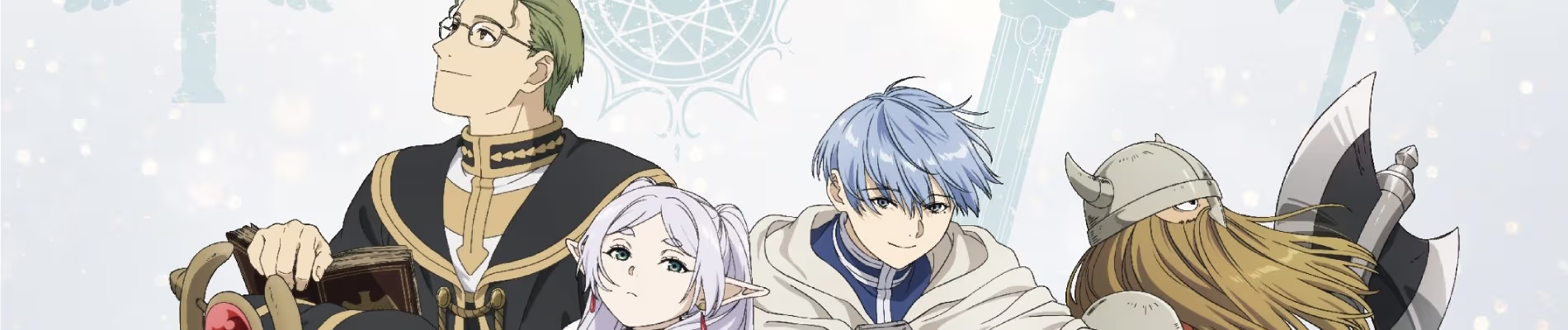
What happens when you outlive the people who made your life meaningful? It's a question that ultimately gives birth to this story. One that begins where most would roll the credits: the main villain is defeated, the world is saved, and the heroes return home from their arduous journey - victorious. But what follows is eternal rest for half of her party, companions she had subconsciously grown attached to. And then - silence. Frieren experiences a funeral that hits her in the spots she never knew existed. Yet it was also that very funeral which gave birth to a spark - one that ignited a new purpose in life.
▶ VideoHerein lies her next journey - not with a new threat or some magic hourglass ticking down, but with the absence that follows an ending. Frieren's quest isn't about saving the world again. It's about figuring out how to feel the weight of something after it's already gone. The show's emotional core is built on the fact of time moving unevenly, of people dying before they could be understood. It’s not tragic in the loud, melodramatic way. The question just quietly lingers in the air.
As she travels with her new companions - Fern, a reserved and quiet prodigy mage, and Stark, an awkward but kind-hearted swordsman who wears his heart on his sleeve. - something shifts. On paper, they collect spells. But what they're really collecting are connections. Moments - the kind of things that would barely register in the life of an elf who has lived for centuries. A rust-cleaning spell. A tea-warming incantation. Spells so trivial, they'd be background clutter in most RPGs. But here, they're everything. Because behind each one lies a memory, a missed opportunity, and a fragment of someone who's no longer around.
▶ VideoAnd that's when the flashbacks come into play. Little reframings that make the present richer. This is such a simple, yet clever storytelling method. A joke that used to feel throwaway suddenly carries weight. A landmark passed without comment now draws a pause. Even a simple mundane spell can act as a catalyst for peeling back Frieren's guarded interior. Like the moment when she lost her ring - Himmel's ring. At first, she brushes it off with the kind of detachment you'd expect from someone who has lived for over a thousand years. "I'm used to losing things", she says. And maybe she believes that.
But still, every night, she wanders off, searching. Quietly. Without telling anyone. There's a wordless ache behind her eyes - a kind of longing she doesn't quite know how to articulate. And when Fern notices - it's her gentle insistence, her human input that shifts the course of events. She's the one who reminds Frieren, without saying it outright, that sentimentality isn't weakness. And it's thanks to Fern not being afraid to ask for help that they receive a spell for tracking down lost valuables. And then, once it's cast and the ring is finally retrieved, the show does what it always does at its best - it stops and gives space. A flashback surfaces. And suddenly the weight of that ring shifts. It's only then she understands: she wasn't just missing an object. She was grieving something unspoken. And maybe, on some level, still learning how to hold onto things that truly mattered. It's one of those moments that remind you how well this show understands loss. But more than that, it understands living through it, with it.
▶ VideoIt's not a story about moving on - it's about learning how to carry the people you've lost into the life that keeps going. The grief doesn't disappear. It just becomes part of the journey. And remarkably, the show never forgets to be a show. It still delivers beautifully animated battles, breathtaking landscapes, and music that knows exactly how to hold a moment. It acts as a good example for an old saying: simplicity is the key to brilliance. We don't need to reinvent the wheel, merely take proper care of what already works. This is how you create good anime. Thanks for reading.
80 out of 86 users liked this review