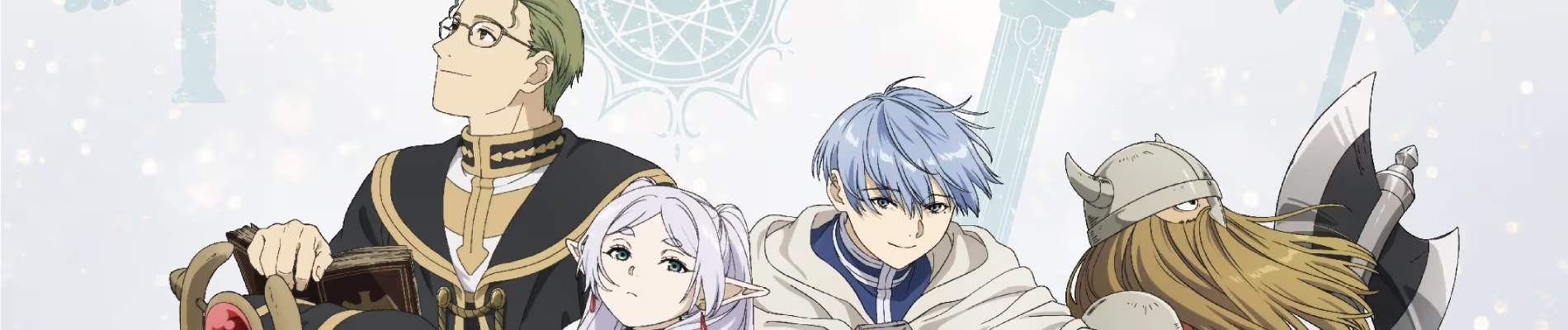
We're all familiar with the hero's journey, where we observe a young sword-bearing hero rise from humble beginnings, gathers a party of allies, and travels the world to defeat a great evil threatening all of humanity. They've been around since the time of Greek myths, and even now, we still get stories about heroes fighting evil across all forms of media, because that premise is instantly recognizable. Some are done well, some are done badly. But recently, some writers decided to ask the question "What happens after the heroes defeat the great evil?" Most stories end right as the villain is defeated, but have you ever wondered what the heroes' lives are like after the fact? Do they retire, or do they still go adventuring for the thrill of it? Does the hero's party stay in contact, or do they go their separate ways? Somebody decided to try answering all those questions, but doing so from the perspective of an immortal elf and having the story lean hard into what it means to make connections and how important the time you spend with your friends and the memories you make together are, no matter how fleeting. That's how we got Frieren: Beyond Journey's End. Screw all those dumb power fantasy/wish fulfillment isekais, if you ask me, Frieren is where its at! Sure enough, everyone else seems to agree, as Frieren has become massively popular since its inception, favoring heartfelt, character driven drama over your typical shounen battle action, and it's all the better for it. But a story like this absolutely needs to be adapted by people who not only understand the material to the letter, but know how to really elevate it into an animated medium rather than just simply copying it from text to screen. Thankfully, the team at Madhouse exceed people's expectations, mine included, and managed to make Frieren truly shine.
Based on the manga by Tsukasa Abe and Kanehito Yamada, the story is as follows: For a decade, the immortal elf Frieren traveled with Himmel the hero, Heiter the priest, and Eisen the dwarf on a journey to defeat the evil Demon King. They managed to do just that, and their efforts are celebrated and exalted by everyone all over the continent. The party decides to go their separate ways, and with Frieren being an elf who doesn't quite understand how time flows differently for her as it does for humans, she sets out on her own, just doing her own thing as she pleases. She reunites with them fifty years later, but not long after, Himmel dies of old age. It's only then that she realizes that even though she spent ten years with him, she never truly got to know him, and now that he's gone, she'll never get the chance to do so. Frieren begins to ponder the nature of connections at a time when it's already too late to say goodbye. This time, she sets out on a new journey, with a new band of companions, to see the world she had already explored with a new perspective, experiencing all the danger and joy that comes with it.
It's been a while since I've read the manga, even though I own all the volumes that are out in the US right now, so I don't quite remember the nitty-gritty details about the manga's paneling and artwork. But like I mentioned above, Frieren is the type of story that absolutely NEEDS a good, proper adaptation that treats the source with respect, and bad adaptations often do the opposite. Remember Lucifer and the Biscuit Hammer and Tale of the Outcasts? Luckily, the staff at Madhouse absolutely understood the assignment. There's so much care put into the animation in this show, from the lush, gorgeous backgrounds to even little things like the movement of fabric and each characters' unique body language, not to mention the dynamic action scenes that actually feel like they have weight to them. Case in point, the scene where Stark kills the Solar Dragon. I mentioned before in my Pluto review that being slavishly faithful in adapting a comic book to the screen isn't always the right call. If you're just copying the manga panels frame by frame, it can compromise how the anime adaptation looks, and there's benefits to experimenting with things like the storyboarding and camera angles. In Frieren's manga, the scene where Stark kills the Solar Dragon is just six manga panels, but the staff for the anime decided to make it into a full-on action scene that's packed to the gills with dynamic camera angles, experimental animation that favors fluidity, kineticism, and impact over staying on-model, and creative story-boarding that no static medium could imitate. One thing I did notice about the anime is that it really seems to like using negative space. There's tons of scenes where the background is just the sky and nothing else, whether it be framing a character's face or taking up 80% of the scene, and there's just something about the way its used in Frieren that just feels so atmospheric. Oh, and do I even mention that lusciously animated ballroom dance sequence with Fern and Stark? Eat your heart out, Tearmoon Empire and your bad CGI models.
Speaking of atmospheric, the soundtrack! I've only just started becoming familiar with Evan Call's portfolio, but he's been hitting home runs with all the soundtracks he's been making. Josee, My Happy Marriage, and now Frieren. I've heard his music for Violet Evergarden is pretty good too, but I haven't seen that yet. But hot damn, Frieren might just be his best and most versatile soundtrack yet, mainly in that it makes really good use of folk music and Irish or Celtic sounds to really give it that Tolkien fantasy feel. The same goes for the action, which often times mixes folk music with epic choirs, which actually made a better combination than I expected. Whether it be subtle oboes and acoustic guitars or a full-on orchestra, Frieren's soundtrack goes hard, and I didn't find any moments where its usage felt inappropriate or out of place. That being said...I'm gonna get lynched for saying this, but I wasn't really a fan of the first opening or the ending song. The visuals and lyrics for them are fine, I'd argue astounding for the former, but...I don't know, every time I hear YOASOBI sing, I always wind up mistaking her for a Vocaloid, and the robotic-sounding voice she uses just feels...off for a series like this. Milet doesn't have this problem, but her voice hurts my ears whenever she tries to go for the high notes. Ironically, I liked her song "Bliss" more than "Anytime Anywhere," and I wish the former had been the ending theme song instead. I do like the second opening, though.
But the characters are where Frieren as a show really shines. Even if they do start out as recognizable archetypes, the series really takes its time to show what they're like: How they behave, feel, and interact with each other, along with expressing their opinions on various matters and showing what they're like outside of whatever conflict they're facing, all done with a superb attention to detail, to the point where you can't sum them their personalities up in just one sentence. Having the series start from defeating the Demon King rather than ending with it probably helped in this regard, because Frieren as a show isn't about the epic monster fights or some grand journey to save the world, it's about how important making/maintaining friendships and connections are and how they can make an impact on people no matter how fleeting the encounter. It's kind of like Natsume's Book of Friends in that its approach to characterization favors subtlety over excessive melodrama, and many of the post-Demon King adventures Frieren finds herself on lean more into being laid-back and heartwarming, exploring how Frieren's journey impacted her in both big and small ways. Even the minor characters Frieren and her party meet have their own stories to tell, and don't feel like just generic NPCs who just take up space. Frieren is a series that actually puts in effort to get you to care about our main party, and on that front, I think it succeeded with aplomb.
Seriously, you have no idea how much I want to hail this series as an undisputed masterpiece. Alas, not even Frieren is perfect. I already mentioned my issues with the first opening and ending themes, but those feel more like nitpicking than anything. One thing even fans of the manga tend to dislike about Frieren is one particular tournament arc that puts Frieren's adventures on hold for over 20 chapters and embracing more generic shounen tropes that feel out of place in a series like this. While that particular arc isn't bad, I do agree that it's not as good as the stuff before it. The second half of the anime covers this particular arc, and now that I think about it, the whole arc and the justification the series tries to argue for it does come off as really silly, especially in regards to how one character approaches the third test and how she treats Frieren even though she's, y'know, the strongest living mage ever. Yeah, I don't like Serie. She's a petty brat who really needs a good slap to the face. There was one aspect of Sein's introduction episode that really rubbed me the wrong way, though that's a minor thing, and the English dub softened it a bit so it's not as off-putting. But really, those are the only criticisms I have of Frieren, and from what I've heard, there hasn't been a repeat of the mage exam arc since. I should probably get back to reading the manga.
It's honestly a modern miracle that Frieren even got a high quality adaptation at all, especially since anime don't usually get full 24-26 episode runs anymore, and Frieren wound up getting 28, which really helped the pacing and story progression. Frieren: Beyond Journey's End is a series you need to see if you like a more character-driven fantasy that favors subtlety and atmosphere over action and melodrama. For me, while Frieren didn't become one of my favorite anime of all time (If this had come out when I was much younger, it probably would have dethroned Shounen Onmyouji as my favorite anime of all time), it did remind me of why I really love anime as a medium and as an art form, even if the current anime landscape is still overrun with soulless, corporate, substanceless isekai wish fulfillment power fantasies made only to cater to the lowest common denominator. But even beyond that, Frieren is living proof that it's the execution that matters, along with how an adaptation, if put in the right hands, can help a series thrive and become beloved for years to come. There's still more Frieren after the point where the anime ends, but it could very well stand toe-to-toe with greats such as Cowboy Bebop, Trigun, Clannad, and many other anime that have been revered over the years. Frieren: Beyond Journey's End is a series that absolutely earned its popularity, and here's hoping its success continues in the future.
27.5 out of 31 users liked this review