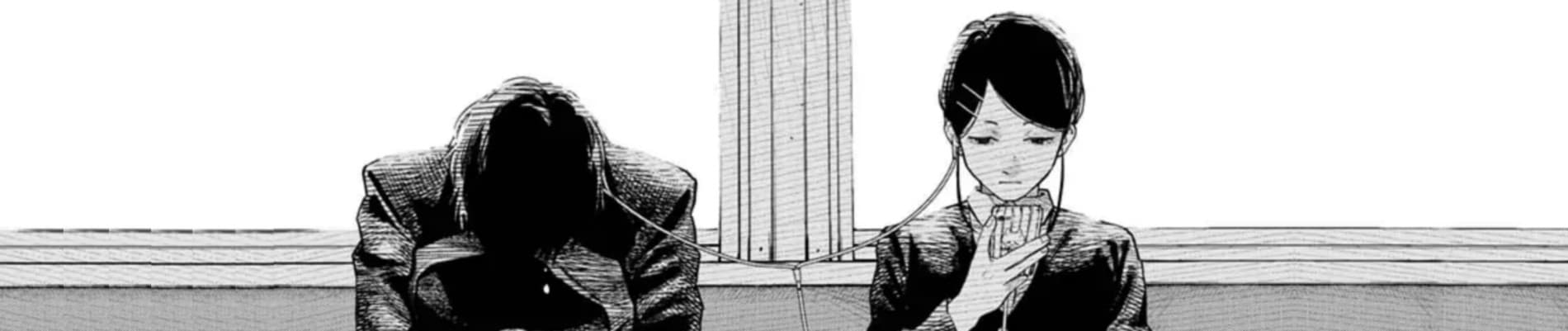
To preface, I think it's a bit silly that the first review I write on this website, or any website, is on a largely forgotten one-shot from two years ago that no one will read. However, I just can't help myself because it's rare I have an experience like this where a piece of art connects with me in such a clear way, only to look around and see that the majority of people seem to not see it like I do. Since this one-shot has been much more poorly received than Fujimoto's others(and not just on the basis of the length), it saddens me a bit.
I've seen many people say that this one-shot is criticizing people for overanalyzing, for looking too deeply into a piece of art. Whether you like or dislike it, that seems to be the message people are taking from it. And while it can certainly be viewed that way, it isn't the extent of what I got out of it. So what did I get out of it?
This was created in the long awaited lead up to Chainsaw Man Part 2 and works through the anxieties that I'm sure Fujimoto was feeling at that time. He was worried about the expectations of Part 2 and his ability to reach those expectations built by all the interpretations he may not have meant in the previous part. The character in this story, like Fujimoto, is overwhelmed by the interpretations of his art, but does that mean those people are wrong to make those interpretations? Is that what the story is getting at? I don't think so at all. That's because the things people were seeing in the main character's song in this story were not blatant over analysis, but literally in the art, intentional or not.
The people seeing the ghosts and the sky fish weren't people thinking too deeply, they were literally there. The commentary on gun culture, similarly, seems to have literally been there, "if it was by sheer chance, is it divine revelation?" implies that. Maybe some of the interpretations made were far-fetched(the cat symbolizing the sun sticks out to me), but to say that the story is decrying analysis of art on the whole seems incorrect to me.
The interpretations that people were making about the song seem absurd to the main character because he didn't intend them, and so they intuitively seem absurd to us. Not to mention that there doesn't seem to be any way in reality for a love song played backwards to be a critique on American gun culture(among the other silly things), but in the world of this story that seems to be what happened. In the world of the story, the interpretations are reasonably made and while the main character doesn't see it that way, I don't believe we as the audience should see it like he does.
I don't take the main character's proclamation to "just listen to the song" as the story's message, but instead the character running away from the expectations that he couldn't hope to match again. His feelings are valid. He didn't intend to include everything people saw in his first song, so he couldn't possibly recreate it. He just to wanted his work to be seen how he intended. But the interpretations of the public were similarly valid. I simply can't see this as Fujimoto lashing out at people analyzing his work, but a showcase of how unintended interpretations put pressure on an artist. I don't think anyone is meant to be at fault here. It just is what it is.
The final layer is the anxiety from when a work is interpreted exactly as intended and criticized for it. His crush sees his art just how he wanted it to be seen and thinks it's cringe. He's both happy and embarrassed, although I'm not entirely sure in what proportions(more happy than embarrassed, probably). I think it's an interesting aspect to include and makes for a nice ending.
In any case, I enjoyed it. Of course, I could be wrong about everything and I need to Just Read the Manga.
7 out of 8 users liked this review