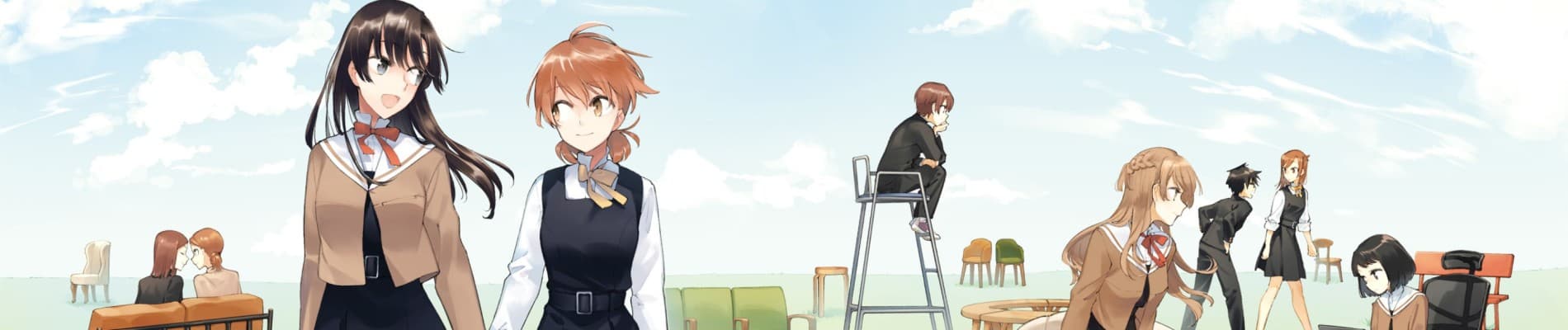
Bloom Into You
a review by hdtcoa
a review by hdtcoa
WARNING: FULL SPOILERS FOR BLOOM INTO YOU
Like the title says, this will be an overly long (nearly 8k words wtf) and overly stupid overanalysis of Bloom Into You. I will look very in depth at symbolism and themes and all that jazz that you probably got sick of in english class. So click away if you don't like that stuff. If you do, take a seat and get ready to read an idiot's attempt at an overanalysis of one their favourite works of art.
______
"The words in shoujo manga and love songs... they're always sparkling brightly. I don't need a dictionary to understand the meaning... but I've never felt them for myself." Bloom opens with a brilliant line that informs us of one of its major themes: Creation of identity through art. Bloom instantly criticises these kitsch art for mindlessly pandering to the fantasies of the general reader, giving them a false and unrealistic impression of love. To put it bluntly, Bloom wants you to get a fucking life. Stop deluding yourselves with these fantasies. Take action to change your life, and use your actions to form your identity, which is also a nice lead in for me to talk about Bloom's most prominent and overarching theme: Creation of internal identity through external action.
We are then introduced to Yuu Koito. Immediately, we can see her defining trait for the first half of the manga - ironically, though she is one of two protagonists in the manga, she is a static protagonist in her own life, unwilling to and unsure of how to take control over her own life. She doesn't know what club to join, she doesn't know where she should take her life towards. Of course then, her decision is swayed by the first sign of authority. Even after realising the teacher was likely just taking advantage of her indecisiveness, she still chooses to blindly follow what she is told. She has no agency, and this is only caused by her lack of urgency to take her life into her hands. Repeatedly throughout the first half, we see her face carrying an apathetic expression even in times of sincere love and passion. Yuu Koito is simply coasting through life, unable to change what she does, or rather the lack thereof, and therefore unable to change who she is.
Next, we are introduced to Touko Nanami - with someone confessing his crush on her. Our first impression of Touko is not through her own words or actions, but someone else's perception of her. Immediately, we can also see her defining trait for the first half of the manga - her entire identity is defined by her external achievements and goals, leaving her own self empty inside. This is different from Bloom's most prominent theme I mentioned earlier. External action and its consequences can form your inner identity, yet Touko has no inner identity. Her external does not help to create her identity, it merely is her whole identity. And, like Yuu, she too will have to learn how to take charge and form her identity through her actions.
Later, we learn that Touko is just trying to live up to her sister's name. Of course, Touko rejects him. She says it's because she doesn't want to date anyone, ever, but really this is just an excuse for her to run away. To run away from love, to run away from the pain which can be caused by love. Nanami Touko has been traumatised by love, and now her identity is fractured and empty. This fear prevents is what prevents her from being able to use her actions to create her identity. After all, without an identity, how could someone love her - and hence, how could someone hurt her? She introduces herself to Yuu as "a student council member", once again defining herself only through her external title.
Yuu doesn't seem to have particularly close friends. It's not that she is on bad terms with them, it's just that they seem to be more like those kinds of friends you mainly just hang out with for fun, not friends who genuinely understand and know you. She refuses to tell them who she's talking to right at the opening of the manga, and of course has not asked them yet for their advice regarding the boy's confession. There are many panels in the first chapter simply depicting Yuu physically, and emotionally, distanced from her friends, her friends smiling in bright light while Yuu is shrouded by darkness (the panels are literally like that I'm not being fancy here). We can then see how this relates to Bloom's third and final major theme: Creation of identity through forming genuine human connection. Yuu, because of her apathetic attitude towards near everything, has not yet gained any such connection. Though, she will gain one such connection very soon. Of course then, the place where she gains this connection is the student council room, a space formerly used for calligraphy - for art.
I'll elaborate more on my interpretation the themes before I continue. Bloom does not posit that your identity is only your actions and achievements, like Touko believes it to be. Rather, it is your actions which mold your identity and inward qualities. Your actions are not part of your identity but they play a major role in forming your identity - actions like engaging in art and forming genuine human connection. The most important thread between these themes is simple - action. Without taking action for your life, identity cannot be formed, which is something Bloom's characters will struggle with a lot.
Yuu asks Touko for advice. Of course, it is not because she thinks Touko understands her well enough to give her advice, but because of her perception of Touko as a perfect genius. "There's nothing wrong with the way you feel." This is Touko assuring Yuu of her perceived aromanticism, but also Touko assuring herself that her love for Yuu will be okay because Yuu will never fall in love with her. This is the first step taken to deepen the connection between them. Touko successfully pushes Yuu to finally take responsibility for something in her life.
Touko chooses Yuu as her campaign manager. From Touko's perspective, this proves her absolute trust in Yuu. She trusts Yuu to help her maintain her public image, her outward appearance, the only things that define her identity as of now. She wholly entrusts Yuu with her very being. It is because of this that Yuu takes the first small step to changing her own identity. By helping Touko with her campaign, an intrinsically kind gesture, Yuu herself becomes kinder in the process and adds this kindness to her own identity - a part that will help her gain connection. And despite Touko's sensible explanation, Sayaka still manages to easily figure out the real reason. Sayaka understands Touko perfectly, so "why is it that Touko falls in love with Yuu instead" is a question that will be given an obvious answer later. Oh, and they kiss pog. (Insanely obvious symbolism about the theme of homosexuality here at the end of this chapter)
Touko gifts Yuu a souvenir, lighting up the roof of her room with a flashy display of stars. Touko is literally telling Yuu, I want to reach for the stars with you, my love for you extends to the moon and back. "I wonder if someday... I'll reach the stars too..." The gift will then serve as a motif that will continually symbolise the status of their relationship. For now, it represents Touko's never-ending love for Yuu, but also how far away love currently is for Yuu. Plus, this is a romance manga, and whenever any romance manga makes any reference to the moon or space, The Tale of the Bamboo Cutter immediately comes to mind, accompanied by its very obvious symbolism.
It's time for Touko to deliver her speech. She's extremely anxious, and Yuu notices this. What follows is a monologue that normally would've been lazy exposition in most other manga, but in this case, it works because it doesn't actually explain or reveal Touko's motivations. Sure, she may have been average, she may want to become someone special and looked up to, but she is NOT chasing after her "ideal self". No, she is chasing after an illusion, after a false identity, hopelessly trying to live up to her sister's identity and become her. Touko isn't chasing after her ideal self, she's chasing after her ideal image of her sister. This monologue brilliantly sets up expectations about Touko's character for us before completely subverting them later. Yuu's explanation right after this is similar. Yes, Touko fell in love with her because she didn't have to act special and perfect in front of her, but this is not the full explanation. Touko feels comfort in the fact that Yuu cares less than most about her perfect image, lifting an enormous pressure and stress off her when she is around Yuu as the impossible task of becoming her sister seems less crucial to her. "I can only be like this... with you." Though, Touko is still absolutely not ready to take off her mask and reveal her true self to Touko, their relationship is not that close yet, they have yet to gain that genuine bond. Well, not like she has any true self right now anyway.
Yuu delivers her speech successfully. "_I'm the only person whom she can turn to for help._" As of now, this is still true. The only other person could be Sayaka, who already accepts Touko for who she is underneath, but Touko has not realised this yet. Yuu is the only person whom Touko feels less pressured to be perfect around, and even that tiny bit of her burden of perfection being lifted around Yuu, makes her feel that Yuu is the only person she can be vulnerable around, the only person with whom she can let her mask slip, even if just by a tiny little. Once again, Yuu's connection with Touko pushes her to take responsibility for her own life and join the student council officially, taking responsibility for her relationship with Touko and Touko's emotional reliance on her. "I've decided I want to be a student council officer. I want to help Nanami-senpai however I can."
The side characters in Bloom are not particularly complex, they don't represent whole themes by themselves, which is fine, but they're still extremely valuable. Maki is one such example. Later, he will serve as an important foil character who will help Yuu realise she isn't really aromantic and provide her with confidence, but for now he is just a wholesome example that there are people who are accepting of homosexual relationships. Seeing Yuu and Touko kiss, he doesn't just ignore it, but actively goes out of his way to encourage Yuu. Speaking of their kiss, like their first, their second is also overshadowed by their unwillingness to expose their true identities. "Her eyelashes are so long..." The eye is an obvious symbol of one's soul and true self, and so Touko is still hiding her true self from Yuu. But this time, they kiss in a place that literally gives Maki a window into their lives, helping Maki understand Yuu more and gain a deeper connection with her, in turn helping Yuu sort out her feelings and identity. Again, genuine, human, connection.
Koyomi asks Yuu for her opinion on her novel. Art is another gateway into the soul, and so this is where Yuu's first friendship forged from genuine mutual understanding starts. By creating this art, Koyomi is expressing her self and her identity, and by asking Yuu to read it, she is asking Yuu to make an effort to understand her better.
Yuu studies with Touko. To Touko, this is the ultimate declaration of trust, as she is being trusted to maintain Yuu's grades, her public image. To Yuu, these are just ordinary study sessions. She goes to sleep hugging Touko's gift with the display turned on. "I'm not alone, but... I wish my heart would choose for me. If only I could choose..." Here, the motif of the gift symbolises her desire to confirm her relationship with Touko. Yuu may not be alone, but she is lonely, and she needs concrete and sincere relationships in her life to cure this loneliness. And it is her blossoming relationship with Touko that makes her realise it is her indifference towards her own life holding her back from forming these relationships. "I'm sure I'll keep spending time with Nanami-senpai... both in and outside of student council, but... even though senpai loves me so much... I'm still not sure if I'm going to change. Am I always going to be like this? I hope not."
And now it is time for Yuu to learn about Nanami Mio. Of course, she only gains this knowledge through Sayaka, showing just how much greater Sayaka's understanding of Touko currently is. Yuu confronts Touko about this. She already knows Touko is not the perfect being she tries to present herself to be, and so Yuu feels she need not strive for this level of perfection. Plus, Yuu also understands the emptiness of Touko's identity, and so she wants Touko to stop trying to become her sister so that her true identity can be formed, so that Yuu can begin falling in love. Yet, Touko firmly rejects this. Living up to her sister's name is all that gave her life meaning, and to her all that gives her identity. Throwing away your identity is scary, after all. Hence, Yuu believes that Touko will never change and gain her identity, and so resolves to never fall in love. But now, just like Touko, Yuu is simply running away from love. But unlike Touko, Yuu realises she is just running away. Unfortunately, Yuu has not changed her identity enough to completely take control over her life and fall in love and create genuine connection yet. It'll take a while before we get there. "I want to change. But I lied about that... I guess I must be lonely, too." Fortunately, they will soon be creating the play, creating art, and this experience will be the final catalyst that pushes them to form their own identity.
In her second monologue, Touko reveals to us why she doesn't want Yuu to fall in love with her. She believes love is not freeing, but binding. Yet, like her first monologue, there is more complexity to it than meets the eye. Right now, Touko believes, rather irrationally mind you, that she is only in love with this current form of Yuu, this current form that is not in love with her or anyone for that matter. Were Yuu to fall in love with Touko, she believes that, again, rather irrationally, she will no longer love Yuu. Touko still has no real identity, the only thing in her mind distinguishing herself from her sister is loving Yuu, and so this change would remove the only distinction between her true self and the rest of her identity, completely breaking her mentally. "Then, how was she fine before meeting Yuu?" you may ask. Touko herself explains it. "Now that I've felt such comfort... I can never... go back to being alone."
We are properly introduced to Miyako and Riko, the cafe manager and her girlfriend/Yuu's teacher. Like Maki, they're not particularly complex and mainly just serve as wholesome examples of homosexuality in adulthood which the characters, specifically Sayaka, can look up to. More importantly, Sayaka explains why she fell in love with Touko at first - for her appearance, talent and hard work, all obviously only external. Because of these external traits, Sayaka takes action to get to completely know and understand Touko. It's highly likely that by this point Sayaka loves Touko for her internal qualities, but the more important thing here is that, ironically, Sayaka believes she cannot confess to Touko as she understands Touko so well that she knows she will be rejected. This is mostly a result of their somewhat one-sided relationship, as they both help and support each other greatly, but only Sayaka truly understands Touko, not the other way. Plus, it's foreshadowing for future events and confessions that may or may not end unfortunately for Sayaka.
All the symbolism from here till chapter 22 is, quite frankly, very obvious and somewhat "repetitive". It's not bad, I just don't feel that analysing those chapters 100% in depth will add much to this already far too long analysis. To sum it up, Touko realises her sister wasn't the perfect mirage she envisioned her to be, leaving her already fractured identity in shambles, and so Yuu decides to take action and make her form her own identity by changing the ending. Plus, we obviously see Yuu starting to really fall in love with Touko. Starting back from chapter 22, we see another instance of the motif of Touko's gift. Yuu, holding it, vows to "change her". Here, the gift represents how scattered and fragmented Touko's identity currently is, just like the stars, but at the same time Yuu's newfound resolve to piece Touko's identity together - turning the seemingly random stars into cohesive constellations.
Although Yuu vows to change Touko, this is the first time she actually manages to make a significant change to herself. She isn't just going through the motions of life uncaringly, she is forcibly taking action to help someone - and by helping Touko, she helps herself change for the better. The first action Yuu takes is to invite Touko to the aquarium, also the first time she takes initiative in their relationship. A lot of obvious symbolism in this chapter, but most importantly, they both buy a pair of matching dolphin keychains, yet another motif to represent their relationship. In this first appearance, it obviously represents how the pair are more connected to each other now. And the chapter ends with this absolutely fucking brilliant line: "We'll be at the transfer stop soon". Like how they are changing stops, they themselves are changing and going in different directions in their lives. Yuu is the one who speaks this line, finally taking responsibility to change herself, while also changing Touko through changing herself.
Koyomi meets her favourite author. Obviously, this mini sub plot of her meeting said author (whom she probably has a crush on) and finding out that said author is a woman parallels Yuu and Touko's story, but importantly it foreshadows the story of the two leads. Koyomi uses this newfound understanding of her probably crush to motivate herself to change herself and achieve what she really wants, foreshadowing that yes, eventually (eventually) Yuu and Touko will come to truly love and understand each other, not in spite of, but because of them changing themselves and each other, contrary to what Touko erroneously believes. And, the immediate effect of Koyomi's motivation is making the script better, which will help Touko herself form her identity. Again, identity through art and connection.
And, the immediate effect of Yuu taking responsibility for her life is on Sayaka. With the new script and Yuu pushing for it, Sayaka finally understands why she couldn't confess. "I was happy being the closest of her many friends... Just waiting for the day that she would change." The change that Sayaka is referring to here is Touko finally willing to love someone again, to love her, and thus she realises that she, like Yuu before, is also not taking responsibility for her life. Here, we see that Yuu changing herself for the better, her action, leads to positive change in the people around her as well.
Okay, so Touko gets pissed at the new script and wants to kiss Yuu. Though I have some minor problems with this chapter, the important thing here is that the motif of Touko kissing Yuu is given a lot more meaning. She kisses as a way to express her love for Touko as herself, not as her sister, without really exposing herself, i.e. it's a way for her to "be herself" while not truly breaking away from her identity as her sister, the reasons for her doing this should be clear enough by now. Hence, Yuu takes the next major step in progressing their relationship. She doesn't let Touko kiss her, she doesn't let Touko fall into the downward spiral of endlessly trying to become her sister. This is the first time Yuu directly does something to help Touko form her own identity.
The parallels between the play and Touko and Yuu are ridiculously obvious (which isn't necessarily a bad thing) so I'll skip over that part. But before I move on, I just have to mention this is about the last significant time in the manga where the theme of forming identity through art will be relevant, besides Touko becoming part of the theatre troupe which has very obvious symbolism, so uhh, bye, i guess.
___________
It's difficult to pinpoint exactly when Yuu falls in love with Touko, it can be argued that she was in love from the beginning, it can be argued that it was at the sports festival etc, but by now, at chapter 32, it is made blatantly obvious that Yuu has finally fallen in love, and most importantly it is clear that she has accepted her feelings. Yay, Yuu fell in love, she got what she wanted. Right? Not quite. Because what she really wanted was, again, genuine human connection. Yuu was lonely, and still is, though to a lesser extent, and she misinterpreted her loneliness as a yearning for love. However, her love will now enable her to form a genuine connection with Touko, but as we know, this is around the time their relationship unfortunately starts to get rocky. (Also before I move on can I just say that chapter 33 is the most wholesome shit I've ever seen. Yuu's sister actual best girl)
Yuu confesses to Touko. Just wanna talk about the obvious symbolism of the location (which was also where they had their conversation in chapter 10): The river represents the incoming change in their relationship, and the path over the water made of disconnected stones represents the difficulty they need to overcome because of the change. Plus, the river is quite literally water under the bridge.
Anyway, to finally move away from the symbolism stuff onto more technical/structural criticsm, because chapter 34 is one of the best executed "confession scenes" I've ever seen. The art and pacing of this whole scene are ridiculously good, perfectly conveying the emotions of the characters and the flow of the scene. It starts with slow, casual dialogue, heightening the tension of the scene since we know, through by-now obvious foreshadowing, that Yuu will confess. And a few lines from Touko really make this scene even more tense: "You've kept all your promises from that time", "In fact, you haven't changed at all", "Yuu... I hope you'll stay with me... just like you always have". Then, a kiss, and the inevitable "I love you", except this confession is overshadowed by repeated panels only showing Touko's featureless face and their legs. Plus, the actual words "I love you" are written in a panel of Yuu covering her face in shame and guilt. Yeah, devastating.
And then, even more pain. Page 19, best page in the whole manga. First panel, complete darkness. Despair. Second panel, streaks of white. Hope? No. Third panel, Touko's hands. We're in a first person POV, thrust straight into the throes of Yuu's situation. Her hands, asymmetrical, unevenly spaced throughout the panel. Streaks of white, cutting through an overwhelming blackness of instability, now streaks of wavering confidence. Fear. Mental chaos. Fourth panel, a desperate "I'm sorry!" connecting these panels. Her hands, now white with streaks of black, fully split apart, reveal Touko. But, not really. It's a different Touko, cold, distant. Just black leggings and shoes.
And so the rest of the scene continues excellently. Touko, now wracked with guilt, tries to keep Yuu from running. But her fear. Her fear of love, her fear of being loved, her fear of her persona, painstakingly built up over the years, being torn away, her true self laid bare all for Yuu to see. Her fear stops her from stopping Yuu immediately, and their relationship is now at a significant hurdle. "Yuu... She really has changed, hasn't she...?" Fortunately, and finally, Touko understands how her fear is holding her back from loving Yuu and forming her identity.
Aftermath. The next chapter - and volume - starts with some "Dutch angles" which I really like, plus a very cool inner monologue from a sad Yuu. "What did I mean by love? It's a word I've never been able to say... But I think I've always wanted to say it. Yet even now that I have, I still don't really understand it. 'I'm sorry!' Is this what they call a broken heart? But I didn't even cry. I don't know... It's more like my heart is numb. It's right here in my chest, but somehow it feels so far away." Here, we see Yuu reflecting on what love means to her, and this is where she really starts to confront her perceived aromanticism and begins to realise - she isn't incapable of love, the way she feels love is simply different from the way it is portrayed in the manga she reads. Art can help create connection, yet it can also distort and deceive. It all depends on how it's made.
Touko tries to rationalise distancing herself from Yuu, yet subconsciously she knows that she needs her. "It never even occurred to me... That I could be myself someplace that isn't by Yuu's side. The troupe... School... Home... I'm sure there are other places for me, too. Yuu isn't my special someone anymore. The person who wouldn't fall in love with me is gone. And yet... I feel so lonely." The two of them keep away the dolphin keychains which they got from the aquarium, very clear symbolism here. This is where Bloom's leads really begin to confront their inner selves and their loneliness.
Of course, Sayaka immediately notices something's wrong with Touko. "I do think Touko has changed. She never would've shown her weakness so readily before." She goes on a "date" with cafe manager, which does provide for some nice comedy, but more importantly, this helps Sayaka decide to confess (FINALLY OMG YOU LITTLE-). Here, we once again see the positive change Yuu helps to create in the lives of others by changing herself - she helps Sayaka realise that she cannot have any more excuses for not confessing to Touko. The final factor in her making her decision is her talk with cafe manager, her bond with someone older helping her make her decision. (Also can I just say the extra chapter right after this one about cafe manager and teacher is so damn cute and wholesome and I fucking adore it I love them so much)
Second confession chapter of pain ~~lessgo~~. Chapter 37 is also wonderfully executed for the most part. It begins with the junior council members discussing Touko's and Sayaka's trip, reminding us of Yuu's role in making Sayaka confess, as well as the reason why Sayaka will be rejected (sorry Sayaka). "I've watched her for so long. All this time, just watching and waiting... But I don't want to wait any longer. I have to tell her... I'm in love with her." Sayaka's inner monologue parallels Yuu's arc of inaction to action, once again reminding us of the aforementioned things. Yet, it also creates an ironic sense of tragedy - while Yuu taking action helps her to find love, Sayaka taking action has the opposite effect. This is how Bloom creates the important distinction between finding human connection and love. Love is simply another great form of human connection, not a necessary part of forming identity. Sayaka, regardless of the status of her relationship with Touko, will be able to find and accept her identity anyway due to her genuine bond with Touko. Without having this distinction, Bloom could've easily been interpreted as saying love is necessary to form identity, which is a very unhealthy and untrue mindset.
The rest of chapter 37 before the confession is like a compressed version of the whole manga themes-wise, showing Sayaka trying and failing to muster up the courage to do so, all while spending some very quality time with Touko. Of importance is what she does at the shrine. She doesn't want to check her love fortunes, since "No amount of effort can change a fortune... So I don't really like them." Once again, like the first line of the whole manga, Bloom is telling us to take action to change our lives instead of relying on these kinds of things. Yet, these things can also be useful to us. "I'm not the type to pray for help. I'd rather get what I want with my own two hands. But I could use... A little courage." Touko is the one who helps her reach the stone, again showing the importance of connection, while the stone serves as the representation of engaging with art, with the stone specifically being culture instead of art. Summarising the manga's themes in this single chapter serves as a helpful reminder of the themes up to this point while also, again, reinforcing the important distinction between human connection and love.
Sayaka confesses. This confession scene at the end is, unfortunately, my biggest problem with the manga, but even then it is still quite minor. Sayaka's big monologue, unlike the other big monologues in the manga, is basically just exposition without really revealing or hiding anything else beneath the surface of exposition. However, that only applies to the big monologue, because the other symbolism in this scene is brilliant.
Sayaka basically just tells Touko everything we already know about them - how she fell in love at first with the external image Touko was trying to portray, but eventually understood Touko's true inner self and fell in love with that part of her. Yet, in the middle of this relatively mediocre monologue is one of the most beautiful pieces of imagery I've ever seen in any work of art. In one panel, Sayaka appears to begin hugging Touko, the external image of Touko's sister. However, in the rest of the page, it is revealed that Sayaka is actually bending down, extending her arm out to a smaller version of Touko crouching behind the physical Touko. This smaller Touko obviously and ironically represents the real, inner Touko. On the next page, across three small panels, creating a slow personal pace, Sayaka grabs the hands of small Touko and pulls her up. Similarly, the rest of the page reveals Sayaka holding physical Touko's hands. Sayaka here has literally and metaphorically helped Touko to drag her inner self out from her false, external image. This is one of the most fucking breathtaking and uplifting uses of visual storytelling I've ever seen. Might be my favourite panel in the whole manga.
Arguably the most important question posed by the manga and by Touko - "How can you stay in love with someone who keeps changing?" - is once again brought up in chapter 38. To Touko, whose only understanding of identity for the majority of her life was her singular, unchanging image of her sister, the idea of falling in love with someone who could change at any moment is terrifying. And so, after 37 chapters of character development and thematic development, Bloom delivers its answer.
"You know... Love... Doesn't mean 'I never want you to change.' But I don't think it means 'I don't care if you change,' either. So I suppose it might mean... 'I believe that you'll always be the person I adore.' A declaration of faith... Perhaps."
__________
Touko rejects Sayaka. We all knew this would obviously happen, but damn does it hurt like hell, thanks to how perfectly executed chapter 38 is. "Touko is all I ever thought about. I thought I could do... Everything she could ever need. But I waited too long, was too scared... And she stepped in instead. I'm not the one." The key word here is "thought". Instead of taking action to progress their relationship and tell Touko she accepts her, flaws and all, Sayaka simply waited and prayed. Touko falls in love with Yuu instead of Sayaka for a simple reason - though almost certainly unintentional, Yuu was the one who took action first and let Touko understand she could be herself around her. And Touko finally understands - herself, and her love.
"The words in shoujo manga and love songs... I thought they might actually be in my grasp. But now..." In chapter 39, Bloom calls back its very first line, indicating that the thematic and plot conclusion to everything that has been built up so far will come so very soon. Yuu goes to a batting cage with Maki in a poor attempt to stave off her loneliness. She tries tell him that she doesn't care about love anymore, an obvious and stupid attempt at rationalising her giving up on love, but Maki sees right through this: "No, you can't. You're just running away. You're afraid, and you're trying to hide it. You really haven't figured that out yet? The truth is, you already know how it feels to love someone. But if you admit that, then having that love rejected... Is going to hurt a lot. So you're just faking. Right?"
Like I already said, Maki is not a particularly complex character, but it is abundantly clear by now that his most important role is as a foil character to Yuu, showing us and her that she is not really aromantic. "Don't try to pretend we're alike." Maki has been shown to be very astute, almost like an empath, so his words carry extra weight to us and Yuu. With this scene, Bloom yet again posits something pertaining to its themes of identity: Due its performative nature, we can only reveal and understand our true selves through our interactions with and actions around others. It's your actions surrounding other people that are the most important in forming identity.
"Maki-kun is right. I am running away. The truth is, it hurts. I'm sad. I'm lonely. If I didn't understand, I wouldn't have to feel this way. But the fact is... I do want love." Maki's words and actions force Yuu to accept her negative feelings, which in turn pushes her to meet up with Touko once she reads her text.
Up next, the final arc. The end to this masterpiece.
_____________
"I've never been good at making up my mind. So I just waited... For things to come to me. But I see now. 'I want to help Nanami-senpai however I can.' 'I won't fall in love with you.' 'I want to change her.' 'I only know you.' Yes... I keep choosing Nanami-senpai... Over and over again."
Yuu opens the final volume by briefly recalling her journey - from indecisive and unwilling to do, to actively searching for the one she loves, Touko the catalyst for this transformation. And though this is obviously where they will (finally) get together, Nio Nakatani manages to keep the romantic tension of the chapter at a high. Yuu arriving earlier casts the slightest bit of doubt in our minds, which is immediately quenched with a beautiful page paralleling Yuu's hopeful gaze to Touko's desperate running, solidifying that (finally) they are together.
And the moment Touko arriv- "I love you, Yuu!" She cuts all the bullshit. No more hiding behind a wall of persona and achievements. She lays herself bare for Yuu, her true self completely vulnerable to her. And she really does. A beautiful monologue.
"That spring day... In this very spot, I started falling in love with you. And yes, it was because you said you couldn't fall in love. I'd always been afraid of the word 'love.' But... I've decided to stop being scared. It turns out... That love doesn't mean 'you have to stay the way you are.' It's okay to change. After all... I love you now, Yuu. You've changed... But I'm still in love with you."
Understanding Sayaka's words, Touko repeats them, both as an affirmation to Yuu and herself. Plus, a great piece of symbolism here is the constant reflections we see of them in the windows, reflections of their old selves. And so, Touko draws the curtains shut. They really have changed.
"But... Why? The part you fell in love with... Is gone now."
"I love how kind you are. I love how you can be brave for others... Even though you're indecisive when it comes to yourself. I love it when you laugh at me. I love how short you are... And how much that seems to bother you. I love your fluffy hair... Your soft hands, always so cool to the touch... And your calming voice... I love it all."
Touko shows that she finally understands. What she needs isn't to stay and become her sister. What she needs is to grow as herself, accept herself as a valid human being, with Yuu. And she also understands her love for Yuu. Yes, she did fall in love at first for her perceived aromanticism. But she knows now, it's not that. It's the little things that make Yuu Yuu. Her small quirks and characteristics, the small things she does around Touko. Her kindness. Though the part that made Touko fall in love is now gone, Yuu is still Yuu. And she is "the only one" for Touko. So Yuu responds in kind with her own beautiful monologue.
"I thought that love... Was supposed to be a special feeling... That would come crashing down from the sky one day. I thought it was this huge, inexplicable thing... That would totally overwhelm me. But I don't think my love is like that. It's something I chose to reach for myself. All this time... I've been making my choice over and over. The choice to be by your side... The choice to try to help you change. I was able to choose because you told me you loved me so many times. So I've decided... That I want you to be my special someone."
And the obligatory words. Like Touko, Yuu now understands herself and her love. Love isn't some magical entity that you'll suddenly have one day. It's a very real thing, elusive, something you have to actively find and grasp in your heart before it runs away. Yuu finally knows that what she needs isn't to wait around for a miracle. She needs to live, choose her own life, and thereby find love and herself.
Of course, they kiss. Like most romances, this is a monumental scene, but so much unlike most romances, this kiss carries so much weight in Bloom. Repeatedly throughout the whole manga, the motif of Touko kissing Yuu has been used to show her hope to find and be her true self around Yuu, yet also her absolute fear of being vulnerable and so breaking. So what do they do now? Yuu herself initiates the kiss, and Touko lets Yuu in, lets Yuu know that she really is Nanami Touko.
_______
To be honest, that's almost all of the thematic content, but there's still some things left, and structurally the story cannot end yet either. Bloom very much turns into a slice of life, cute bits of their lives and interactions to give some satisfying closure to their relationship.
The first thing is Sayaka scoring higher than Touko on the exams, symbolising two things. One, Touko is truly no longer obsessed with being the perfect image of her sister. She graciously accepts her defeat, where the old Touko would probably break. Two, Sayaka has become her own person too, no longer defining herself by her relationship with Touko. They have changed, and moved on.
Next up, Yuu watches a play that Touko stars in. Art has been shown in the manga to be a reflection of one's true self, and aside from the obvious symbolism with Yuu seeing Touko, what it really shows is that Touko has not just broken away from being her sister, but is proud of who she is and unafraid to let others see.
And the most important moment in this sort-of epilogue - they, for a lack of a better word, have sex. It's not fanservice-y at all, like the rest of the manga, and is instead the final step of this part of the messy beginning of their relationship. The build-up to the inevitable chapter has some of the funniest and cutest lines in the whole manga, plus being really tense.
Touko starts by commenting that it's like they're living together, calling back the opening pages of the earlier chapter with Yuu's dream. And, when they find a family photo, a final confirmation of Touko's identity. "You look a lot like your father... But she looks more like your mother." "You think so, too? We used to get that a lot."
And they do it. It's a declaration of their love to each other, even more intense than their previous kisses. And of course, Nio Nakatani still fits some wonderful and rich dialogue in.
"Lately, I've been thinking that I should be the calm one now... Since I'm the oldest. I've relied on you all this time... And I've given you nothing but trouble in return. I thought it was time to be a senpai you could depend on, you know? It didn't seem fair for me to keep being selfish... So I wanted to pay you back."
"I don't need you to act like the oldest or anything like that. You've already given more than you even know. Besides, saying you're paying me back... Makes it sound like we'll be over once we break even... And I don't want that! You don't have to hold back. One thing I've learned is that when people fall in love... They start to get greedy."
"I hope what you want and what I want... Are the same thing."
"I want to do lots of things with you, senpai. I want it all. So let's do that, okay?"
And they'll continue giving each other more.
"So, where should we go today?"
__________
"There are no punctuation marks in life. Each day follows the next without pause... In the end, even the most special day or moment... Gets left far behind."
The final chapter. The end. It very much serves as a satisfying and necessary conclusion to Bloom, not holding much thematic weight, but that's mostly because all the themes have been fully fleshed out already. Now, a timeskip, it's the start of a new part of Yuu and Touko's lives. It's college, they have long since graduated from high school, but now Yuu goes back to a cultural festival there, the place where it all started. Everyone has grown - Koyomi, Akari, Maki, Doujima. Sayaka and Touko. And they all come to watch the student council play again.
"The play was about a boat traveling down a vast river. Day in and day out, the journey goes on without end. Even those special days and moments... Are far behind us now with all the rest. And yet... If you turn around, you can still see them shining on... Like beacons or stars, lighting the way as the boat travels on."
In that last line, a gorgeous double page spread of an older Yuu and an older Touko, sitting on that boat and looking back at all the memories they have made. That part of their lives may be over, but the lessons learnt and the experiences they went through still guide them to this day.
We find out Sayaka has a girlfriend, and she hasn't told Touko yet. Not much to say here, but this might be the single most satisfying piece of closure in Bloom to me. Throughout the whole manga, Sayaka has been struggling with her sexuality, Touko being her only way to understand it. But finally, she has accepted it, accepted herself for who she is, and is now even independent enough of Touko not to tell her at all. Beautiful.
And finally, the end comes. Touko and Yuu return to that bridge over the river, where, as Touko remarks, they "had a lot of serious conversations here back in the day". Instead, Yuu comments on her bathtub cleaner running low. They really have moved on to a new stage in their life. They talk about their future, a picture of domestic life, and...
"The stars are coming out."
"Shall we go... Touko?"
"Sure, Yuu."
Bloom has beautifully portrayed the struggle to find one's identity. Yuu, unable to do anything for herself, finds a way to change herself through Touko, and Touko, unable to move on from her sister, finds a way to find herself through Yuu. Ultimately, we have to make the effort we shape our own identity. No cosmic star will fly down to you and magically gift you identity. It's something we create through our own actions, through what we do for other people. Identity is a difficult thing to make, but it is possible, and it is worth all the effort.
_______________
The final page of Bloom Into You is a simple shot of Yuu and Touko holding hands, looking at the stars. The gift Touko gave to Yuu all the way back has now become reality, and they are moving towards it together. This page isn't the end of the chapter. The chapter number and title still linger at the top. We've watched them struggle together to find their identity, and now that they have, it's time for them to start their new voyage.
34 out of 35 users liked this review
