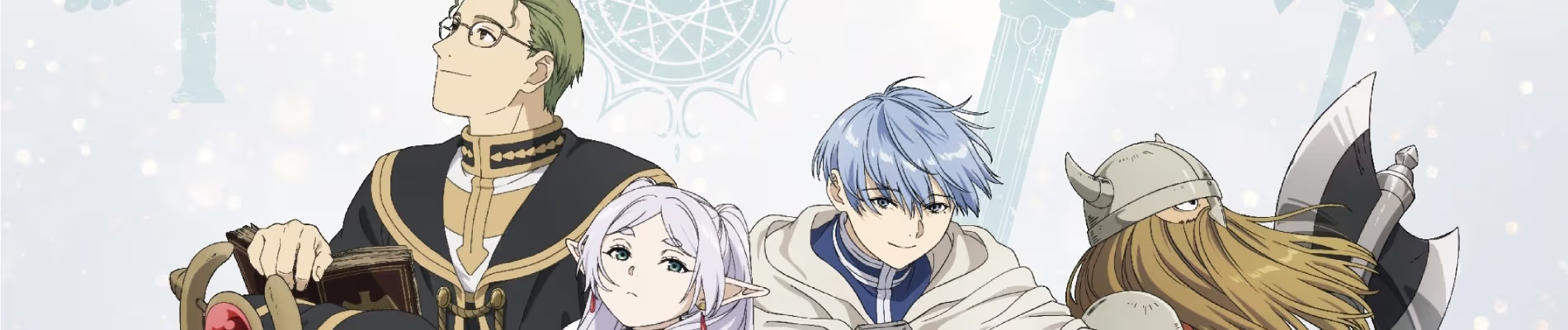
With an overwhelming number of recent entries in the fantasy genre shoved full of metahumour and other undiegetic elements, Sousou no Frieren stands out as is the one of the few with a sincere tone. It is no surprise that this breath of fresh air in a genre made stale by the prevalence of isekais has attracted much praise and attention. Yet it promises to be a high fantasy Violet Evergarden but ends up being a Critical Role campaign. That is still something praiseworthy but presents a major issue since it was not what was advertised. There is quite a lot that both sides of the spectrum seem to miss in their examination of Frieren, so bearing with me on this rather detailed analysis is appreciated. Though if only a brief overview is desired, the next paragraph also serves as an introduction to the points before they are substantiated.
Despite the refreshing return to an earnest fantasy story without many gimmicks, Frieren is still fundamentally limited in that it sticks closely to its genre’s conventions without breaking much new ground, if any. To the show’s credit, opening with its more profound character elements and themes is putting its best foot forward, demonstrating there is more to the narrative than just the usual fantasy tropes or spectacle. The degree to which it has explored its characters already placed it well above genre expectations. However, much of Frieren’s deeper questions and thematic ideas are still underdeveloped, especially when compared to what the show promised in its opening hook. It is certainly resonant relative to the average expectations of a shonen action-fantasy, and at least gives the appearance of profundity, but much of its narrative resources are still spent relishing in tropes and spectacle instead of furthering the emotional and character elements that could make it stand out. What thematic ideas it presents certainly has the potential of depth, but currently amounts to merely provoking the viewer to infer possible meanings from its smattering of tidbits instead of the text doing anything concrete. While this could be argued as subtlety, the show has gone on for a significant length of time without unpacking or elaborating on of its ideas, such that it raises doubts about its capacity or intent to explore them instead of just using it as an emotional aesthetic. Instead, an inordinate amount of narrative time and effort is spent expositing about its world and “magic system”, only for it to undercut a lot of its sincerity and suspension of disbelief with how tropey and incongruent it can be. Frieren is not a poorly executed or meritless show by any stretch of the imagination, far from it, but it is also apt to question how much of the exceptional praise is warranted on closer inspection.
The first complication with any good faith discussion of Frieren is establishing what the show’s opening promise to the viewer truly is. The initial episodes set this up to be the story of the character of Frieren reflecting on how experiences of her last adventure have subtly changed her. It takes on the framing of a more pastoral and introspective story told mainly through her changing her perspective on the world and how she interacts differently with the new people in her life. Intersecting all of this is the implied examination of themes like the perception of time, memory, loss of loved ones, the nature of religion, even more metaphorical ideas like what mana and magic symbolize about the human condition, just to name a few lofty ideas brought up, or perhaps only hinted at. While this is the dominant tone in the first few episodes, it is juxtaposed, sometimes quite jarringly, with a gradual increase in tropey worldbuilding and growing “anime-ish” tone. Perhaps most concerning of all, there is an escalating importance of action and spectacle as the main means the show uses to entertain the viewer and derive meaning from.
The two halves certainly can exist in the same show, and already do to a degree within Frieren despite the inherent tension. However, beyond the problem with tonal whiplash and suspension of disbelief it creates within the narrative, it also stifles a lot of discourse with how easy makes shifting the goalpost. Any criticisms of Frieren being a rehashing, albeit an effective one, of D&D or Pathfinder tropes is unceremoniously put down with the argument that its world merely serves as a setting for a deep character study. On the other hand, criticisms of the characters and themes being underexplored are dismissed as snobbery, with the pretext that the more tropey elements, growing focus on action and occasional juvenile tone mean it is expecting too much from what is obviously a simple action-adventure romp. Obviously, these two ideas are incongruent with each other and demonstrate how easy this sophistry is. How can something be both profound enough to warrant high praise while being shielded from closer inspection by pleading itself as merely popular entertainment? Like most things, much of Frieren lies somewhere in between these extreme positions, falling more to one side or another depending on personal perception and preference.
However, prima facie, Frieren’s promise to the audience is a focus on its more serious and profound ideas, with the more tropey elements implied to be there merely to further this end instead of supplanting it. This is how it is sold via its various synopsis, how the MAL summary has elected to pitch the series, and how an overwhelming number of preliminary reviews have interpreted the series and praised it based on this. Even the vocal minority who concoct rather disingenuous reasons to deride this show have it as a core assumption: that Frieren is boring because it is, ostensibly, a show where characters just talk about their feelings instead of blowing each other up for their entertainment. While there are some grounds to see Frieren as just an another action-adventure fantasy, it is clear that this is neither the intuitive nor intended way to perceive the show. There are elements that are indicative of its later change in trajectory, but these are only apparent in hindsight or to a viewer who was actively seeking them out instead of the narrative emphasizing them. This is a crucial distinction to make since it is neigh impossible to discuss whether the show fulfils its expectations if what its objectives are ill-defined.
With that established, Frieren’s issue is that the trajectory of the show eventually takes on the trappings and structures of a standard shonen series despite announcing an intent to go in a different direction. This is not necessarily something detrimental to its entertainment value or narrative integrity. In fact, there is a brilliance to having the show’s premise centered around the aftermath of a traditional narrative. It has been done before, but it is far from common and Frieren’s execution of it was excellent. This setting gives the show a strong emotional and thematic core right off the bat by drawing on potent feelings of sentimentality, nostalgia and loss. This allows Frieren to proxy the emotional weight of the sequel without the baggage of fan expectations around it or having to go through the relatively trite initial narrative of a quest to defeat an archvillain. It gives what would otherwise be a relatively generic fantasy shonen a better capacity to balance between characters and action while delivering emotional punches that take comparable shows years of cultivating nostalgia around their own series to achieve.
The real pain point lies in how Frieren undergoes this transformation gradually by stealth. It goes against the initial promise, even tone of the series, to be point of arguably stringing along the section of the audience sold primarily on a more introspective character driven narrative. This is most clearly seen in the whole premise of the later Mage Exam Arc, which is simply a tournament arc of sorts by another name. It is still relatively well executed, but it has the same pitfalls of its ilk in other shonen series: The focus on spectacle as the primary source of entertainment, minimal or surface level tie back to the characters and themes, and a few of the usual tropey irritants like characters monologuing exposition or their backgrounds mid-battle. There is a steady escalation of battles, organizations, “magic systems” and nebulous “lore” built atop D&D tropes becoming the main driver of the show, all while feeling like these elements are interesting primarily for the sake of it and nothing much else.
Despite this, and to Frieren’s substantial credit, the character work as it stands is still of a relatively high quality. Many of the subtle character interactions and little windows we get into their inner thoughts during quiet moments already demonstrate some level of substance or complexity. However, it is apparent that this has more to do with how shallow many competing shows are than any proven depth delivered by Frieren. While having these fragments, tidbits and musings might pass for character depth in other shows, it is still asking viewers to do most of the hard work by filling in more gaps than ought to be expected. Not only does this potentially distort the vision the writer has for a character too far, but it also suggests that there might not be much beneath the surface to beginning with. Surpassing this standard is certainly a high bar, but Frieren has received high praise to match that expectation and has firmly established a promise with its text that it should be aiming to achieve this.
The issue is that for all the insight into the characters that the show provides, they are all still mainly relegated to being flashbacks kept to themselves, or short conversations that mostly talk around any substantial exploration of the issue. While some of this is appropriate, perhaps even subtle or sophisticated in exploring the character’s inner life, the show has gone on for a substantial amount of time while only brushing up against what was promised to be its core themes. Frankly, a significant part of the profundity attributed to the show’s meaning has been contributed by generous viewer inferences or them bringing some of their personal history and feelings to the table. This is not necessarily a bad thing since it is indicative that the show has delivered compelling ideas with enough literary ambiguity to engage the audience. Nor can the viewer be blamed for reading too much into things since the ideas the show presents are designed to encourage this response with their obvious potential to be unpacked further. However, the issue remains that none of these unpackings are within the text. Some of this is to be expected and even encouraged, but so many ideas have been left unelaborated for too long, to the point the constant tiny reminders to them have come to feel like surface level repetitions or truisms instead of showing the audience anything.
While a viewer is expected to start off giving media the benefit of the doubt in order to establish a suspension of disbelief, there is still a need to renew and earn further trust as things progress. A series can only go so long hinting at big ideas before it eventually must prove that there is something to back it up. This is not to say that Frieren should spew everything all at once in some ham-fisted way, but there is a distinct lack of elaboration at any level on the greater themes and how characters feel about them in detail. Put more directly, we know only in general what characters like Frieren feel, have some concrete idea of why, plenty of interesting suggestions, but can only make weak inferences that are more parts speculation to what any of it reflects or changes about their view of the world and beliefs.
What this has led to is the steady erosion of the viewer’s confidence in the intentionality of the writer. That instead of deliberate ambiguity to demonstrate the complexity of an idea and build towards a larger point, it is there as almost a red hearing of sorts, that possibly there is nothing deeper or more coherent than this. It could be argued that not every theme, especially ones tackling emotional experience, need to be organized and interrogated to be presentable or meaningful, yet there is never any direct indication by the narrative that this reason for their lack of elaboration. Imagine an action show that only shows snippets or brief sequences of fights, never fully entering a prolonged scene that requires any real choreography of the characters or demonstration of how one of them beats the other. These short flashes of action might be dramatic and compelling, a way to abruptly and violently boil over tension or create a memorable subversion of pacing or expectations. Yet it is hard to say the show really delivers on its promise of being about action since it never proves it knows what stakes, character motivations or framing makes a compelling fight scene. In the same vein, there is always this constant hope that Frieren will use some of its many quieter moments to have the characters actually explore their feelings or ideas. It certainly does not need to reach a definitive conclusion, but merely problematizing only one of its many themes would have been sufficient to earn the trust of the viewer. It is an indicator that the writer is aware this is an important part of the show’s promise, has the means to meaningfully explore these themes, and the lack of proper discussion on these ideas while musing about them is a stylistic choice instead of fleeing from it. The problem is that there never is that deep heart to heart talk or direct introspection.
What compounds on this issue is that show demonstrates it is willing to dedicate time to direct exposition and elaboration, just in service of a completely different end. Frieren spends a substantial amount of time, from as early as episode 3, elucidating about the history of the world and how magic functions. Much of this background knowledge is frankly tropey and incongruous, drawing more so from D&D and RPG systems than other fantasy narratives. The idea that the worldbuilding of Frieren is comparable to Tolkien is laughable, but perhaps also speaks to how well executed its emotional storytelling was since it smoothed over its flaws to such a great degree. Although it is usually the coherence of the world that supports the believability of its characters, Frieren is exceptional in proving that the reverse can be done. Of course, vague or even incongruent worlds are hardly the dealbreaker some people make them out to be. Having a setting serve the characters is a perfectly legitimate way to tell a story, especially one focused on exploring ideas instead of some grand plot. Yet drawing so much attention and dedicating a substantial amount of narrative resources to explain parts of the world only makes any incongruence harder to overlook. And more importantly, it begs the question of what purpose any of it serves beyond being done for the sake of it.
For instance, a significant amount of dialogue and narrative time has been spent attempting to explain magic: The suggestions of some kind of distinction between magic of human or arcane origin and that of being drawn from the divine; the suggestions on the nature of mana and how it can be manipulated; the suggestions of rational principles behind magic spells yet also an instinctual way to produce magic; the then somewhat contradictory suggestion that magic is reliant on imagination; even a rather tropey video game style distinction between the magical and physical nature of forces. Yet for all the ink spilt on this matter, it does not create any systematized magic system that has the benefit of making the world feel more concrete. They are all vague notions of how magic works, which still leaves no inferable or understood parameters of what is possible or impossible for characters to do.
This is not necessarily a problem since magic is after all precisely that, magic. But it begs the question of how much magical technobabble was really necessary or meaningful since all it amounts to is the rule of cool with a sprinkling of some nebulous metaphors on top. Nor does any of this effort do much to further depth since most of this is used to justify the conclusions to fights instead of furthering characterization. While many colourful, poetic inferences or symbolism can be drawn from the magic, they are all still rendered weak by the questionable intentionality behind any of it. Only the surface level connections like matching certain styles of magic to the personality of a character are concrete, and it is hard to praise this level of symbolic depth when so much more was promised. Perhaps this will all amount to some payoff further down the line, but that seems to be too far off and too late relative to how much time is spent on the matter now.
Yet perhaps the most jarring examples come from the world building side, the most obvious of which is the existence of dungeons. Instead of these being explained as the occasional ruin or place of significance that have attracted monsters for one reason or another, they are quite blatantly framed as something straight out of a video game, designed to be explored floor by floor with secret rooms and treasures. Similar instances of lifting from D&D and calling it world building appear as early as the introduction of Kraft, who announces himself as a monk for no apparent reason. What significance or meaning that would hold is hard to discern since the title alone tells us little. It lacks to mention some sort of holy order that would give the viewer or characters some insight to his specific beliefs and shape expectations. It is easy to overlook earlier instances of characters functionally announcing their class as if this was a video game. For the Hero’s party, it is natural to assume the titles were something tied to their personal renown. In other instances, like Fern saying she is a mage, it is easy to see how this information has immediate contextual significance since it is an uncommon vocation with special skills, more akin to announcing oneself as a medical doctor. On the other hand, when Stark is introduced to Kraft as a warrior, it is hard to see how that designation carries any significance beyond being a man with a weapon, something that ought to be commonplace and hardly worth mentioning in a medieval fantasy. In retrospect, the idea that Himmel is using the title of Hero not because of some renown he earned prior to their quest but because it’s his “job” or “class” is disappointing to say the least.
This fault alone might be more of a minor contrivance in other shows, or for some even a feature since the use of D&D tropes as narrative short hands or an aesthetic is apparently popular these days. However, the issue is that Frieren dedicates a significant amount of effort to explaining all its lore, draws significant attention to it, only for it to still be found lacking. All this at the expense of time that could be used to elaborate on its promised, and frankly much stronger character elements. This is perhaps one of the cases where the world is better off being left vague since a poor attempt at definition has had the opposite effect and undermined the suspension of disbelief. D&D created many of its game systems and concepts as an abstraction of a fantasy narrative to allow for players to interact with a story instead of being railroaded along. Passive media telling a fixed narrative has no need for this, such that using many of these conventions only highlight to the audience the hand of the writer. While this might still be tolerable to some since suspension of disbelief has a subjective component, it is still hard to give Frieren a pass when it so obviously and unnecessarily places it under strain. It calls into question the consideration, effort and seriousness the writer has about the narrative if they are willing to use tropes without much thought to them. A writer who is ostensibly dedicated to exploring the deeper ideas they brought up would have been cognizant of this and would have at least adapted these tropes to have them feel less blatantly incongruous. All of this serves only to harm the believability of the characters instead of supporting it.
This is to say nothing about the occasional tonal lapses of the show which disrupt the earnest and serious framing of the narrative. Most of Frieren’s camera work and animation is as unintrusive as possible so as to minimize jarring reminders that the viewer is watching a show. However, when it comes to many of the comedic moments, there is this double shift where both the tone of the characters and the framing of events become almost that of an anime style sitcom. The abrupt cutaways that use the camera to aid in the joke combined with the voice acting taking on a highly exaggerated style really takes the viewer out of it. This does gradually improve, with the show only using either exaggerated tone or camera work to land a joke, such it does not overwhelm suspension of disbelief, but the damage still remains. For all the subtlety the show has with its quieter character moments, very little of that effort has been put in with its humour. This issue with the overall tone only compounds as the series goes on, with many new members of the supporting cast being introduced taking on a tropey and even caricatured personality. While there is certainly room for characters like Ubel, Kanne and Lawine to be developed, much of the immediate depth the show displayed with the core cast is conspicuously missing from them. While still serviceable, and sadly still relatively good when it comes to the expectations of most shonen series, it is a noticeable step back from Frieren’s initial character work and the quality it promises to continue delivering. All these tonal issues creates a pattern of questionable effort or thought that only serve to further undermine suspension of disbelief and the intentionality of the writer.
None of this was said to detract or ruin the personal experience. That is frankly something no review, no matter how objective, can really take away from someone. Sometimes the themes and tone of the show just connect with someone’s personal experience in such a way that the emotional experience surpasses what the actual contents of the text can back up. Yet it is also disingenuous to say that this personal lens renders an objective assessment non-existence or unimportant. Absolute objectivity may be impossible, but that does not eliminate the rest of the spectrum where views and opinions can certainly have more or less bias.
Despite its merits, it is hard not to feel a little cheated by the show. It promised to be a character piece with occasional action but inverted this dynamic as the show went on. In some ways, it speaks to Frieren’s effectiveness at storytelling since many viewers seemed not to have noticed or cared. It has onboarded and retained a significant audience who would otherwise be uninterested in more traditional shonen fare. Perhaps it is a testament to the genius execution of Frieren’s introduction that its emotional punch still lingers this far when they’ve done relatively little to reinforce it. At the same time, it is also eye-wateringly ironic that many viewers who would presumably like Frieren at its current stage could not get past or were in contempt of its first few episodes. While it remains easy to dismiss a lot of their complaints as made in bad faith, it is still notable that both camps technically do share the same premise of what they expected Frieren to be yet still mostly do not recognize that it has strayed from that. It is then even more remarkable that how much discourse around the show on both sides centers around a promise that is never quite lived up to.
Overall, it’s hard to say Frieren is outstanding when it deviates quite far from the promise it makes to the viewer. It is still of high quality, especially relative to the genre and demographic it ultimately falls into, but that is all inspite of its opening being misleading rather than because of the strengths it builds off it. There is much more that can be said about the myriad of other cracks in the worldbuilding and lore, but those are only major issues relative to the expectations the show wants to be held to rather than the standards that are actually appropriate for it as a fairly juvenile action-adventure fantasy. With that understanding, Frieren is a good as show as any to be well liked and is of a quality many others should aspire to. The flaws brought up here are only meant to highlight the serious pattern of how they undermine one crucial element, the promise of Frieren to focus heavily on characters. Given how critical setting viewer expectations accurately is, the dizzying level of praise the show receives seems hardly deserved. While some will parrot the idea of liking a show for what it is, the saying’s true meaning is that one ought to discard preconceived notions that unfairly taint an experience rather than an insistance that a viewer is obligated to make lemonade out of lemons. Perhaps it is somewhat contradictory to give the show a high numerical rating of an 8 out of 10 while still not fully recommending it, but unfortunately, that is the only reasonable way to square the circle of a show that does not give you what was advertised but provides something else of a fairly high quality.
Though I was led to expect something more subdued and meditative, I like Frieren well enough as it stands. I will admit it is a genre and type of story I have somewhat outgrown, but not something I cannot appreciate as seen with other shows I have watched. The failed promise might have simply been an author having a brilliant idea of a short, more contained series but had to find a way to force it into a serialized format for an entirely different demographic. But even with that benefit of the doubt, there is still a sour taste in one’s mouth when so much of the show feels like it wants to have its cake and eat it. To explore the psyche and experience of a long lived, immensely powerful character, yet also draw drama and tension from trials of raw combat instead of testing their feelings or beliefs. It wants to be this great, profound character study while also being easily digestible and having the mass appeal of flashy entertainment. My only wish was that Frieren would have opened with letting me like it for what it eventually becomes instead of pretending to be something it was not.
31.5 out of 42 users liked this review